Showing posts with label World War II propaganda. Show all posts

2/10/11

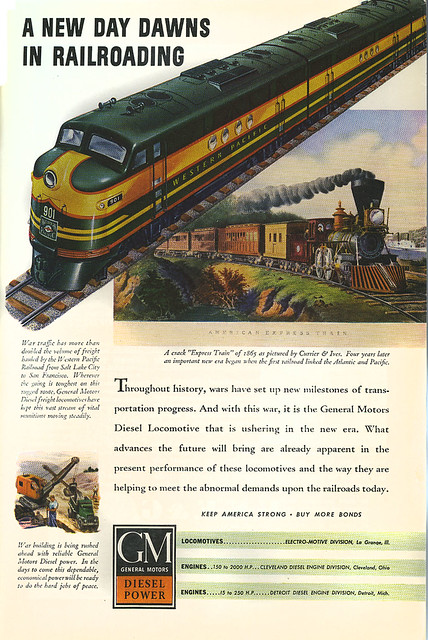
GENERAL MOTORS Goes to War


This ad is, like the ones I've been featuring the past few weeks, from the November 1943 National Geographic. Back when General Motors was a super power. Back when railroads were still the way to move products from coast to coast. How people moved coast to coast. The railways and General Motors are a shell of what they once were and both require tax payer money to stay afloat.


General Motors in WWII_tatteredandlost
Click on image to see it larger.

2/6/11

LOCKHEED and DISNEY in World War II


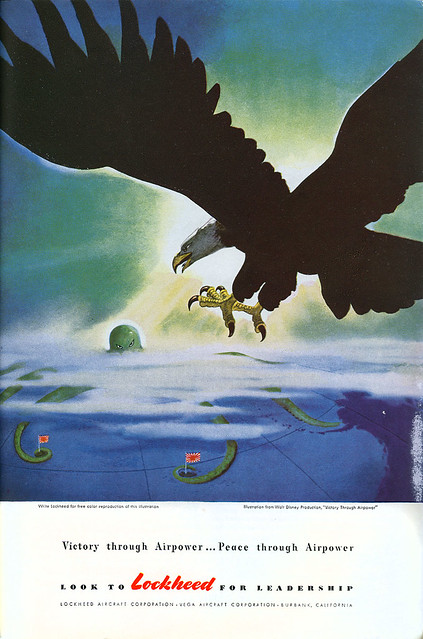
Another World War II ad from the November 1943 National Geographic, this time an image from the Walt Disney companies movie Victory Through Airpower.

Click on the image to see it larger and you'll notice that Lockheed offered to send free prints of this image. I wonder how many of those still exist? How large were they? How many did they send out?

VICTORY THROUGH AIRPOWER_tatteredandlost
Click on image to see it larger.

I'll let Wikipedia tell you about the film referenced below the image and then there are two parts from the film. Who knows how long they will be left on youtube before Disney or Lockheed forces the person to take them down. So if there is a black square with no movie I think we can safely assume that will be what happened.
Victory Through Air Power is a 1943 Walt Disney Technicolor animated feature film based on the 1942 book by Alexander P. de Seversky. De Seversky appeared in the film, an unusual departure from the Disney animated feature films of the time.

The film received an Academy Award nomination for Best Music Score of a Dramatic or Comedy Picture, but lost to The Song of Bernadette.

Production
The popular filmmaker Walt Disney read the book and felt that its message was so important that he personally financed the animated production of Victory Through Air Power. The film was primarily created to express Seversky’s theories to government officials and the public. Movie critic Richard Schickel says that Disney "pushed the film out in a hurry, even setting aside his distrust of limited animation under the impulses of urgency." (The only obvious use of limited animation, however, is in diagrammatic illustrations of Seversky's talking points. These illustrations featured continuous flowing streams of iconic aircraft, forming bridges or shields, and munitions flowing along assembly lines.) It was not until 1945 Disney was able to pay off his 1.2 million dollar war film deficit.

Reception
On July 11, 1943, the New York Times devoted a half page, "Victory from the Air," to a feature consisting of pictures of scenes from the film with short captions. This was possibly the first time that such skilled use of visual description had been placed at the service of an abstract political argument.

It is one thing to hear someone say that against modern bombers, "bristling with armament… small single-seater fighters will find themselves helpless, for their guns are not maneuverable—they are fixed and can only fire forward." It is quite another to have this accompanied by vivid animations of swastika-tailed fighters jockeying for position and being shot down by beam-like animated blasts of fire from a bomber whose guns are "always in firing position."

Schickel quotes film critic James Agee as hoping that

“Major de Seversky and Walt Disney know what they are talking about, for I suspect that an awful lot of people who see Victory Through Air Power are going to think they do… I had the feeling I was sold something under pretty high pressure, which I don't enjoy, and I am staggered at the ease with which such self-confidence, on matters of such importance, can be blared all over the nation, without cross-questioning. ”


Impact
On December 8, 1941, Disney studios were essentially converted into a propaganda machine for the United States government. While most World War II films were created for training purposes, films such as Victory Through Air Power were created to catch the attention of government officials and to build public morale among the U.S. and allied powers. Among the notables who decided after seeing the film that Seversky and Disney knew what they were talking about were Winston Churchill and Franklin D. Roosevelt. The Disney studio sent a print for them to view when they were attending the Quebec Conference. According to Leonard Maltin, "it changed FDR's way of thinking—he agreed that Seversky was right." Maltin also adds that "it was only after Roosevelt saw 'Victory Through Air Power' that our country made the commitment to long-range bombing." Roosevelt recognized that film was an effective way to teach and Disney could provide Washington with high quality information. The American people were becoming united and Disney was able to inform them of the situation without presenting excessive chaos, as cartoons often do. The animation was popular among soldiers and was superior to other documentary films and written instructions at the time.

Victory Through Air Power played a significant role for the Disney Corporation because it was the true beginning of educational films. The educational films would be, and still are, continually produced and used for the military, schools, and factory instruction. The company learned how to effectively communicate their ideas and efficiently produce the films while introducing the Disney characters to millions of people worldwide. Throughout the rest of the war, Disney characters effectively acted as ambassadors to the world. (SOURCE: Wikipedia)


2/4/11

GO GREYHOUND in World War II


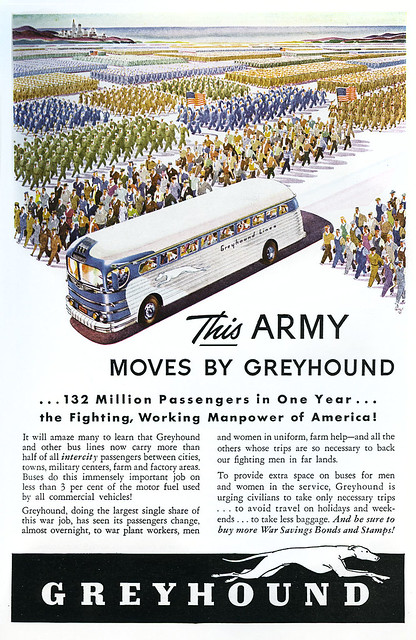
I'm thinking they're going to need a bigger bus.

Greyhound_19433_tatteredandlost
Click on image to see it larger.

Another great vintage World War II advertisement from the November 1943 National Geographic.

2/1/11

INTERWOVEN STOCKING COMPANY Goes To War


As I've been showing for the past several posts, companies in one way or another tried to show they were supportive of the national war effort during World War II. For some companies this wasn't an advertising problem because it was obvious their products were necessary. Other companies...not so much.

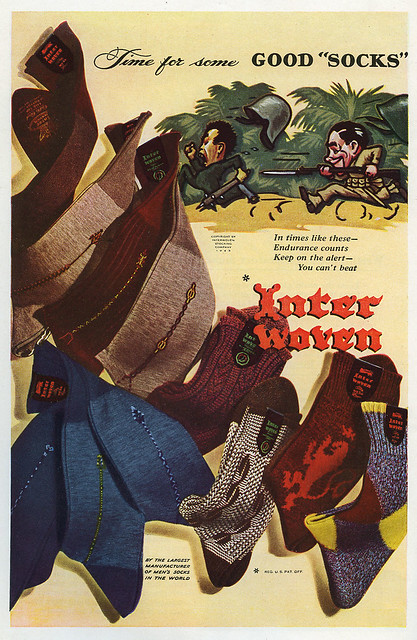
I give you an ad for the Interwoven Stocking Company from the November 1943 National Geographic.

Interwoven Stocking Co_1943_tatteredandlost
Click on image to see it larger.

Of course socks were important, and you often read horror stories of what soldiers went through with their socks, specifically in jungle climates. But I think this one is pushing it. It makes me think of the PF Flyer ads in the 1950s that were marketed to kids implying you could run faster and jump higher if you wore them. What exactly does this ad say? Were soldiers able to run through the jungle chasing the enemy faster because they wore Interwoven socks? They were to "sock" it to the enemy? Did the company actually have a government contract?

Okay, the real value of this ad historically is the racist image. This was acceptable during the war. I'm sure there are small companies today with limited advertising dollars with extremist views that use racial stereotypes, but you don't find it in large main stream ads.

From what I've been able to find online the Interwoven Stocking Company is no longer in business. In fact it shares a similar history to a lot of other companies I've looked up online over the years. At some point they were incorporated in Florida and simply disappeared. There must be something about Florida's laws and I don't know what it is.
Incorporated by Power, James A., Stark, William E., Rice, Lacy I’., Gregory, Marshall G., Mettler, John W., Jr., Simmons, Harold W., Interwoven Stocking Company is located at 123 Church St New Brunswick, NJ 08901. Interwoven Stocking Company was incorporated on Thursday, July 09, 1953 in the State of FL and is currently not active. Source: Public Record data - Department of State - Division of Corporations.
1/27/11

NEW YORK CENTRAL RAILROAD in 1943


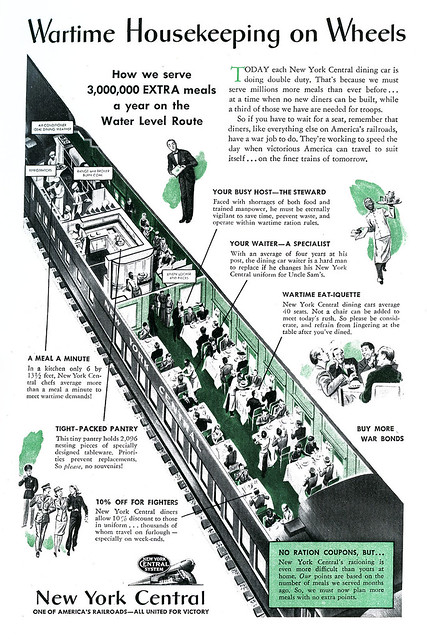
I would have loved this ad as a child because of the miniature people and the fact that they showed a whole little world inside the train. Okay, it reminds me of the little buildings a friend and I used to build in tiny boxes. Take the lid off and a whole tiny world was inside. But this nonsense is not why I'm posting this vintage ad.

New York Central_1943_tatteredandlost
Click on image to see it larger.

Another World War II ad from the November 1943 National Geographic. This ad is full of war time talk including the apparent need to remind customers to be polite and not steal. Oh, and Buy War Bonds.

The New York Central is no more. To read the history of this railroad click here.