Showing posts with label Coca-Cola ad. Show all posts

8/5/12

A FIGHTER PILOT and Coca-Cola in 1940


This vintage Coca-Cola magazine ad is from a 1940 Ringling Bros and Barnum and Bailey Circus Magazine and Daily Review. I find it fascinating that it uses a military theme before the war.


Click on image to see it larger. 
(SOURCE: Ringling Bros and Barnum and Bailey Circus Magazine and Daily Review, 1940) 

To see other vintage Coca-Cola ads click on "Coca-Cola ads" or "Coca-Cola" below in the labels.

3/17/12

1960 Boy Scout Handbook ADVERTISEMENTS: Part 1


My last post was about the 1960 Boy Scout Handbook. I mentioned I'd be featuring some ads from the book. There are a total of over 40 ads so sit back and go Scout shopping. One particular item will show up over and over again, but not on the first spread.

Remember, items are for honest and trustworthy Scouts only.


Click on the "Boy Scout" label below to see previous scouting posts. Or click on "Coca-Cola" or "Coca Cola" to see vintage Coke ads.

And visit Tattered and Lost Vernacular Photography to see some old scouting photos from Scotland.

9/3/10

A WOMAN OF INDEPENDENCE with Coca-Cola


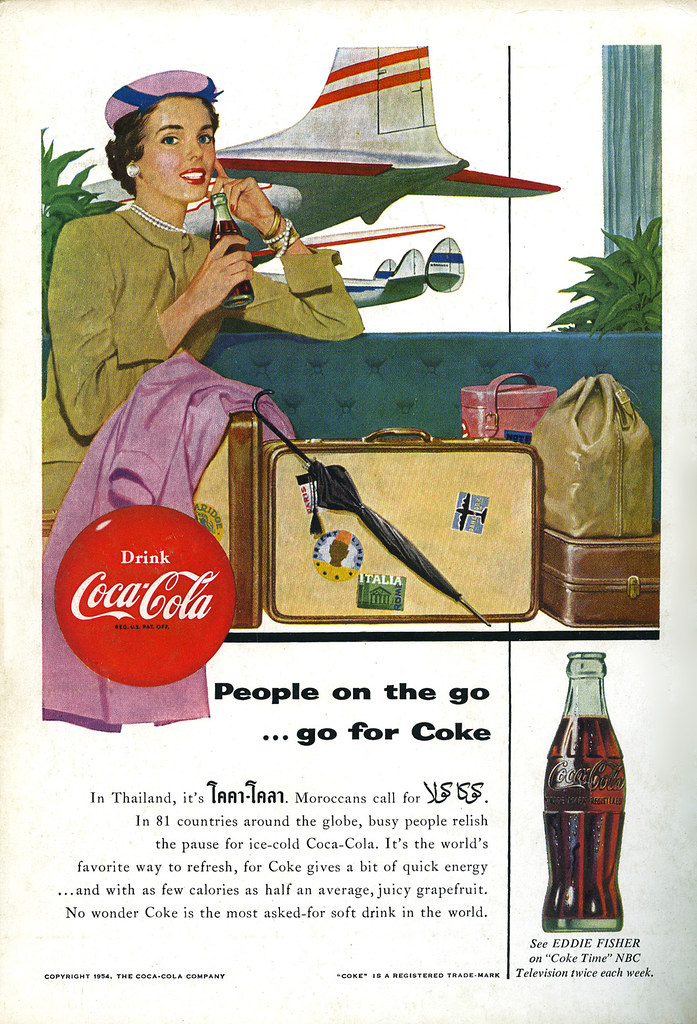
This ad dates from the October 1954 National Geographic back cover and once again shows an independent woman. It's actually pretty stunning since most ads showed women in domestic situations, on the job as a secretary, or sitting in the passenger seat of a car. Women were never driving the cars. So I'll give Coca-Cola credit for sending a woman out on her own to see the world.

Coca-Cola Oct 1954_NG_tatteredandlost
Click on image to see it larger.

I have no information about the illustrator. I do like the very nicely balanced illustration with perfect movement to the product.

Of course, they still couldn't leave off one item that they knew would be gender specific: the calories in a coke. Read the copy and you'll see that they want to make sure the woman knows it has "...as few calories as half an average, juicy grapefruit." Doubt they'd have put that in an ad showing a single man.

Wish there'd been more images like this when I was growing up. I'm not sure boys really understood the power they had and how small girls felt in relation to the world. You really weren't allowed to dream. Fortunately I had parents who told me I could do anything, even if I looked outside the door and saw the obstacles. Boys had a swagger and confidence that girls weren't allowed. Girls had to dream small.

9/2/10

Coca-Cola DURING THE WAR


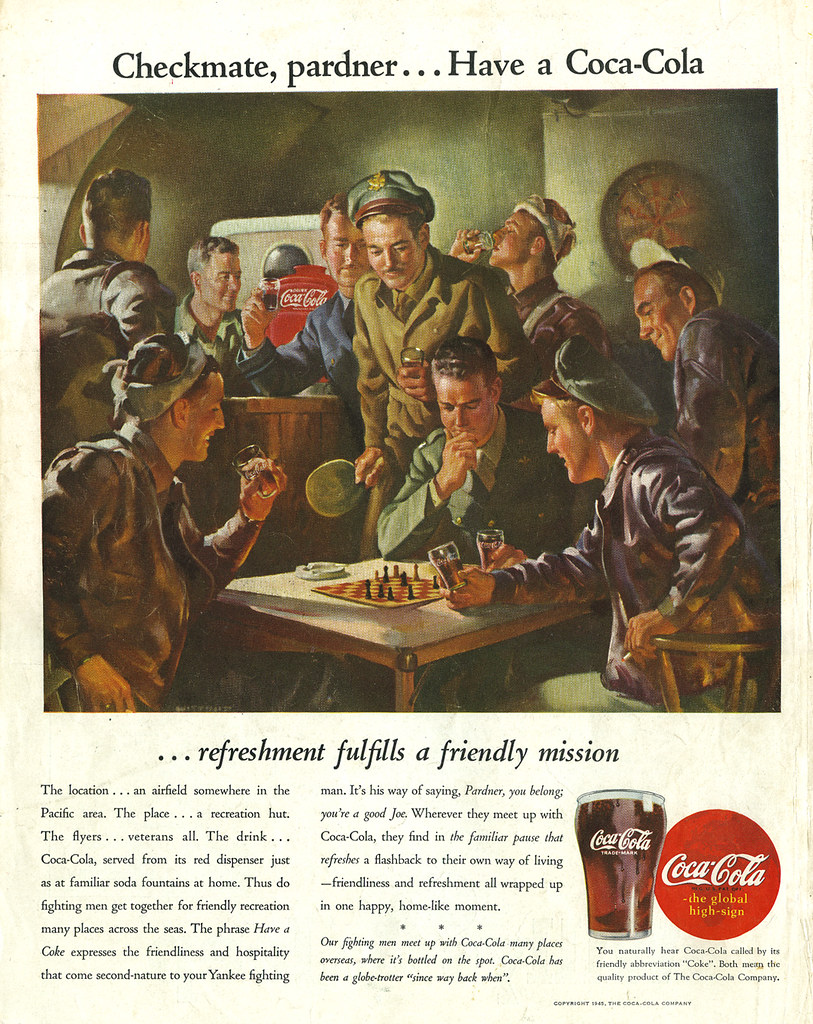
This vintage Coca-Cola ad dates from the August 18, 1945 Saturday Evening Post back cover. Of course the war in the Pacific was over on August 15, 1945 with the signing of the Japanese surrender document occurring on September 2, 1945.

Even if I no longer like the product I still appreciate the illustrations in the old advertisements.

Coca-Cola ad 1945_tatteredandlost
Click image to see it larger.

There is a lot of information about Coca-Cola during World War II, not all of it a shining example of a positive war effort. The ads were how the corporation sold its product manipulating the public for a positive corporate image. And indeed, they did do their part for the soldiers:
Coca-Cola was involved in the Second World War.
Robert Woodruff made a point of supporting US troops so metal cans were introduced to meet their needs.

In 1941, when the United States entered the war, Woodruff decided that Coca-Cola's place was near the front line.

He sent an order to:

"See that ever man in uniform gets a bottle of Coca Cola for 5 cents wherever he is and whatever the cost to the company".

In 1939 Coca Cola only had 5 overseas bottling plants. By 1945, they had 64. What made it so popular? Because the water was disgusting. The army kept it clean by adding chlorine-so the water tasted like your local swimming pool, or worse.
On the 29th June 1943 General Dwight D Eisenhower ordered three million bottles of Coca- Cola to be sent to the allies in North Africa.

Plant and machinery for down town bottling plants were also sent so another three million bottles could be sent to the troops every six months.

By the end of the hostilities five billion bottles or cans of Coca-Cola had been drunk.

Coca-Cola had not only lifted the spirits of the US Armed Forces, it had also introduced itself to new markets. When the war ended the bottling plants and a little bit of America stayed too. (SOURCE: Digger History)
So while Coca-Cola was supporting the troops they were also still manufacturing their product, or trying to, in Nazi Germany. Since I'm not finding a definitive brief article I'll just give you links:


And a page with some images of the creator of Coke and the pharmacy where he sold it can be seen on this page.

To see more vintage Coca-Cola ads from World War II click here.

9/1/10

OFFER A MARINE A COKE


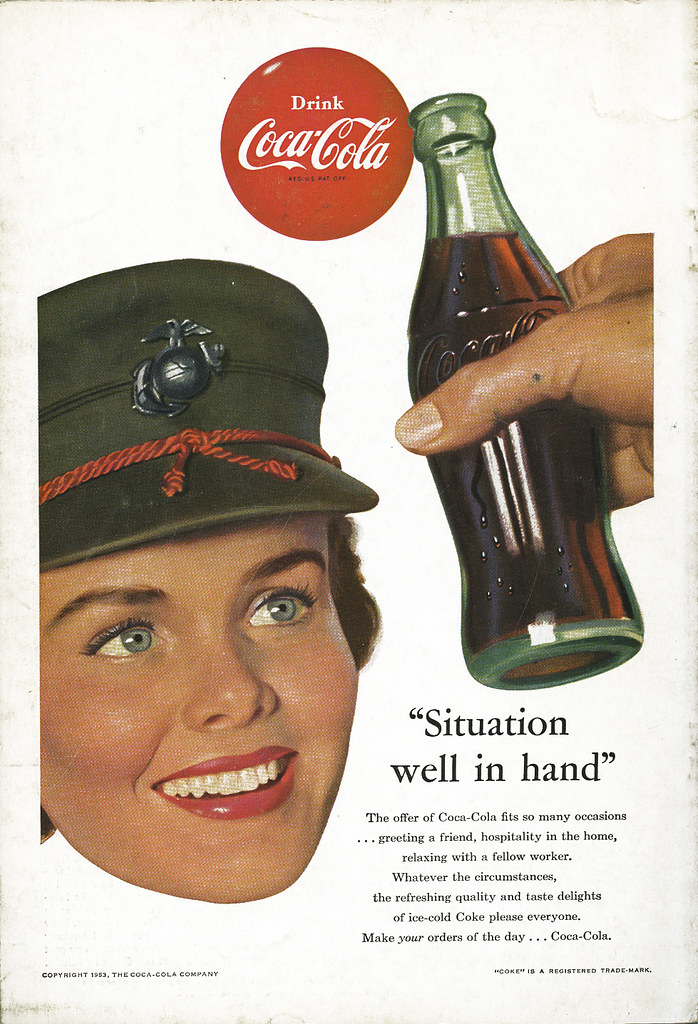
This ad dates from the February 1953 National Geographic back cover. It looks almost like a photograph, but it is an illustration. Again, I have no information about the illustrator. And again, I find it interesting that they are marketing this with a woman in uniform, a Marine.

Coca-Cola_Feb 1953_tatteredandlost

Women in the Marine Corps
In 1918, the Secretary of the Navy allowed women to enlist for clerical duty in the Marine Corps. Officially, Opha Mae Johnson is credited as the first woman Marine. Johnson enlisted for service on August 13, 1918; during that year some 300 women first entered the Marine Corps to take over stateside clerical duties from battle-ready Marines who were needed overseas.

World War II Service
The Marine Corps Women's Reserve was established in February 1943. The first director of the Marine Corps Women's Reserve was Mrs. Ruth Cheney Streeter from Morristown, New Jersey. By the end of World War II, 85% of the enlisted personnel assigned to Headquarters U.S. Marine Corps were women.

The first group of women officers was given direct commissions based on ability and civilian expertise. These women were given no formal indoctrination or schooling, but went on active duty immediately. Women Marines were assigned to over 200 different jobs, among them radio operator, photographer, parachute rigger, driver, aerial gunnery instructor, cook, baker, quartermaster, control tower operator, motion picture operator, auto mechanic, telegraph operator, cryptographer, laundry operator, post exchange manager, stenographer, and agriculturist.

After the war; Retention for active duty
On June 7, 1946, Commandant of the Marine Corps General Alexander A. Vandegrift approved the retention of a small number of women on active duty. They would serve as a trained nucleus for possible mobilization emergencies. The demobilization of the Marine Corps Women's Reserve, 17,640 enlisted and 820 officers, was to be completed by September 1, 1946. Of the 20,000 women who joined the Marine Corps during World War II, only 1,000 remained in the Marine Corps Women's Reserve by July 1, 1946.

June 12, 1948, the United States Congress passed the Women's Armed Services Integration Act and made women a permanent part of the regular Marine Corps.

In 1950, the Women Reserves were mobilized for the Korean War and 2,787 women were called to active duty. By the height of the Vietnam War, there were about 2,700 women Marines served both stateside and overseas. By 1975, the Corps approved the assignment of women to all occupational fields except infantry, artillery, armor and pilot/air crew. Over 1,000 women Marines were deployed in Operations Desert Shield and Desert Storm in 1990-1991. (SOURCE: Wikipedia)
So if you see a member of the Navy, Marines, Army, Air Force, or Coast Guard looking a little parched, buy them something to drink. Shake their hand and tell them you appreciate what they and their family are doing. Heaven knows the paycheck they receive barely stretches as far as a handshake.
To see past posts of Coca-Cola ads click on:


8/31/10

MIXED MESSAGE from Coca-Cola


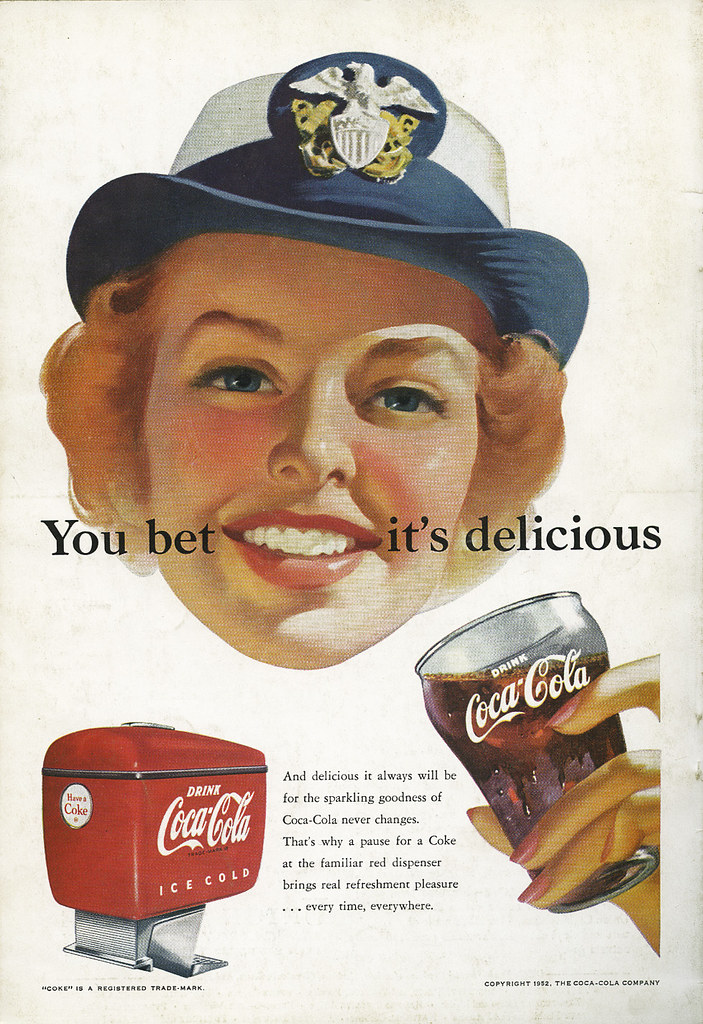
This Coca-Cola ad is on the back of the October 1952 National Geographic. Again, I have no idea who the illustrator was, and it's a nice illustration, but it's a bit of a strange ad.

Coca-Cola_Oct 1952_tatteredandlost
Click on image to see it larger.

Why put the headline cutting across her face? It literally looks like she's been slashed. Am I the only one to notice this? A disembodied head with this headline cutting from ear to ear. It works, but it makes me uncomfortable.

Then there is the idea that in 1952 a women is being shown having a job, in fact a career. By '52 women were supposed to be back in the home and most ads show them in domestic situations. I think it's interesting that Coca-Cola was pitching the idea of a woman with a career years after Rosie the Riveter was forced out of her job. I'd have loved to have heard the conversations between Coca-Cola and their agency. Who was pushing this idea? I think it's great, but highly unusual.

12/9/09

Santa meets the MAD MEN AGENCY


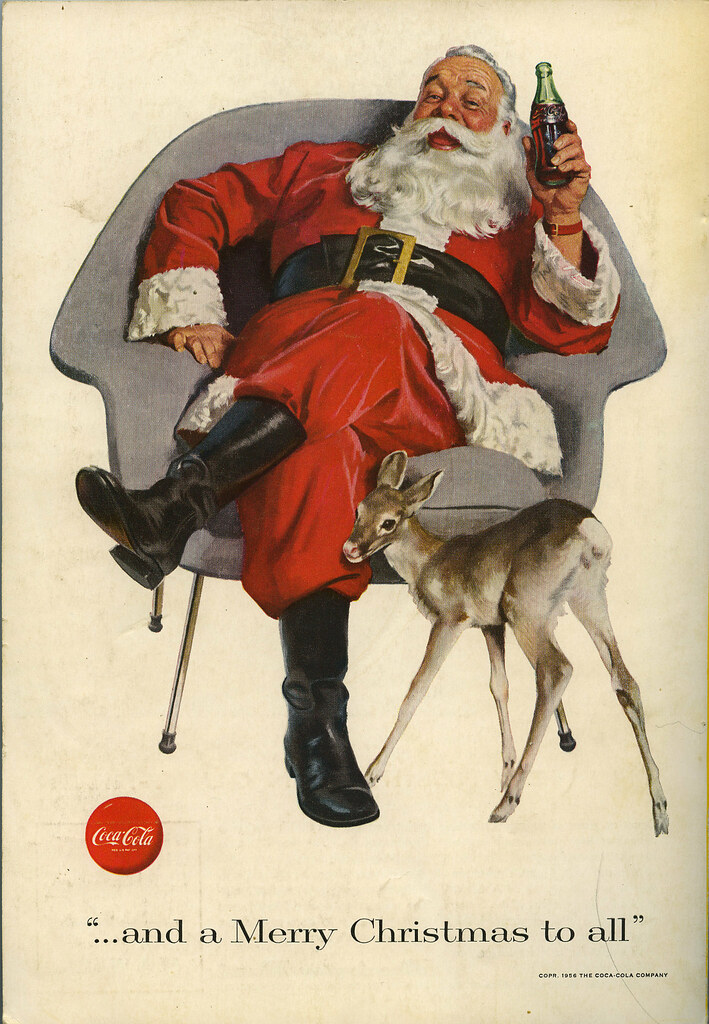
This Santa is cool daddy-o. He's hip. He hangs out in the Village after hours with the cats from Sterling Cooper. They've influenced this version of the iconic Coca-Cola Santa. 

Coca Cola ad_Dec 1956_tatteredandlost
(Source: National Geographic December 1956) Click on image to see it larger.

So sit down, tell Santa everything. Oh, and just to let you know that mirror on the side of the room...yeah, there are five guys in business suits on the other side watching you. They're researching you. Researching how you interact with Santa. They're seeing if you're worthy. But for heaven's sake don't look at the mirror. Just act casual, like Santa. Have a coke and tell the jolly man everything. He doesn't keep track of what you say.

10/6/09

Brothers who drank COKE TOGETHER


So, is this the brother of the soda jerk at Woolworths? It's certainly NOT Eddie Fisher, though people these days wouldn't know that. You have to be of a certain age to know Eddie Fisher and young people today would assume Eddie was a bowler who had a weekly show and drank Coke in table cloth shirts.

Coca Cola_1954_tatteredandlost
Click on image to see it larger. (SOURCE: National Geographic, April 1954)

I'd say this is by the same illustrator as yesterday's and again I have no clue who it was. I'd say they worked from photos which means somewhere out there are people who posed for these illustrations or perhaps their relatives who cherish these images. 

This is on the back cover of the April 1954 National Geographic. National Geographic is a gold mine, I tell you. A GOLD MINE!

Unfortunately the next year, 1955, the Coke ads are photographs, no illustration, though I haven't yet found the December issue.

10/5/09

Remembering COCA COLA


Recently I was thinking back to the old Coca Cola machines that used to sit outside gas stations in the 50s. I saw one in a movie sitting outside an old store. I was suddenly drawn back to hot days in the car, pulling into a gas station, and hearing the "ding ding" as you drove across the bell cord announcing your arrival. Then the begging to get a cold drink would start. My mom or dad giving me a nickel for a coke. That red metal box was an oasis. Lift the lid and look down to see what was available. Sometimes what was inside was cold, just as often it wasn't. Decide which bottle you wanted, deposit your coin, and then drag the bottle along the rack to the end where, if the coin had deposited just right, you'd be able to lift your bottle up and out. Then sticking the cap into the bottle opener hole, pressing down, and wait for the sound of it popping off and falling down into the machine amongst the other caps. The sound of the soda's effervescence escaping from the bottle soon followed. Put the bottle to your mouth and usually you could feel the fizziness against your noise. If you finished the bottle while still at the station you'd put it in a wooden box next to the machine so it could be returned to the bottler to be filled again and again and....

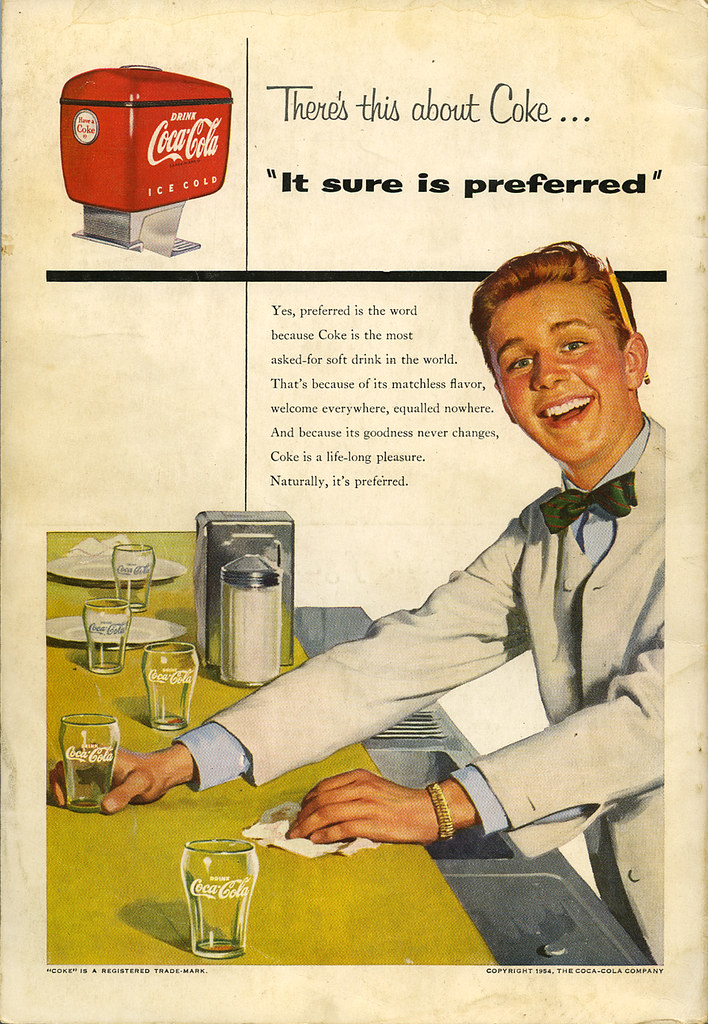
I found this ad on the back of the February 1954 National Geographic. It brings back memories of trips to the lunch counter at Woolworth's with my grandmother and mom in Harrisburg, PA. Having a burger and a Coke while out shopping. Good times. Good times. 

coca cola advertisement_1954_tatteredandlost
Click on image to see it larger.

I do not know who the illustrator was. If anyone ever reads this and knows I'd be happy to add the information.

One other thing, the ad copy. "Because its goodness never changes" sure couldn't be said these days. Yes, I drank Coca Cola as a child and teenager, but not a lot. But when they stopped using sugar and went with the high fructose corn syrup...aaaakkkkkk!!!! Hate the stuff. Can't get it down. I remember for awhile my best friend had a "stash" from Mexico where they still used sugar. The difference in flavor is amazing. These days the only time I drink a soda is when I'm sick. Then I crave 7-Up or root beer. The rest of the year I won't go near the stuff. So Coke screwed up. They lost me as a customer a very long time ago. New Coke didn't even come close to old traditional Coke. You had a good thing going until you let ADM convince you "corn syrup" were the words of the future.