Showing posts with label vintage magazine ad. Show all posts

9/9/15

FELIX ADLER, Clown


A few months ago I was contacted by a person who works behind the scenes for the tv show American Pickers. She was interested in using an image I'd posted on August 16, 2012. The show with the image below was shown tonight. I decided I'd repost the entire piece in case anyone went searching for Felix Adler after watching the show.
__________________

The clowns I've featured in photos have been nameless, except for Felix Adler. The reason Adler is named in the Ringling Bros and Barnum and Bailey Circus Magazine and Daily Review is because he was the head clown at the circus.


Click on image to see it larger.
(SOURCE: Ringling Bros and Barnum and Bailey Circus Magazine and Daily Review, 1940)

First Clown to Appear on Television
Felix Adler entertained millions in his role as head clown for Ringling Brothers Barnum and Bailey Circus. In the hierarchy of clowns, he ranked at the top as a whiteface clown.

He performed with such famous clowns as Lou Jacobs and Emmett Kelly.

All three circus greats lived and practiced their routines in Sarasota.

Adler's costume took up a lot of space because he buttressed his posterior with a couple of basketballs hitched in place with a custom sling similar to a brassiere. He wore traditional whiteface clown makeup adding a big rhinestone on the tip of his nose.

Often the clown topped his garb with a big jello mold for a hat. Remember, the early days of television and product sponsorship? Adler had ties to Jell-O!

Piglets played integral roles in Adler's clowning. He named each one Amelia after his wife and as the piglets became full fledged pigs, he traded them in for a new piglet whom he promptly named Amelia.

The first clown to appear on television, Adler earned his title "The White House Clown" by performing for three presidents (Warren Harding, Calvin Coolidge, and Franklin D. Roosevelt). He and his wife were the first American husband and wife clown team. (SOURCE: Squidoo/Felix Adler)
Felix Adler died on February 1, 1960. The following is his obituary from the Sarasota Herald-Tribune on February 2nd.


(SOURCE: Sarasota Herald-Tribune)

Notice the handwork of the staff artist on the photo of Adler. Apparently the image was less than satisfactory for reproduction so the artist did a bit of doodling. Sort of surprised that the newspaper from the town where the circus was headquartered did not have a decent photo of the most important clown.
__________________

Available at Amazon:
Tattered and Lost: Cakes, Picnics, and Watermelon

3/27/13

So...are you feeling like a LUCKY TIGER?


It's always fun to find a piece of ephemera about a company that I've never heard of. My usual reaction is that the company no longer exists and all I'll find is historical data, if anything at all. I went into my search about this company with that preconceived notion. How wrong it proved to be.

Lucky Tiger, started in 1927, is still in business, and apparently has a loyal following.

This ad from the May 1937 The American Magazine is full of copy they'd never get away with today. Well, that's not true. They'd find ways to say the same thing, but might have the government taking issue with their claims that this product helps with baldness. Their implication was that if you were bald it was partially your fault because you were lazy. So they played on your vanity in the ad.


By the 1950s they were telling you your virility was at stake if you didn't use the product.


Today it seems mostly about memories and the possibility of adventure. Remembering "better times" when you were younger and spent time happily being groomed at a barber shop. The sensations of the visit are brought back by using their product. Perfectly valid direction to go. The adventure aspect? Might be stretching it a bit.

I don't know if the products are still being used in barber shops, but it's nice to see they're still around and have even expanded their product line.

3/25/13

It's the CADILLAC OF VACUUMS!


There used to be a phrase that was thrown about quite a bit. If you were to tell someone about an item, like a dishwasher, which was considered to be top of the line you'd say, "It's the Cadillac of dishwashers." Talking about a tractor? "It's the Cadillac of tractors."

I don't know if this phrase is used anymore. Cadillacs are not thought of in the same way as they once were. Perhaps people say, "It's the Mercedes of dishwashers." I don't know.

But here, from the May 1937 The American Magazine, is an ad for the Cadillac Vacuum Cleaner. No, not the Cadillac of vacuum cleaners; the actual Cadillac vacuum. I don't know how long the company was in business. I'm not finding historical information readily available, and I don't have the bandwidth to do much of a search. Perhaps when things are back to being hunky-dory with my net access I'll return to add to this post. Then again...why? I don't have the Cadillac of net access.


Let's just be glad we don't have to drag all the rugs outside each spring and beat the hell and dust out of them. I mean, I do like hitting things and watching the dust come out, but not if I have to. I'd rather do it for fun...in someone else's home...and then smile and leave.

3/1/13

COOL SAILING in 1966


A commercial came on tv last night for some cruise line that has a HUGE ship that has a gaping hole in the fantail area with cabins facing across this expanse like some apartment complex. I looked at it and immediately thought that it looked like a Borg ship. Thousands upon thousands of people on board. The hive. Everyone being directed to activities. People surrounded by other people, but unaware of their existence. Blinded by vacation.

Then there's the old Matson Lines.


Click on image to see it larger. (SOURCE: Here's Hawaii, 1966)


To get a feeling of what it was like to travel on a Matson Liner there is a wonderful book called To Honolulu in Five Days. Full of images of ephemera, it tells the story of your trip to heaven and what it was like once you got there.

2/27/13

MATSON ad, October 1936


There's nothing particularly Polynesian about this ad, and yet that was what they were hoping to sell you. This ad could have just as easily been for Miami. So why weren't the people of Polynesia featured in ads? I don't think I need to delve into the answer for this. I think most people can figure it out. It's a shame, because I'm guessing that when a lot of passengers disembarked from their ship at the Aloha Tower their senses were soon overwhelmed by Hawaii that they dreaded ever returning to their world of browns and grays. Who would want to leave a place full of color and flowers that bloom all year long?


Click on image to see it larger. (SOURCE: The American Magazine, October, 1936)

You can actually buy a sign of this image, sans type, from a company that is licensed to reproduce vintage Matson Liner ephemera. They also have many of the beautiful illustrations Matson commissioned for murals and ephemera. I wish they offered posters instead of signs.


To get a feeling of what it was like to travel on a Matson Liner there is a wonderful book called To Honolulu in Five Days. Full of images of ephemera, it tells the story of your trip to heaven and what it was like once you got there.

2/12/13

Was Pillsbury TRYING TO FOOL PEOPLE?


The original Quaker Oats Man was first registered as a trademark on September 4, 1877. The fellow on the Quaker Oats boxes we grew up knowing was actually painted "by Haddon Sundblum sometime between 1939 and 1941 using fellow Coca Cola artist Harold W. McCauley as the model." (SOURCE: Wikipedia)

So what was Pillsbury thinking in 1932 when they used this little colonial fellow for their flour ad? How long did this fellow last in their campaign before someone said, "Is that the Quaker Oat Man?"


Click on image to see it larger. (SOURCE: Collier's, October 8, 1932)

2/11/13

PROOF OVALTINE HELPS YOU SLEEP!


For anyone who has been reading my nonsense for a few years you might recall my posts (here and here) about Ovaltine being a sleep aid. Every so often the old Ovaltine posts become "popular" with repeated daily hits. I've always found this curious. I envision a group of people discussing amongst themselves via email:
"Hey, did you see this? This person says Ovaltine can help you to sleep better."
"Where'd you read that?"
"Right here."
"I don't believe them. I don't think they should make statements like that without some sort of proof!"
Oh, I know, this seems far fetched, but I guarantee you it isn't.

A few weeks ago I received a lengthy comment from someone demanding I provide "PROOF" that Ovaltine was a sleep aid. They went into all sorts of self-analyzation trying to convince me and them that perhaps they needed to be drinking it with warm milk. They also informed me they preferred it with cold milk. I mean, this was a comment that they'd actually spent time composing. I stared at it and thought, "Are you freakin' kidding me?" There are just some days when comments like this need to go into the trash. If they can't understand the absurdity of the original post I'm not going to spend time explaining it to them. I'm sure they were just a curious person, but they hit me on a bad day and they were deleted. I thought of posting it, but really didn't want them to look the fool and I didn't want to spend the time dealing with it.

Well, perhaps they'll eventually come upon today's post in which I provide "PROOF" (they used the all caps, not me) that the makers of Ovaltine say it is a sleep aid. I rest my case. I just had a glass and I'm too tired to continue.


I'm not a real doctor; I just play one on the internet tubes.
________________________

New book available on Amazon.
Tattered and Lost: Forgotten Dolls

This one is for those who love dolls!

Snapshots from the last 100+ years of children and adults with dolls. Okay, there are a couple of dogs too.

Perfect stocking stuffer!


2/4/13

The voice of PHILCO RADIO


These days we're used to loud mouths spouting what is supposed to be news. Most often it isn't news because they're just speculating on what might happen or what they'd like to see happen. Real news is harder to find. Too much hot air filling the atmosphere from the current crop of media clowns. Think it's something new?


Click on image to see it larger. 

I give you Boake Carter for Philco radios. It will all feel rather familiar.
Harold Thomas Henry Carter (15/28 September 1903, Baku – 16 November 1944, Hollywood, Los Angeles, California), aka Boake Carter, was an American national news commentator in the 1930s and early 1940s. He was born in Baku, Russian Empire (now the capital of Azerbaijan), where his father, Thomas Carter, worked for a British oil company. Carter would later claim his father had been in the British Consular Service. Carter grew up in the United Kingdom, and enlisted in the Royal Air Force at the age of fifteen, serving with the RAF's Coast Patrol for eighteen months. He attended Tonbridge School from 1918 to 1921, and would later claim to have attended Christ's College in Cambridge. He arrived in the United States on September 25, 1921, after his father was assigned to Mexico.

Carter worked at the Philadelphia Daily News as a journalist of no particular acclaim.He entered broadcasting as a news commentator with WCAU in Philadelphia in 1930, initially as the announcer for a rugby game, getting the job by default as he was the only person WCAU's director knew who was familiar with the sport. In 1931, he became the narrator for Hearst-Metrotone newsreels. He rose to fame as a broadcast journalist when he covered the Lindbergh kidnapping trial, beginning in 1932. He continued to work for WCAU, with his broadcasts distributed through the CBS network.

After achieving fame, he was a familiar radio voice, but his commentaries were controversial, notably his criticisms of Franklin D. Roosevelt's New Deal and the powerful Congress of Industrial Organizations. Carter was an accomplished salesman for the sponsor of his program from 1933-1938, Philco Radios, blending his reporting and commentary with plugs for the company's sets. In 1936, he had more listeners than any other radio commentator. He published several books in the 1930s, and began writing a widely syndicated column in 1937. But by 1937, the Roosevelt White House already had three federal agencies investigating him. In 1938, under pressure from Roosevelt's allies, he lost his WCAU job, was barred from CBS, and lost his General Foods sponsorship that had replaced Philco. With his removal, there was no longer any popular radio commentator who opposed Roosevelt's foreign policy.

That year, Carter went on a speaking tour through the States. He subsequently continued to work in broadcasting where he could.

In the early 1940s, Carter was drawn into a 'British Israelite' cult led by a Moses Guibbory.

He was almost a forgotten figure when he died of a heart attack in 1944. A messy fight between his three former wives followed over his estate. Stewart Robb's "The Strange Death of Boake Carter," published in 1946, suggested Boake was murdered, perhaps by Guibbory. In 1949, his final years were documented in a book, "Thirty-three candles," by fellow cult adherent David Horowitz. (SOURCE: Wikipedia)

2/3/13

Zenith TRANS-OCEANIC


Yesterday and today I've done posts at Tattered and Lost Photographs (here and here) showing old Zenith Trans-Oceanic radios. How fortuitous that today I found an old ad in a August, 1947, National Geographic.


Click on image to see it larger. (SOURCE: National Geographic, August 1947)

2/2/13

Introducing THE STRANGE LOVES OF DANIEL NAUMAN


First off, I have a guest blogger today, The Strange Loves of Daniel Nauman, who loves vintage radios. He’s going to provide some interesting information about the old radio dials on the big beautiful pieces of furniture radios once were.

When I think of the old furniture style radios I think of people during the Depression sitting around listening to Roosevelt’s Fireside Chats. At those moments the country was one. They heard him tell of the Japanese attacking Pearl Harbor and the years of war that followed.


Click on image to see it larger. (SOURCE: The American Magazine, October, 1936)

On a lighter side I think of families gathering around to listen to their favorite comedies, dramas, and musical programs. Unlike today, where everything is in our face, listeners had to use their imaginations. I guess the closest today would be audio books and listening to Prairie Home Companion.

Click on image to see it larger. (SOURCE: The American Magazine, October, 1936)

And now, The Strange Loves of Daniel Nauman. Note that you can click on any of the images of radio dials below to see them larger.
___________________________ . . .

When Herb Bell’s mother complained that she couldn’t read the typically tiny dials found on early 1930s radios, he set out to do something about it. After all, he could---being co-founder of California’s own Packard Bell radios. He picked up on the latest 1935 trend of the full view round ‘airplane’ type dial but enlarged the size so he could print the station call letters above the frequency numbers. Their trademarked ‘Stationized’ dials were soon mimicked by many other California radio manufacturers.

The first image is from a late 1936 Packard Bell.  You'll see some of the stations are in a larger font than the others, which indicates higher powered stations like KFI Los Angeles.  KPO San Francisco would become KNBR (NBc Radio) in the 1950s.  At 1560kc, W6AXI Bakersfield was above the commercial broadcast band at the time (550-1550kc) and therefore was stuck with an amateur’s call letters despite having a wide and eager audience for their high fidelity signal. Back in 1933, W6AXI was the audio source for the first regularly scheduled mechanical television broadcasts on the West Coast. A high school student sat before a broiling bank of lights and read the news from the evening paper.


The second image is of a 1936 Tiffany Tone dial, which incorporates a few stations from farther east, such as WFAA Dallas and Crosley Radio’s 500,000 watt superstation WLW Cincinnati. The lower short wave portion of the dial shows the principal cities and countries where short wave broadcasts originated.


The third image is of a 1937 Gilfillan 'Radio Log Dial'. This dial omits W6AXI, perhaps because of its experimental status.  The dial does favor KGU Honolulu, however—so it’s likely  Gilfillan had a distributor in Hawaii. Water greatly increases the range of AM broadcasts, so Hawaiians could take advantage of dials marked with KFI, KNX and KPO. I've also discovered that Gilfillan actually had different call letter dials for different markets on their little late 1930s Plastikon radios—such as one for the Salt Lake region, one for Seattle, etc.  It's interesting they'd made the effort---and they must have advertised the fact, as it would be a good gimmick for a cheap plastic radio.


The fourth image is of a circa 1938 Tiffany Tone dial, showing the call letter change from experimental W6AXI to commercial KPMC (Pioneer Mercantile Company) when the broadcast band was increased up to 1600kc.


The fifth image is of a circa 1940 Remler. While most California radio manufacturers were based in Los Angeles, Remler was based in San Francisco, so it isn’t surprising their station list is mostly concerned with the Bay Area. Note the position of KQW San Jose on the dial.


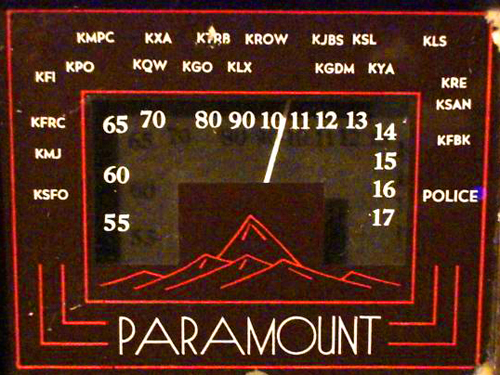
Lastly, a Paramount dial, circa 1946.  I believe this a rebranding of Remler, as once again the station list favors Northern California.  KQW San Jose has been moved down to 740kc—its first step in becoming a high powered station, completed with its rebranding as KCBS about ten years later.


When civilian electronics production resumed after World War II, the majority of California radio manufacturers continued profiting from their military contracts due to the nascent Cold War. Within five years most ceased their consumer operations, unable or unwilling to compete on a nationwide scale. Only Packard Bell stuck with their trademark ‘Stationized’ dials into the early 1950s before vying for a share of the national market.

, , , ___________________________ 

Thank you Daniel!

Do you think The Strange Loves of Daniel Nauman should be a blog? Let him know you enjoyed what he wrote by reaching him at  thestrangelovesofdanielnauman@gmail.com.

1/27/13

ALWAYS A BRIDESMAID, never...


Women's magazines have almost always gone out of their way to make women feel bad about themselves. How else can you possibly logically sell products without telling your buyer they're nothing without it? But this...this has always been a saying that irked me. And for young women today who think the feminist movement was not for them, consider this ad and ask yourself if they'd use it today. I'm sure in some narrow-world-view-circles this is still considered a perfectly logical fear. I ask that those people get off the bus.
Edna’s case was really a pathetic one. Like every woman, her primary ambition was to marry. Most of the girls of her set were married—or about to be. Yet not one possessed more grace or charm or loveliness than she.
And as her birthdays crept gradually toward that tragic thirty-mark, marriage seemed farther from her life than ever.
She was often a bridesmaid but never a bride.
What I'd really like to know is if it was a man or woman who wrote this copy. It wouldn't change my perspective of how bad the ad is, but it would have me wondering about the discussions that went on at the ad agency.

Click on image to see it larger. (SOURCE: The American Magazine, October, 1936)

And if you think not getting married is the biggest horror in life caused by bad breath...I give you death by halitosis.

Personally I think this photo looks like Edna might be crying over Ivy's casket.

1/25/13

KILLS RATS ONLY, yeah sure


Do you ever have trouble with rats? I'm not talking about the human type, I'm talking about the little buggers that get into the attic and drive you nuts?

Where I live virtually everyone has rat problems. Not something well known to people thinking of moving into the area.

A few years ago I was at the county fair and stopped to speak to someone at a booth giving out info about mosquitos and rats. Fun booth to work, huh? When I asked about rats they immediately said, "Oh do you live in...?" I stared at her and said, "Uh, no. Are they  known for their proliferation of rats?" We then discussed the county wide problem and I made a note to not visit the town mentioned.

I'll admit that I don't like killing the little creatures. I don't find them all that ugly, but I also don't like having them in my walls, especially when they start squeaking. And considering how many cats and owls are in this neighborhood I'm surprised there are any rats. The lizard population has certainly taken a nosedive, but then that might be due to agricultural pesticides. Don't get me started on the lack of frogs.

So is K-R-O still made? This vintage magazine ad is from the 1936 October The American Magazine. You'll notice that they say the product is made from Red Squill. After reading a bit about Red Squill I find their claim of "Kills rats without poison" a little dubious. You can read about all of this to your hearts content here and here.


As far as human rats are concerned...they're best ignored.

And alas, no information given about the illustrator of the rat. I'm just sayin'.

1/24/13

Craving an OLD HAT


I love these old hats. I've mentioned before that I have one that belonged to my grandfather. I long ago tore out the inside band so that it looks now more like a hillbilly hat than a nice gentleman's chapeau. For years I wore the hat in the mountains when I went hiking. Now I wear it when I go for walks on cold days. The hat must date back to at least the 1940s, possibly earlier. That silly old hat means a lot to me. Another one I had was stolen from the cabin. Curse the imbecile who took it. May they have nothing but bad luck beneath its brim.

So first we have a man who "...knows where he's going." I'm thinking he's at a stoplight watching a pretty young thing in the crosswalk. John Hancock Insurance is not on his mind. The light turns green and he suddenly remembers where he's going.

(SOURCE: The American Magazine, October, 1936)

He's going to the Mallory Hat Company factory located in Danbury, Connecticut.


(SOURCE: The American Magazine, October, 1936)

I love this illustration. Sadly there's nothing to indicate who the illustrator was.

Now wouldn't you know that there's all sorts of information online about the Mallory Hat Company. I'll let you do much of the digging, but I'll throw you a few crumbs.

Click here to see a few hats at the Metropolitan Museum.

Here is an image of the old factory in 1884.

((Photo courtesy of the Danbury Museum and Historical Society )
An 1884 photograph of the Mallory Hat Company factory in Danbury, one of the many hat manufacturers situated along the city's Still River. Mallory finally closed its doors in 1965.

At a library in Wisconsin they have an old brochure about the company. Below are a few pages. The illustrations were done by Edward Penfield. Do you notice anything wrong in the photos?


Here's an article about some union problems from The Day, September 1, 1951.


Now, as to this product on the hats called "Cravanette." I love the name...crave a net. Of course, perhaps the person who invented it was named Cravanette. Then it just sounds like a candy bar. Click here to read an article about Cravanette, the waterproofing stuff, not the candy bar.
Some thirty-five years ago, a woman n “Merrie England,” that fog-famous land, dreaded alike the wetting of her clothes and the odor of rubber coats and mackintoshes.
Said she, “Deception is the better part of valor;” and being afraid, as aforesaid devised an innocent deceit. Taking a piece of woolen cloth, she treated it to a process of her own invention, and—the cloth was more than cloth, it was waterproof.
From that cloth was made a coat which led an unusual double life, unusual is that both lives were good. On rainy, foggy days it was a waterproof, and preserved her clothes. ON sunny days it was a stunning long overcoat and preserved her pride. Incidentally, by serving a double purpose, it preserved her pocketbook also. (SOURCE: America's Textile Reporter)
Of course, a man went on to market it and the woman's name seems to be another lost to history...herstory.

To read an article about a court case regarding Cravenette click here. And to buy a box of Raisentes.

1/22/13

AN OYSTER A DAY is all they ask


I can definitely say that I will never ever slurp an oyster out of a shell. In fact, I may be so bold as to say I will never eat an oyster no matter how it is prepared. I know I am not alone with this thought.

Then there's the Oyster Institute of North America. Or perhaps I should say there WAS the Oyster Institute of North America. I cannot find any information indicating this group still exists. I'm sure, somewhere in the halls of Congress there is a lobbyist knocking on doors carrying a bucket of slurpy oysters hoping to entice some representative into writing a bill that leans towards oysters and oyster farmers. And so it goes.

This vintage magazine ad for oysters is from the October, 1936, The American Magazine. Has anyone seen any oyster ads lately?


The illustrator was Don Hearld. I cannot find any biographical information about him, but then after one post in an old book I decided I didn't care to know anything about him. He was apparently the author of some humor books available here and here. His one main claim to fame seems to be this image of Santa.

If you're a researcher interested in the Oyster Institute and find yourself at the Mystic Seaport: The Museum of America and the Sea you might want to check out the archives of Howard W. Beach who was the president of the Oyster Institute of North America, and the Oyster Growers and Dealers Association of North America. He apparently kept a series of scrapbook dating from 1905 to 1941.

1/21/13

Why is she SMILING?


Who came up with this idea? A woman's disembodied head floating over a serving tray in an ad for Gillette razors. I'm confused. I'm bafffled. I'm surprised. It's magical. It's creepy.

Anyone able to translate the characters on the tray? Are these the woman's last words?

Okay, the fellow is Harry Blackstone, Sr., famous magician.
Harry Blackstone (September 27, 1885 – November 16, 1965) was a famed stage magician and illusionist of the 20th century. Blackstone was born Harry Bouton[1] in Chicago, Illinois,[2] he began his career as a magician in his teens and was popular through World War II as a USO entertainer. He was often billed as The Great Blackstone. His son Harry Blackstone, Jr. also became a famous magician. (SOURCE: Wikipedia)
I get it. But seriously....?

Click on image to see it larger. (SOURCE: The American Magazine, October, 1936)

1/19/13

Sellin' the good stuff for McCONNON & COMPANY


I don't know about you, but when I look at this truck/car I feel like there should be guys with Tommy guns hanging out the windows shootin' at the coppers following behind. Alas, this fellow isn't carrying booze. Well, he could be because by the time this ad ran prohibition was over.


No, this is a just your friendly McConnon & Company representative rushing your order direct to your home. I've found a variety of information about the company, but nothing concrete saying they still exist. Here's a little of the history I did find.
McCONN'ON, Henry J., manufacturer; born at Winona, Minn., Aug. 1, 1870; son of James and Ellen (McKee) Mc- Connon; educated in public schools of Winona; unmarried. Began active career in drug business, 1889; was pro- prietor retail drug store for 9 years; entered manufacture of remedies, stock food, flavoring extracts, toilet articles, etc., 1899, and incorporated, 1904, as McConnon & Company, of which he has been president from the beginning. Member Board of Trade. Democrat. Catholic. Club: Arlington (director). Recreations: Fishing and hunting. Ad- dress: Winona, Minn. 
McCOlTNON, Joseph B., secretary and treasurer McConnon & Company; born at Winona, Minn., 1877; son of James and Ellen (McKee) McConnon; educated in public schools of Winona; married at Winona, 1905, to Miss Jeanette Morey. Entered the house of McConnon & Com- pany, manufacturers of remedies, stock foods, toilet articles, etc., in 1896, and has been secretary and treasurer of the company since its incorporation, 1904. Catholic. Clubs: Arlington, Meadow Brook. Recreations: Golf, fishing. Ad- dress: Winona, Minn. (SOURCE: The Book of Minnesotans)
So, we have more than we probably wanted to know about the secretary/treasurer of the company, but because of Henry J. McConnon's bio we know when the company started.

Through the years they manufactured a variety of items including cookbooks.

(SOURCE: Abe Books)

And then there were all the legal cases. Lots of legal cases. After all, they did warn you right in their copy that "BIG STOCK SENT ON TRIAL." You were warned. Who knows how Big Stock's trial ended.

This is all legalize double-speak. I haven't a clue about what was going on.


And here they are accused of aiding and abetting. Don't you love that phrase? Aiding and abetting.  Apparently, it was decided they hadn't aided and abetted. Sorry Mr. Holden.


And this one sounds quite interesting, but alas, we can't get the ending to the story without paying some dough.


They even made it into Snopes.com:
About 50 or 60 years ago, Mexican vanilla farmers were competing with synthetic vanilla makers from the US and Europe. It got so bad that the Mexicans began selling synthetic as the real thing. To get away with this they had to add coumarin to differentiate it from the familiar taste of fake vanilla. Among other things, coumarin cause liver damage. The Mexicans went back to selling real vanilla (sans coumarin) about the same time the USDA banned coumarin in the early '50s.
It might be worth knowing that McConnon & Company, a now-defunct direct-sales company out here in Winona (anyone remember McConnon's?), had among its products "Extract of Vanilla, Vanillin and Coumarin" in their line until they went out of business a few years back.
And I'll leave you with the idea of putting DDT in your underwear to prevent lice. Think of that tomorrow morning when you're getting dressed.


UPDATE: Today I received the following from Leigh Griffith:
McConnon and Company was my great-grandfather's company. His name is Joseph R. McConnon. As my mother always says, they sold everything from sheep dip to makeup! Alas, my great-uncle sold the company in the 1960s.
Thank you Leigh. I'm glad you found this post.