Showing posts with label 1937. Show all posts

12/8/15

More from HILDEGARD WOODWARD


The following images are, like yesterday, from a book entitled Christmas: A Book of Stories Old and New published by Charles Scribner's Sons. The illustrator is Hildegard Woodward. These are only a sampling of the black and white illustrations throughout, including spot drawings.


And please take a moment to look at my new book Tattered and Lost: Forgotten Dolls.

12/7/15

Christmas with HILDEGARD WOODWARD and FORGOTTEN DOLLS


The following images are from a book entitled Christmas: A Book of Stories Old and New published by Charles Scribner's Sons in 1937. Well, actually I'm not sure when it was published because the copyright page says 1935, but the title page says '37. Perhaps this is a different edition. The anthology was put together by Alice Dalgliesh with illustrations by Hildegard Woodward.

Endsheet


Click on image to see it larger.
Hildegard Woodward was born in Worcester, Massachusetts February 10, 1898. Her parents were Rufus and Stella Woodward. She was educated at the School of the Museum of Fine Arts, Boston and in Paris. She is the author and illustrator of many children's books, two of which were awarded a Caldecott Honor. In 1948 she was recognized for her illustrations of Roger and the Fox written by Lavinia R. Davis and again in 1950 for The Wild Birthday Cake.

In 1953 Woodward painted a mural on the wall of the Center School cafeteria in Brookfield, Connecticut near her residence in Hawleyville.

She began to lose her sight in the 1960, but didn’t stop painting. When she went blind she developed a method of "painting by touch".

Woodward's art was not restricted to children's books; her portfolio includes numerous works of fiction and humor for adults. Although most noted for her watercolor illustrations, she painted in oil and [6] was a children's portrait artist.

Woodward never married or had children. She died in December 1977 in Connecticut. (Source: Wikipedia)
Frontispiece


___________

New book NOW available on Amazon.
Tattered and Lost: Forgotten Dolls

This one is for those who love dolls!

Snapshots from the last 100+ years of children and adults with dolls. Okay, there are a couple of dogs too.

Perfect stocking stuffer for the doll collector on your list!


3/28/13

Getting a cold? COULD BE CONSTIPATION!


Why are the constipation ads in the back of the magazine? Why aren't they on the inside cover? We're embarrassed by constipation. We're embarrassed by the opposite of constipation. Why am I talking about constipation? Because there are all these fine ads in the back of the May 1937 The American Magazine.

Now, I don't know about you, but staring at this guy just makes my old sphincter just close right up. Moving on...so to speak...


This company, Pluto Water, we've visited before. They had a lovely little gazebo. When I'm constipated my first thought is of gazebos. Okay, better gazebos than this fella. Again, I'm feelin' a little tightening going on. And I don't know why, perhaps it's the 10 year old in me, but I keep wanting to change the headline to "For Constipation Do As Doctors Do Do."


Okay, this is better. A breath of fresh air, wind blowing on my face, bathed in sunshine. Oh wait, that's the bathroom light. I've just remembered I need to take one of these before I turn out the light. And I need to run through the house telling everyone else. Well hells bells, why don't I just canvas the neighborhood? Why keep this to myself? It looks glorious!


Seriously? I mean...seriously? Honeymoon constipation? Now I know what to get that bride and groom I need to buy a gift for. I'm sure nobody else will give them this. I like to be original with my gifts.


Best of all! Dance baby, DANCE! Dance that constipation away! Nose rubs optional and will actually not help at all when trying to ummmmm...relax your...well, you know. Apparently the cure for Saturday night fever.


This was a most irregular post.

3/27/13

So...are you feeling like a LUCKY TIGER?


It's always fun to find a piece of ephemera about a company that I've never heard of. My usual reaction is that the company no longer exists and all I'll find is historical data, if anything at all. I went into my search about this company with that preconceived notion. How wrong it proved to be.

Lucky Tiger, started in 1927, is still in business, and apparently has a loyal following.

This ad from the May 1937 The American Magazine is full of copy they'd never get away with today. Well, that's not true. They'd find ways to say the same thing, but might have the government taking issue with their claims that this product helps with baldness. Their implication was that if you were bald it was partially your fault because you were lazy. So they played on your vanity in the ad.


By the 1950s they were telling you your virility was at stake if you didn't use the product.


Today it seems mostly about memories and the possibility of adventure. Remembering "better times" when you were younger and spent time happily being groomed at a barber shop. The sensations of the visit are brought back by using their product. Perfectly valid direction to go. The adventure aspect? Might be stretching it a bit.

I don't know if the products are still being used in barber shops, but it's nice to see they're still around and have even expanded their product line.

3/25/13

It's the CADILLAC OF VACUUMS!


There used to be a phrase that was thrown about quite a bit. If you were to tell someone about an item, like a dishwasher, which was considered to be top of the line you'd say, "It's the Cadillac of dishwashers." Talking about a tractor? "It's the Cadillac of tractors."

I don't know if this phrase is used anymore. Cadillacs are not thought of in the same way as they once were. Perhaps people say, "It's the Mercedes of dishwashers." I don't know.

But here, from the May 1937 The American Magazine, is an ad for the Cadillac Vacuum Cleaner. No, not the Cadillac of vacuum cleaners; the actual Cadillac vacuum. I don't know how long the company was in business. I'm not finding historical information readily available, and I don't have the bandwidth to do much of a search. Perhaps when things are back to being hunky-dory with my net access I'll return to add to this post. Then again...why? I don't have the Cadillac of net access.


Let's just be glad we don't have to drag all the rugs outside each spring and beat the hell and dust out of them. I mean, I do like hitting things and watching the dust come out, but not if I have to. I'd rather do it for fun...in someone else's home...and then smile and leave.

2/27/13

MATSON ad, October 1936


There's nothing particularly Polynesian about this ad, and yet that was what they were hoping to sell you. This ad could have just as easily been for Miami. So why weren't the people of Polynesia featured in ads? I don't think I need to delve into the answer for this. I think most people can figure it out. It's a shame, because I'm guessing that when a lot of passengers disembarked from their ship at the Aloha Tower their senses were soon overwhelmed by Hawaii that they dreaded ever returning to their world of browns and grays. Who would want to leave a place full of color and flowers that bloom all year long?


Click on image to see it larger. (SOURCE: The American Magazine, October, 1936)

You can actually buy a sign of this image, sans type, from a company that is licensed to reproduce vintage Matson Liner ephemera. They also have many of the beautiful illustrations Matson commissioned for murals and ephemera. I wish they offered posters instead of signs.


To get a feeling of what it was like to travel on a Matson Liner there is a wonderful book called To Honolulu in Five Days. Full of images of ephemera, it tells the story of your trip to heaven and what it was like once you got there.

2/26/13

MATSON ad, May 1937


For anyone who has followed this odd corner of the universe for any length of time you'll know my love for the Matson Lines and Hawaii back in the 1950s and '60s. If you aren't aware of this and want to bore yourself for a little while just click on some of the label links below.

This ad was the front inside cover of The American Magazine, May, 1937. Obviously there were still enough people who had spendable cash to take trips during the depression. You had to be very well off to go on one of these cruises, or at least been saving your pennies for a long time.


Click on image to see it larger.

I'm always searching for images from the Hawaii I remember. The Hawaii of today is a foreign land. The landmarks, even a couple of my homes, are long gone. But, I know there are others out there who remember these times; military kids who were uprooted from the Mainland and suddenly dropped into paradise. In my searches online I found the Flickr site of Kamaaina56. Hundreds of images of long ago vistas and buildings. I sat for hours looking at them, memories flooding back to a time that I still long for. I miss the magic of the place. It was indeed the most incredible place to be a child.

Stop on over to Tattered and Lost Photographs to see a mystery photo of a hotel in paradise. My problem is which paradise?

1/14/13

CHEWING GUM for purely medicinal purposes


In July of 2009 I ran a piece about a Double Mint gum ad from a 1934 magazine. Take a look at it, but be forewarned, this ain't YOUR Double Mint gum. This is your grandma's Double Mint or maybe your great-grandma's gum.

Wrigley's wasn't just using sex to sell gum, they were using medical theories. What? You never thought of gum as a beauty aid? Wrigley's did and continued to do so as per this example from the May 1937 The American Magazine ad. Obviously they were toning the blatant sex down and hoping for something a bit more elegant than carnal.


Now, I have to wonder how they came up with this campaign. It was the 1930s; tough times. When I think back on people chewing gum in the '30s I think of gun-mols in old movies who said "soitanly" instead of "certainly," and they cracked and popped their gum. Was this gum chewing stereotype a threat to gum companies? By the time these ads were running the son of the original Wrigley was in charge of the company and he seemed willing to push advertising limits to keep the company name in a good light.
1891–1932: William Wrigley Jr.In 1891, 29 year-old William Wrigley Jr. (1861–1932) came to Chicago from Philadelphia with $32 and the idea to start a business selling “Wrigley’s Scouring Soap”. Wrigley offered premiums as an incentive to buy his soap, such as baking powder. Later in his career, he switched to the baking powder business, in which he began offering two packages of chewing gum for each purchase of a can of baking powder. The popular premium, chewing gum, began to seem more promising than the actual baking powder. Thus, in 1893, Wrigley launched his classic chewing gum brands, including Juicy Fruit, Spearmint, and Doublemint. All three brands have stayed relevant for over 100 years, continuing to satiate the customers of Wrigley’s Chewing Gum to this day.

1932–1961: Philip K. WrigleyAfter the death of William Wrigley Jr., his son Philip K. Wrigley (1894–1977) assumed his father’s position as CEO of the successful Wrigley Company. Philip is most well-known for his unusual move to support US troops and protect the reputation of the Wrigley brand during World War II, in which he dedicated the entire output of Wrigley’s Spearmint, Doublemint, and Juicy Fruit to the US Armed Forces. Philip launched the “Remember this Wrapper” ad campaign to keep the Wrigley brands on the minds of the customers during times of wartime rationing. (SOURCE: Wikipedia)
I can't find anything online about how this campaign came about, but I did find this wonderful article from the Northern Territory Times in Australia on November 27th, 1928. It's a hoot!

1/13/13

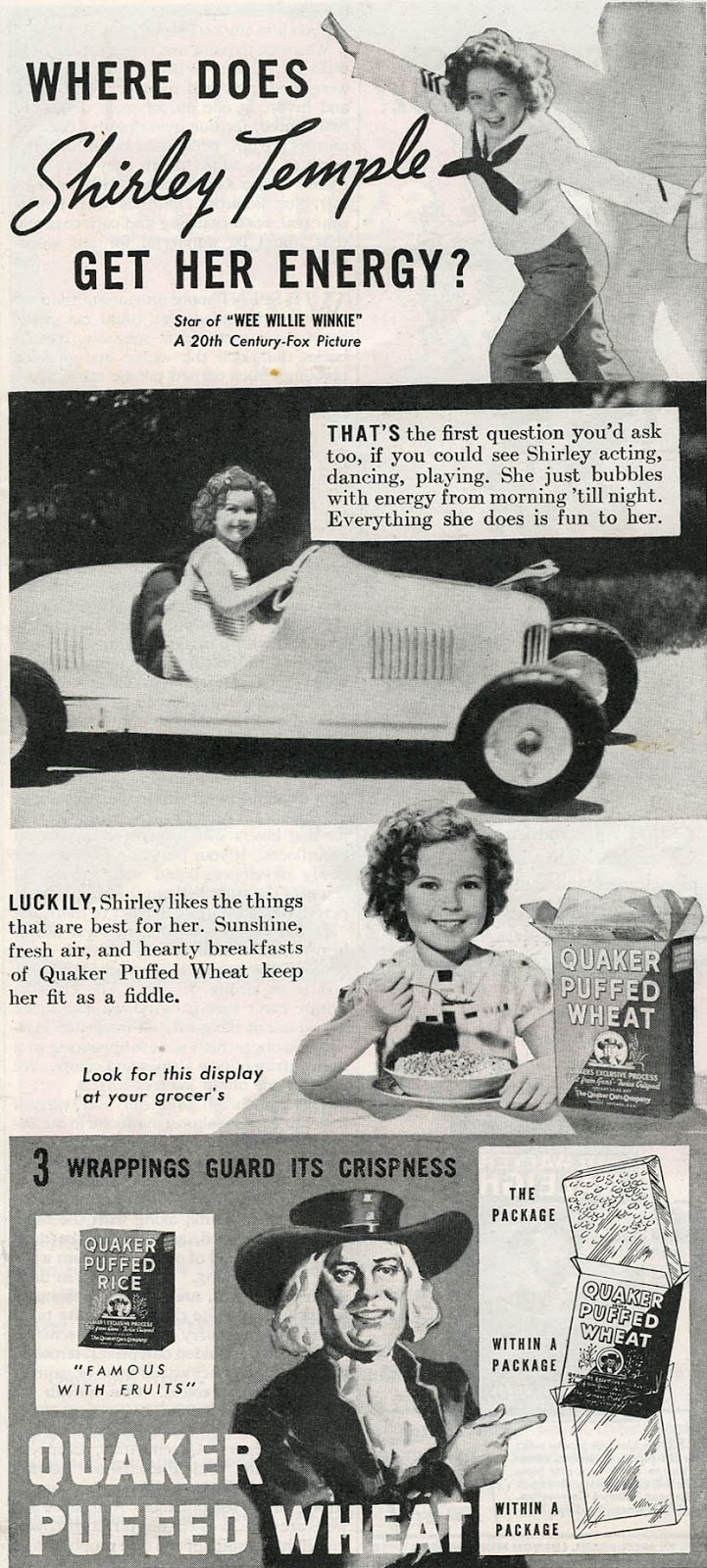
Would Shirley Temple MAKE IT TODAY?


I ask you, honestly, would Shirley Temple even have a chance today? Personally I don't think she'd even be able to get an agent interested in her. She wouldn't fit the rather skanky mold of young "stars" these days.

I simply can't imagine what she'd have been like had she been part of the culture of the '90s and the 21st century. I think she'd have still turned out to be a good and decent person thanks to her parents constant interest in what surrounded her. She certainly wouldn't have turned into a Lindsay Lohan or Miley Cyrus. But you do have to wonder how she would have been changed by our current culture.

Click here to see a vintage Shirley Temple paper doll from my collection.

9/17/12

Harry, ain't youse evah goin' to CUT THE GRASS?


Poor Harry if these were his choices in 1937. All ads from the May 1937 Better Homes & Garden.


Now, for me...I say TORCH THE SUCKER!

9/16/12

Wouldn't you like to MODERNIZE YOUR KITCHEN?


Just in case the two stoves shown yesterday weren't to your liking I have a few more for you to peruse. Think of this places as the catalogue shopping source for 1937.

All ads from the May 1937 Better Homes & Gardens.

So in alphabetical order I present the latest in cooking convenience.


No longer in business.


Hotpoint is still in business. Click on image to see it larger.


The brief Wikipedia history of Magic Chef. Click on image to see it larger.


A division of Whirlpool.

9/15/12

Wouldn't you like to MODERNIZE YOUR KITCHEN?


I'm in a stove sort of mood. I have no idea what that means.

These ads are both from the May 1937 Better Homes & Gardens magazine.

I've never seen a stove like this one from the Perfection Stove Company. In fact, until now I'd never even heard of the Perfection Stove Company. But let us not impeded our need for information. I found some historic information here.


In 1888, Henry Parsons Crowell was approached by Frank Drury to build, and market, a 'lamp stove'. The two men discussed the practicability of such an item. A patent was applied for; the Cleveland Foundry Company began building and then selling the stove. The 'Perfection Stove Company' was born.

In 1888 the Cleveland Foundry Company was formed. They manufactured a line of oil lamp stoves, along with many lamp companies such as Bradley & Hubbard and Miller. In 1894, the plant started producing portable heaters.  These heaters used the "store lamp" wick that had been standardized by Rochester in 1884. In 1901 Francis Drury approached John D. Rockefeller of Cleveland owner of Standard Oil Company. At the time Standard Oil was delivering kerosene to homes and businesses for use in kerosene lamps. Rockefeller knew that with use of the Drury Stove the demand for this kerosene would increase substantially and it did. Rockerfeller selected the company to design, develop and manufacture for it a complete line of stoves which were to be sold under the name "Perfection" to dealers by a group of 300 Standard Oil salesmen. This arrangement was continued by other oil companies.

The Perfection product lineup was extremely important to the growth of American civilization.  By 1918, over 5,000,000 heaters were in use.  By 1922, over 3,000,000 Perfection kitchen stoves and ranges were in use in American homes!  A sizeable percentage of households used a Perfection product on a daily basis. (SOURCE: Miles Stair's Wick Shop)
Now the Coleman Company I'm familiar with, but only as a company making stoves and lights for camping. I still have an old Coleman camp stove and a couple old Coleman lamps. I can still hear the sound of the lamp lighting and the bright glow at the campsite. But kitchen stoves? I've never seen one.


According to this newspaper column from the June 3, 1937 Lodi News-Sentinel it was a pretty doggone good stove to have out in rural areas.


Here's an ad in the same paper a few pages away. Coleman was certainly getting their money's worth.


To see some even older stoves and the men who sold them click here to see my post at Sepia Saturday of a Tappan store in 1927.

1/6/11

ANTHONY BERKELEY, Mystery Writer


First off, when you receive a software update notice and you find that update is over 1 gb and you're on satellite...your online usage comes to a standstill. So it was for me yesterday. I set the download going and just walked away from the machine. Everything now is neatly installed, ship to shore up and working. All clear.

Today I feature a book I found at a thrift store years ago. The graphic image grabbed me as well as the fact that it was one of the special war time issues in which the publisher included a blurb on the back cover stating "Share this book with someone in uniform." They gave no information as to how you were supposed to do this and no information that they would provide a free or discounted copy in a way that would lead you to believe they were being especially patriotic. I'm guessing they just thought you should give your copy to someone in uniform (and guys working at gas stations in uniforms need not apply). But then we come to the word "share" which means that you are not actually giving the book to someone and you expect to be able to get it back. You are after all just sharing the book.

So let's say you met a soldier in a drug store in 1945 and you felt all patriotic and walked up to him and said, "I want to share this book with you." The soldier, taken aback by your kindness, takes the book from you and puts it in his pocket after saying, "Thank you." You remind him that you aren't giving it to him, you're just sharing, and that you've left your address on the inside cover so that he can return it to you when he's finished with it. Now this might have worked as a genuinely good come-on if he was especially appealing to you, but if you were just sharing because you thought it patriotic...I think you can see where I'm going. Nowhere.

Trial and Error_anthony berkeley_tatteredandlost

Trial and Error_anthony berkeley_bk_tatteredandlost

As to the book Trial and Error by Anthony Berkeley I have found the following, though nothing specifically about this October 1945 edition of a book originally published in 1937.

First off, neither movie that was made with the title Trial and Error (Peter Sellers and Richard Attenborough in 1962; Jeff Daniels and Michael Richards in 1997) have anything to do with this novel. Apparently this is not a copyrighted title. So if you're thinking of writing a cookbook you might find this a useful title, especially for a book on cakes (which makes me think of the book Cake Wrecks, one of the funniest books I've ever seen and which got its start at this blog: www.cakewrecks.com).

Now, if you Google "Trial and Error" you'll find over 3,500,00 results, including a book published by Oxford University Press in 1985 with the subtitle "The American Controversy Over Creation and Evolution." Okie dokie then. Not opening up that can of billions of years old worms or 6000 year old worms, depending on your DNA.

After looking at 10 pages of Google suggestions and seeing nothing about this particular book I reluctantly tried Bing which said there were 157,000,000 entries. Yeah, I'm not feeling the love of those Microsoft Bing clearing-your-brain-of-clutter ads.

You will find that the first Google entry is actually Wikipedia's discussion of the phrase "trial and error" and the surrounding methodology:
Trial and error, or trial by error, is a general method of problem solving, fixing things, or for obtaining knowledge. "Learning doesn't happen from failure itself but rather from analyzing the failure, making a change, and then trying again." (SOURCE: Wikipedia)
So basically we have no idea why this author, Anthony Berkeley, chose this title and have no idea how it pertains to the copy on the back cover.

As to Mr. Berkeley himself there is some information to be had.

First from our favorite, Wikipedia (you know one of these times I'm going to slip up and type Wikileaks and then I'll end up on the no-fly list for sure):
Anthony Berkeley Cox (5 July 1893 – 9 March 1971) was an English crime writer. He wrote under several pen-names, including Francis Iles, Anthony Berkeley and A. Monmouth Platts.

Life
Berkeley was born in Watford, England, and educated at Sherborne School and University College London. After serving in the Army in World War I, he worked as a journalist for many years, contributing to such magazines as Punch and The Humorist. In 1938 he took up book reviewing for John O'London's Weekly and the Daily Telegraph, writing under his pen name Francis Illes. He also wrote for the Sunday Times in the 1940s, and for the Manchester Guardian, later The Guardian, from the mid-1950s until 1970. (SOURCE: Wikipedia)
They then give a listing of his novels with "Trial and Error" listed under "Other novels" which seems a tad disrespectful. "Oh yeah, that's one of his other novels."

Looking at the site Fantastic Fiction in the UK you'll see at some point the book was reissued with a different cover. Checking Amazon shows only used books so I'm making a huge assumption that he is not being published in the US these days.

To actually read an interesting piece about the author go to Martin Edwards Books. And to see a photo of the author go to Classic Crime Fiction.

To see a picture of Peter Sellers click here which will take you to the official Peter Seller's website. Yes, it's true, the deceased and much missed Peter Seller's has a website. And yes, they offer "news" updates. Okay, not asking why they offer news updates. And by the way, when I clicked on "News" nothing showed up so I guess they've got the whole news thing covered.

And how is it I ended this piece with Peter Sellers? Trial and error of course.

7/29/09

Wouldn't you like to own a STUDEBAKER?


American cars once really were beauties as this piece of ephemera shows. There were diverse designs, elegance, style...not boxes that looked like tanks. The industry has done a lot of harm to itself. When the money crunchers took over control and kicked the design department to the side we ended up with behemoths with pinheads behind the wheels or small cars too ugly to want to spend a hard earned dime on. Sorry, they lost me the last time I went shopping for a car. At least I did get to experience the last hurrah of the 50s and 60s. You used to be able to tell what model a car was simply by seeing the silhouette.

The Studebaker Wheel July 1937_cover_tatteredandlost

This cover is from The Studebaker Wheel, July 1937. It cost 10 cents. 20 interior pages, including inside covers. Articles varied from yachting to "A Cop Looks At Motor Manners" written by Police Lieut. F. M. Kreml from Evanston, Illinois. I especially liked this:
"I don't believe that it is just plain 'orneriness' that makes us act as we do when driving. Certainly I don't believe that we are all sadists at heart, getting a big kick out of offending, scaring and even injuring other people.

I prefer to believe that our tendency towards bad motor manners is merely part of the huge comedy that makes us human beings--and makes us careless and selfish....

Sometimes you hear the remark, too, that people are just too dumb and slow-witted to learn how to operate anything which responds as quickly as the modern automobile. It is argued that people can walk without continually bumping into others, because of the thousands of years of practice they have had since their ancestors came down from the trees; but that it will take us hundreds of years at least to learn how to deport ourselves as instinctively orderly drivers.

Yet, it has been my observation that few drivers really deserve a dunce cap. Rather, most accidents are the result of mere thoughtlessness on the part of driver and pedestrian. All of us have numerous friends who have driven five--ten--fifteen years or more with never an accident or at least never a serious accident. Those who have had accidents may be inclined to cal these clean records the result of better luck; but undoubtedly, if we check into the driving habits of people who had had no accidents, or very few accidents; and then check the minority--those who have had a series of accidents--we shall find important difference in driving habits."
Okay, this gentlemen never dreamed of Hummers with pinheads behind the wheel texting and drinking a double grande soy latte whatever while changing channels on their DVD player on the freeway. And just imagine if a car magazine today were to give any credence to Darwin's theory as this fellow did. We're talking massive boycotts.

I would actually look at this car and think, "Yeah, I can imagine myself behind the wheel traveling across country. I'd look good in this car." This car sold romance, not machismo or boredom.

The Studebaker Wheel July 1937_cent.spread_tatteredandlost
Click on image to see it larger.

To read more about the Studebaker click on:

1/9/09

THE HAVES and the have nots


I think it's hard for younger people today to really grasp how far we've come. This ad for Del Monte pineapple juice is from a 1937 Better Homes and Gardens. I don't really think I need to make any comment. Each person will bring what they want to it. It's like a scene from one of those 1930s Hollywood musicals where the women were bejeweled and white like snow and the servants were always black and spoke broken English. Even the height difference between the two women was calculated.

To see a larger version simply click on the image which will take you to Flickr.


del_monte_ad_1937_tatteredandlost

1/3/09

WHIP YOURSELF into a miracle


Again, from the 1937 Better Homes and Gardens.

It really is funny to look at vintage women's magazines. Rarely are women identified as anything other than their husband's name. We don't know their first name, just his. It's like a stamp of ownership. Complete loss of identity. 


Anyway...Mrs. Fred Wolff seems to be putting together a buffet luncheon for her friends, hoping for compliments. So while she puts salad in the mouths of her guests Kraft-Phenix Cheese Corporation put "It's this dressing," says Ms. Wolff, "that gives vegetable salad the right dash!" into Mrs. Wolff's mouth. 

No information is given as to who Mrs. Wolff is or why they chose her for the ad. Was she important in society? Did she win a contest to be in the ad? Did they just grab the wife of one of the ad guys at the agency because she looked "normal" and comforting to the readers? Unless there are relatives who see this and rush to respond I guess we'll never know. Mrs. Fred Wolff, here's to you and Miracle Whip.

What really attracted  me to the ad is the illustration. It's lovely. Not what you often get in vintage magazines, 4 color photos of food that look like they've long since been forgotten in the back of the fridge. This is a really nice watercolor. No information is given about the illustrator, which is a shame. It's really lovely.


And I guess we can now pencil in Thursdays on NBC for the Kraft Music Hall Program. So that's Thursdays with Kraft on NBC and Saturday night's Alka-Seltzer Barn Dance on NBC. I'll keep looking through this magazine to see how we can fill out the rest of our week.

And speaking of hideous looking food in 4 color, I'd highly recommend the very funny book The Gallery of Regrettable Food by James Lileks. He has captured all the stomach churning photos that were common in women's magazines and recipe books from long ago. Okay, not that long because I remember some of these from my childhood. People call it retro, we called it dinner. I've put a link to this book on the left side of the page.