Showing posts with label motel. Show all posts

8/7/13

MOTEL hopping: Passing through Fort Stockton with a big bird chasing us


Keep your shoes off and stuck out the window. We won’t be stopping tonight. This old Ramada Inn card for Fort Stockton, Texas doesn’t even supply an address so I don’t know if it’s still standing or not. 


Click on images to see them larger.

Having checked Yelp to see if they had any information, I find nothing. It’s possible this building is still around under another name or has had a facelift. Who knows. I always thought Ramada Inns looked like Stuckey’s. Why they both chose the same sort of architecture I’ll never know…or really care.

The publisher of the card was Schaaf Post Card Company out of Alamogordo, New Mexico. I can't find any historical information about them.

Doesn’t it seem stupid to have not put contact information on the back of a post card? No address. No telephone number. No customers. Granted, Fort Stockton is small so you probably couldn't have missed the faux colonial buildings, but still...advertising 101.

So folks, we’re leaving Texas tonight. If you want to know more about Fort Stockton as I barrel out of town click here.

Wave at Paisano Pete as we leave town in a hurry.

(SOURCE: Wikipedia)

8/6/13

MOTEL hopping: Amarillo, Texas


I never stayed in a Ramada Inn, and I won’t be staying in one tonight at this location.


Click on images to see them larger.

Folks, it looks like this place is long gone. Google Earth shows the following for the address on the back of the card. And no, this isn't exactly how it looks at Google Earth. I added the boomerang shape just to make things interesting.


Click on image to see it larger.

I don’t remember seeing any Ramada Inns until the mid-to-late ‘60s. Like the Holiday Inn, they had distinctive architecture. In Ramada’s case it was a bit of colonial Willismsburg kitch. Holiday Inn was always trying to be a bit sleeker and modern. I always wondered if the colonial theme was also in the rooms.
The lodging chain was founded in 1953 by longtime Chicago restaurateur Marion W. Isbell (1905–1988) and a group of investors including Michael Robinson of McAllen, Texas who later went on to start Rodeway Inns in the early 1960s; and Del Webb of Phoenix, who owned the New York Yankees and went on to establish his own lodging chain, Hiway House, in 1956. Other original investors of Ramada Inns included Bill Helsing, Isbell's brother-in-law; Max Sherman of Chicago, a produce operator dubbed "The Tomato King"; Chicago attorneys Ezra Ressman and Mort Levin; and Frank Lichtenstein and Robert Rosow of San Antonio, Texas.
Chicago, a produce operator dubbed "The Tomato King"; Chicago attorneys Ezra Ressman and Mort Levin; and Frank Lichtenstein and Robert Rosow of San Antonio, Texas.

Ramada opened its first hotel—a 60-room facility—on U.S. Route 66 at Flagstaff, Arizona in 1954 and set up its headquarters in Phoenix, Arizona, where the chain built the Sahara Hotel on North 1st Street downtown in 1956 (which later became the Ramada Inn Downtown) and a 300-room Ramada Inn in the 3800 block of East Van Buren in 1958 that would become the chain's flagship property and headquarters. Mr. Isbell, like his contemporary, Kemmons Wilson, the founder of the Holiday Inn hotel chain, devised the idea of building and operating a chain of roadside motor hotels while he was on a cross-country trip with his wife, Ingrid, and their three children. On that trip, Isbell noted the substandard quality of roadside motor courts along US highways at the time. He saw the possibility in the developing market for a chain of roadside motor hotels conveniently located along major highways which would provide lodgings with hotel-like quality at near-motel rates plus amenities such as TV, air conditioning, swimming pools, and on-premises restaurants.

The Ramada name is derived from the Spanish term rama (meaning branch)and was applied to temporary open air structures called Ramadas that were made of brush or branches (similar to an arbor) and were popular in Arizona during harvest time. Company websites commonly refer to the structure as a "shady resting place."

Through its early years until the early 1970s, a typical Ramada Inn was built of colonial Williamsburg-style architecture to set their hotels apart from the standardized architectural designs used by competitors such as Holiday Inn and Howard Johnson's. These are properties that have distinctive triple pillars and a white overhang in the front of the hotel, in addition to all-brick architecture. However, most of these are now rebranded under various other names but a few original Ramada Inns of that colonial design continue as franchises of the chain today including a hotel in Ocala, Florida.

Ramada's logo, from its start in the 1950s until around 1976, featured a friendly bald innkeeper, dubbed "Uncle Ben". He sported an apron (later a suit and tie) and held a top hat in one hand and in the other hand, a red trumpeted banner that read "Ramada Inn Roadside Hotels". From 1976 to 1982, the chain's logo was a simple rounded rectangle that read "Ramada Inn" in the same gothic Western style lettering of the original design. From 1982 to 2004, Ramada changed to a revised, rounded rectangular design with more modern lettering. (SOURCE: Wikipedia)
I did once stay in Amarillo, well, a little east of town. It was early January 1959 and my family was on our way to Hawaii from the East Coast. We were riding in a blue and white Oldsmobile towing a ’56 Chevy Bel Aire convertible, also blue and white. Both cars, my folks, my budgie Pete, and I all shipped out of San Francisco on January 16th. Before feeling the warmth of the tropics we’d had to drive through winter storms that culminated in Amarillo.

Just outside Amarillo we couldn’t see the road because of the drifting snow and wind. We stopped at the first motel my dad spotted. Our room was toward the back of the “u” shaped building. A restaurant was in the front between the corners of the “u.” It was an experience I’ve never forgotten. It was practically as cold in the room as outside. The heater blew nothing but cold air and my father was busy trying to duck tape anything he could find over the vents. Meanwhile my mother and I huddled in the  double bed covered with blankets watching game shows on the snow tv screen.

I can’t remember the name of the show, but it was one of my favorites, and now I was freezing to death while watching it. There was a gauzy curtain with a person standing behind it in shadows. On the other side of the curtain there were three people and the MC. The point of the show, as if there ever really was a point to any of the shows, was for one of the three people to recognize by asking questions who the person was behind the curtain. It was always meant to be heartwarming. Heaven knows in that motel room we needed all the warmth we could get.

Eventually we went up to the cafe for dinner which meant going back out in the wind and snow. On a sunny warm day it would’t have been much of a walk, but that day it felt like it took forever. As I recall my mother carried my little budgie in his travel cage. He went into all restaurants with us, covered beneath a little towel. People would get the strangest looks when they heard a bird in the place.

Anyway, we’re going to keep driving since the Ramada Inn at 1001 E. Amarillo Blvd. is gone. Even the tree is gone. Nothing left but concrete and ugly.


I’m just really pleased it’s not winter along the Panhandle.

7/28/13

MOTEL hopping: HOLIDAY INN memories


For so many years staying at a Holiday Inn was only a dream. They were too expensive for my family. Gradually, I guess as my father's income increased, we began to stay at them more often. The last one I remember staying in was in London in 1975. After weeks and weeks of traveling through Europe my friends and I just wanted something that felt familiar with a bathroom NOT down the hall.

On the same trip we'd also stayed at the Holiday Inn in Augsburg, Germany. Actually there's a very long story about that hotel which only personal friends have been bored with. I'll save you the details, but there was a McDonald's clown involved, a stick shift in a candy colored green Opal, and trolley tracks. Like I said, a long story.


Click on image to see it larger.

7/23/13

MOTEL hopping: Along old Route 66 in Grants, New Mexico


Well folks, stay in the car. We won’t be stopping. 

I’ll let the pictures tell the story. An oasis for sure. A motel along the once grand Route 66.


Click on images above to see them larger.


Oh, don't you wish you could see that neon sign light up? Did the arrows flash or just stay red? And gosh darn, they gave S&H Green Stamps! 

Sadly, they aren't "completely modern" today with air conditioning, television, swimming pool, etc. In fact, I couldn't find a nice word spoken about this place. They rebranded themselves "Historic Route 66 Motel" in hopes of pulling in those of us who still long to travel America's Highway.

Below its last hurrah. And as far as the restaurant is concerned, I don't even see a spot for it. Usually in places like this the restaurant would have been where you see the pool located. And it seems that eventually they indeed did exactly that. Perhaps putting "restaurant" on the back of the card at the time was just wishful thinking.


So settle in, put your feet out the window...I'm going to keep driving. 

7/2/13

MOTEL hopping: Van Horn, Texas


The address for this card of the Western Lodge Motel in Van Horn, Texas, is so confusing that there's no way I can find where it is or was. Many of the highways listed on the back simply don't seem to exist anymore. So we really don't know whether we should unpack or not. I'm guessing we'll keep driving.


Click on images to see them larger.

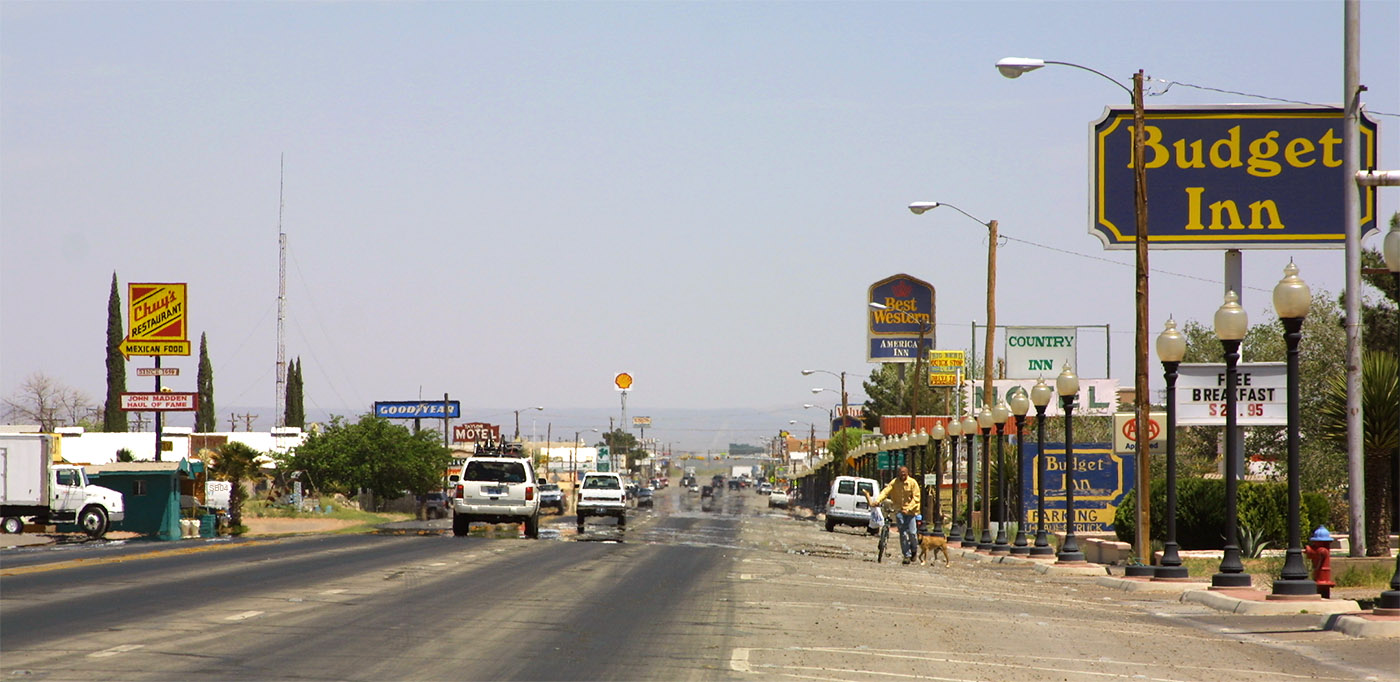
Apparently this is the main drag in Van Horn. I do see another Best Western, but it is not called the Western Lodge.

(SOURCE: Wikipedia)  Click on image to see it larger.

This strip reminds me of so many towns I remember from my childhood. My father driving, my mother with the AAA guide, and me in the backseat with the dog, my doll, and pillow.

Some towns just seemed to be a few miles of gas stations and motels. There were no houses. My mother might have a place picked out, but once we saw it and my parents passed judgement we might pass it by with my dad saying, "What's the next town?" sending my mother back to the AAA trip-tick and guide book.

I always enjoyed when we headed to "the next town" because it usually meant we'd arrive after the sun went down meaning I'd get to see all the neon motel signs. Then, too exhausted to drive any further, my dad would say, "I don't care what it looks like. I'm stopping." And so my mother and I would sit in the car while my dad went into the office. By then I was ready for bed, most likely already in my pjs, having changed while we were driving. My dad would come out of the office and my mother would say, "Did you ask if they take dogs?" And usually my dad would say, "No." End of discussion.

Now, I have no idea if Mr. and Mrs. Evans Burnett or Mr. and Mrs. A. A. Brune allowed dogs, but, looking at the surrounding territory in which Van Horn, Texas sits, I'm thinking the "refrigerated air" was most welcome.

Click on image to see it larger.
Surely I don't want you coming away thinking Van Horn is just a dry spot in a bigger dry spot. Van Horn is part of the space race, such as it is.
Space Tourism
In late 2006, the Wall Street Journal reported that Jeff Bezos, founder and CEO of amazon.com, had acquired 290,000 acres (1,200 km2) of land 25 miles (40 km) north of Van Horn to house his fledgling space tourism company, Blue Origin. As of 2008, Blue Origin had been expected to start commercial operations as early as 2010, aiming for 52 launches per year from the Van Horn, Texas facility. As of March 2010 however, Blue Origin and Bezos "have been very secretive about" the plans for the Van Horn facility for the past five years, having granted no interviews with news media since a single interview with the Van Horn Advocate in early 2005. 
In early 2010, NASA awarded Blue Origin US$3.7 million to work on an advanced technology, which detaches a crew cabin from its launcher if the shuttle malfunctions."[14]

10,000 Year Clock
In 2009 the The Van Horn Advocate announced that the Long Now Foundation was starting geologic testing for an underground space to house a 10,000 Year Clock of the Long Now, on the Bezos ranch, north of Van Horn.
Well there you go then. Learn something new every single day.

And one more thing...why would someone call a motel a "lodge motel?" I mean, it's not really a lodge. It's a motel. I know, a lodge sounds a bit more homey, but it's rather deceptive, don't you think?

6/30/13

MOTEL hopping: Salem, Oregon


I feel like I must begin this post with the correct pronunciation of Oregon. I can always tell when someone is from back east because of the way they pronounce Oregon. It is not ORE GONE. You have no idea how much that drives people from Oregon crazy. Pronounce it OR E GUN, but say it fast. Not ORE GONE. I've even heard network newscasters pronounce it incorrectly. I once had a phone call with a salesman at a large publishing company who kept pronouncing it wrong with me saying, "What? What are you talking about." And he'd say, "ore gone." I finally said, "Please spell it." "Ohhhh, you mean Oregon." Hopefully he pronounced it correctly from that point on.
Now, on to the motel.

Sadly, the La Vista Motel in Salem, Oregon no longer exists.


Click on images to see them larger.

It has been replaced by a tacky strip mall with a person in a banana suit trying to draw traffic in to one of the stores.


"The money is in the banana stand." Arrested Development

You can see from another version of the card that at some point the pool didn't exist. This card, found online, is clearly older than mine. Take a look at the old letter prefix phone number.


Click on images to see them larger.

The real kicker for me is their sign saying you get 3 TV channels. I remember when that was a big deal. Often you were lucky if you got one channel in some out of the way places. You were often lucky to get any TV at all. Here you must have gotten the three networks. These days the signs usually say "Free HBO." Life is too cushy now.

I do so love the circus atmosphere around the pool with the corrugated fiberglass panels. It looks like a happy place. Kids would have been drawn to it. The parents not so much because there was probably a posted sign that said, "No lifeguard on duty."

6/27/13

MOTEL hopping: Idaho Falls, Idaho


I stayed in this motel, Falls View Motel in Idaho Falls, Idaho, in the mid-60s on a family trip to Yellowstone. What I remember was the sound of the falls. That's the only memory that has stuck with me.


Click on images to see them larger.

Sad to say, like so many old motels, it doesn't exist anymore. At least a strip mall wasn't put up in its place. Instead there's another motel, the Best Western Driftwood Inn.


You can see the falls on the right, what looks like a white slash.


Funny, I don't think of driftwood when I think of Idaho. I automatically think of wood along the Pacific coast. Wood from far off shores. But hey, wood floating along the Snake River is driftwood, just maybe not as exotic.

6/24/13

MOTEL hopping: Gorman, California


Here we are on the Grapevine along Route 5 heading to Los Angeles. I don't remember what year I stayed at the Caravan Motor Inn, nor do I remember why. It was either the late '60s or early 70s.


Click on images to see them larger.

This place still physically exists, at least according to Google Earth, but I don't know what it's now called.


I'm always fascinated by motel cards that are architectural drawings. They've always seemed a little less inviting than a photo. What's fascinating about this card is the little piece of information about the architect.

Homer A. Rissman, a longtime Las Vegas architect, made a unique contribution to the Strip skyline when he designed the tent-shaped Circus Circus.

In addition to the Circus Circus, Rissman designed a number of other local properties, such as the Dunes Country Club, the Hacienda on the south end of the Strip and the Bonanza, which had been on the Bally's site.

His work also includes the Flamingo Las Vegas towers and the Primm hotels Buffalo Bill's, Whiskey Pete's and the Primadonna, said Nevada Moore, who had worked for Rissman the past 11 years.

"He was one of the nicest men I ever knew," Moore said.

Rissman died Wednesday (October 2001). He was 74.

Born Feb. 22, 1927 in Chicago, Rissman, who came to Las Vegas in 1956 to design the Hacienda, started his career by building simple, inexpensive houses in Illinois.

In 1954 he moved to California and initially came to prominence building restaurants and motels along the developing interstate highway system.

It was such work that brought Rissman to Las Vegas, where he would become known for his imaginative building design concepts, including Circus Circus, which he co-developed with gaming pioneer Jay Sarno, and the riverboat-shaped Holiday Casino, now Harrah's.

One of Rissman's early jobs was a major renovation of the Flamingo Hilton, where he painstakingly worked around historic architecture dating back to when mobster Bugsy Siegel built the resort.

In the process, Rissman replaced most of the buildings -- which had been built with cheap materials -- with sturdy and useful structures. Still, he saved Siegel's suite, complete with trap doors for quick escapes, as well as other early VIP suites.

In a later renovation, by another architect, those efforts were destroyed as the resort underwent major changes as operators attempted to distance themselves from the property's organized crime roots.

Away from the Strip, Rissman designed luxury apartment complexes, including the Regency Tower, where he lived for many years.

In his spare time, Rissman and his wife, Alice, who survives him, visited Nevada ghost towns and helped preserve them for their historic significance. (SOURCE: University of Nevada, Las Vegas)
The firm no longer exists.

6/23/13

MOTEL hopping: Des Moines, Iowa


It was 1966 and we were on a cross-country trip to visit my grandparents in Pennsylvania. I can vividly remember the night in Des Moines when we stayed at this Holiday Inn. One of the funniest family memories occurred while trying to find the place. I imagine to this day there's someone telling the story from their perspective and still laughing.

It was rare that we stayed in a Holiday Inn because they were the expensive fancy motel chain of their time, but my dad was so exhausted that he saw it and said that that was it for the night.

That same night was the first time I ever had a McDonald's burger and fries. I can also say you wouldn't get me eating any of it now.


Click on images to see them larger.

How about that Mickey Mouse shaped pool? I'm guessing it wasn't intentional.

Ever wonder how Holiday Inn got their name? If you think it has something to do with the old Bing Crosby movie you'd be correct.
Kemmons Wilson initially came up with the idea after a family road trip to Washington, D.C., during which he was disappointed by the lack of quality and consistency provided by the roadside motels of the time. The name Holiday Inn was given to the original hotel by his architect Eddie Bluestein as a joke, in reference to the musical film Holiday Inn (1942), starring Bing Crosby and Fred Astaire. The first Holiday Inn opened at 1941 Summer Avenue in Memphis, the main highway to Nashville, in August 1952 as Holiday Inn Hotel Courts. In the early 1990s the first Holiday Inn was demolished, but there is a plaque commemorating the site.

Wilson partnered with Wallace E. Johnson (1901-1988)[4] to build additional motels on the roads entering Memphis. Holiday Inn's corporate headquarters was in a converted plumbing shed owned by Johnson. In 1953 the company built its next three hotels which, along with their first hotel built in 1952, covered each approach to Memphis. The second motel was built on Highway 51 South in Memphis. It was followed by two more in 1953, one on Highway 51 North and another on U.S. 61. On the occasion of Johnson's death, Wilson was quoted as saying, "The greatest man I ever knew died today. He was the greatest partner a man could ever have." Together they started what Wilson would shepherd into Holiday Corp., one of the world's largest hotel groups.

By 1956 there were 21 Holiday Inns open with more either planned or under construction. In 1957, Wilson franchised the chain as Holiday Inn of America and it grew dramatically, following Wilson's original tenet that the properties should be standardized, clean, predictable, family-friendly and readily accessible to road travellers. By 1958, there were 50 locations across the country, 100 by 1959, 500 by 1964, and the 1,000th Holiday Inn opened in San Antonio, Texas, in 1968. The chain then became known as "The Nation's Innkeeper". The chain dominated the motel market, leveraged its innovative Holidex reservation system, put considerable financial pressure on traditional motels and hotels, and set the standard for its competitors, like Ramada Inns, Quality Inn, Howard Johnson's, and Best Western. By June 1972, when Wilson was featured on the cover of Time magazine, there were over 1,400 Holiday Inn hotels worldwide. The motto then changed to "The World's Innkeeper". Innovations like the company's Holidome indoor pools turned many hotels into roadside resorts.

The Great Sign
The "Great Sign" is the roadside sign used by Holiday Inn during their original era of expansion in the 1950s-1970s. It consisted of a marquee box; a tower with either red, orange, or blue neon lighting, a large chasing arrow that always pointed towards the motel/hotel, and a four-stage flashing animated neon star at the top. It had 1,500 feet (460 m) of neon tubing and over 500 incandescent light bulbs. It was introduced by Kemmons Wilson when he opened his first motel on August 1, 1952. The signs were extremely large and eye-catching, but were expensive to construct and operate. The manufacturer of the sign was Balton & Sons Sign Company (now Balton Sign Company}, whose ancestor D.F. Balton founded Balton & Sons in Memphis in 1875. In shop sketch artists Gene Barber and Rowland Alexander did the orginial design of the sign. Original engineering drawings were also done by Rowland Alexander of Balton & Sons Sign Company. The story goes that the sign’s colors were selected because they were favorites of Wilson’s mother. The popularity of the sign led to many clones being produced, some of which remain to this day. In 1982, following Wilson's departure, the Holiday Inn board of directors made the decision to phase out the "Great Sign" in favor of a cheaper and less catchy backlit sign that still maintained the original backscript logo (this changed after the second remodel). The decision was not without controversy as it essentially signaled the end of the Wilson era and removed a widely recognized company icon. Wilson was angered about this, saying, "It was the worst mistake they ever made". Wilson so loved the sign that it was engraved on his tombstone. The majority of the signs were sold as scrap metal and recycled.

Several intact fragments of the famous sign have been restored and relit, mostly the Holiday Inn top section of the sign, and the marquee box. However, in 2006 a complete sign was finally found. The disassembled sign, complete with star, marquee box, and the sign base, was discovered in a backlot in Minnesota. On June 3, 2007 it was purchased by a neon sign restoration expert, in order to restore it to its 1950s glory. It is currently being restored and reassembled, and after completion, it will be displayed at the National Save the Neon Signs Museum in Minot, North Dakota. Also, a nearly intact sign (sans the star section) that came from a Las Vegas location sits at the new American Sign Museum in Cincinnati Ohio. (SOURCE: Wikipedia)