Showing posts with label Iowa. Show all posts

6/23/13

MOTEL hopping: Des Moines, Iowa


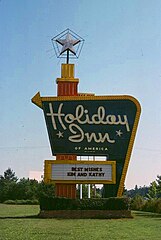
It was 1966 and we were on a cross-country trip to visit my grandparents in Pennsylvania. I can vividly remember the night in Des Moines when we stayed at this Holiday Inn. One of the funniest family memories occurred while trying to find the place. I imagine to this day there's someone telling the story from their perspective and still laughing.

It was rare that we stayed in a Holiday Inn because they were the expensive fancy motel chain of their time, but my dad was so exhausted that he saw it and said that that was it for the night.

That same night was the first time I ever had a McDonald's burger and fries. I can also say you wouldn't get me eating any of it now.


Click on images to see them larger.

How about that Mickey Mouse shaped pool? I'm guessing it wasn't intentional.

Ever wonder how Holiday Inn got their name? If you think it has something to do with the old Bing Crosby movie you'd be correct.
Kemmons Wilson initially came up with the idea after a family road trip to Washington, D.C., during which he was disappointed by the lack of quality and consistency provided by the roadside motels of the time. The name Holiday Inn was given to the original hotel by his architect Eddie Bluestein as a joke, in reference to the musical film Holiday Inn (1942), starring Bing Crosby and Fred Astaire. The first Holiday Inn opened at 1941 Summer Avenue in Memphis, the main highway to Nashville, in August 1952 as Holiday Inn Hotel Courts. In the early 1990s the first Holiday Inn was demolished, but there is a plaque commemorating the site.

Wilson partnered with Wallace E. Johnson (1901-1988)[4] to build additional motels on the roads entering Memphis. Holiday Inn's corporate headquarters was in a converted plumbing shed owned by Johnson. In 1953 the company built its next three hotels which, along with their first hotel built in 1952, covered each approach to Memphis. The second motel was built on Highway 51 South in Memphis. It was followed by two more in 1953, one on Highway 51 North and another on U.S. 61. On the occasion of Johnson's death, Wilson was quoted as saying, "The greatest man I ever knew died today. He was the greatest partner a man could ever have." Together they started what Wilson would shepherd into Holiday Corp., one of the world's largest hotel groups.

By 1956 there were 21 Holiday Inns open with more either planned or under construction. In 1957, Wilson franchised the chain as Holiday Inn of America and it grew dramatically, following Wilson's original tenet that the properties should be standardized, clean, predictable, family-friendly and readily accessible to road travellers. By 1958, there were 50 locations across the country, 100 by 1959, 500 by 1964, and the 1,000th Holiday Inn opened in San Antonio, Texas, in 1968. The chain then became known as "The Nation's Innkeeper". The chain dominated the motel market, leveraged its innovative Holidex reservation system, put considerable financial pressure on traditional motels and hotels, and set the standard for its competitors, like Ramada Inns, Quality Inn, Howard Johnson's, and Best Western. By June 1972, when Wilson was featured on the cover of Time magazine, there were over 1,400 Holiday Inn hotels worldwide. The motto then changed to "The World's Innkeeper". Innovations like the company's Holidome indoor pools turned many hotels into roadside resorts.

The Great Sign
The "Great Sign" is the roadside sign used by Holiday Inn during their original era of expansion in the 1950s-1970s. It consisted of a marquee box; a tower with either red, orange, or blue neon lighting, a large chasing arrow that always pointed towards the motel/hotel, and a four-stage flashing animated neon star at the top. It had 1,500 feet (460 m) of neon tubing and over 500 incandescent light bulbs. It was introduced by Kemmons Wilson when he opened his first motel on August 1, 1952. The signs were extremely large and eye-catching, but were expensive to construct and operate. The manufacturer of the sign was Balton & Sons Sign Company (now Balton Sign Company}, whose ancestor D.F. Balton founded Balton & Sons in Memphis in 1875. In shop sketch artists Gene Barber and Rowland Alexander did the orginial design of the sign. Original engineering drawings were also done by Rowland Alexander of Balton & Sons Sign Company. The story goes that the sign’s colors were selected because they were favorites of Wilson’s mother. The popularity of the sign led to many clones being produced, some of which remain to this day. In 1982, following Wilson's departure, the Holiday Inn board of directors made the decision to phase out the "Great Sign" in favor of a cheaper and less catchy backlit sign that still maintained the original backscript logo (this changed after the second remodel). The decision was not without controversy as it essentially signaled the end of the Wilson era and removed a widely recognized company icon. Wilson was angered about this, saying, "It was the worst mistake they ever made". Wilson so loved the sign that it was engraved on his tombstone. The majority of the signs were sold as scrap metal and recycled.

Several intact fragments of the famous sign have been restored and relit, mostly the Holiday Inn top section of the sign, and the marquee box. However, in 2006 a complete sign was finally found. The disassembled sign, complete with star, marquee box, and the sign base, was discovered in a backlot in Minnesota. On June 3, 2007 it was purchased by a neon sign restoration expert, in order to restore it to its 1950s glory. It is currently being restored and reassembled, and after completion, it will be displayed at the National Save the Neon Signs Museum in Minot, North Dakota. Also, a nearly intact sign (sans the star section) that came from a Las Vegas location sits at the new American Sign Museum in Cincinnati Ohio. (SOURCE: Wikipedia)
9/27/12

BRIDGES: Beaver Creek Bridge in South Dakota


Today we're in South Dakota. I have actually been on this bridge, which is not something I can claim about the three previous bridges.


Click on either image to see them larger.

I quite enjoyed the Black Hills of South Dakota. It's beautiful and the ride through Custer State Park is an adventure when you go through some of the tunnels. I watched a tour bus come through a particularly narrow tunnel. The driver first got out on the other side, pushed in his mirrors, then started inching through the tunnel. I was standing with a group of people and we all stared in disbelief that he was attempting this. When the bus finally got through we all waved at the driver and passengers and they waved back at us. Later on down the road I was able to talk to the driver who told me he did this every week, multiple times, and had never hit the side. I told him, "You're a better man than me Gunga Din."

And now a little historical perspective about the bridge.
The Beaver Creek Bridge spans one of two perennial streams that flow into Wind Cave National Park. It is a deck arch bridge built of concrete and steel. It is 225 feet (69m) long and sits 115 feet (35m) above the canyon floor. The purpose of constructing the bridge in 1929 was to provide travelers a more suitable access to the newly developing Custer State Park to the north of Wind Cave National Park.
One of the significant accomplishments of the builders of the bridge was to create the illusion that the concrete arches rise naturally from the rock walls on opposite sides of the canyon. The nature of this bridge makes it historically significant. It is the only bridge of its particular arch type in the State of South Dakota. It is also only one of three "most significant bridges" in the Rocky Mountain region of the National Park System. Construction of this bridge was made possible through the efforts of Peter Norbeck, U.S. Senator from South Dakota. Senator Norbeck was also involved with the development of Custer State Park and scenic highways within the Black Hills. (SOURCE: National Park Service)
To see previous posts about bridges click on "bridge" in the labels below.

9/26/12

BRIDGES: Railroad Bridge to Quaker Oats Company


This bridge in Cedar Rapids, Iowa apparently dates back to 1898. That's the only information I have. When I looked at the card I'll admit I was wondering what the bridge was used for. I thought it might be for cars, but trains seemed more logical.


Click on either image to see them larger.

Here is a shot of the bridge today taken by PolarisFinder.


I love old railroad bridges. They look quiet, almost waiting for the rumble to start down the tracks. A bridge that only comes alive every once in awhile. The rest of the time it's just a quiet structure. Can't you just hear it? The slow rumble as it approaches the bridge from either side, especially in darkness, headlight shining through the beams and cutting through the river in jagged shapes.

To see more bridges click on "bridge" in the labels below.

8/18/11

LET'S GO FIRST CLASS across America: Part 9


Back into the middle of the country for this one, the Hotel Tallcorn in Marshalltown, Iowa. It is apparently still standing, but don' t unpack your bags, you might want to sleep standing up in anticipation for tomorrow which is a truly first class hotel.

This postcard was sent by my mother to her folks when she drove across country in 1941 from Pennsylvania to Los Angeles. It was purely a trip for fun. She had a ball.

Click on either image to see it larger.

This hotel, like the Hotel Bonneville, was a community project.
The Hotel Tallcorn is located at 134 East Main Street in Marshalltown, Iowa. Today it is called the Tallcorn Towers Apartments. Built in 1928 by the Eppley Hotel Company, local citizens contributed $120,000 to ensure the successful completion of this seven-story hotel. It was completed in connection to the seventy-fifth anniversary of Marshalltown. The hotel's sale in 1966 from the Eppley chain to the Sheraton Corporation was part of the second largest hotel sale in United States history. (SOURCE: Wikipedia)
It looks like it might have been the place to stay in Marshalltown once upon a time.
Local Boosters Made Tallcorn Possible

February 18, 2011
By MIKE DONAHEY, TIMES-REPUBLICAN

An event which would later be described as the "welcoming of the dawn of a new era in Marshalltown" started off modestly with a Sept. 3, 1927 meeting at Elmwood Country Club.

A group of Marshalltown citizens joined to discuss financing a downtown hotel, but they needed funding to induce the Eppley Hotels Co. of Omaha, Neb. to build the facility.

That night, $38,500 was raised and the group set its eyes on a $120,000 goal.

Those who pledged funds of $5,000 each were the Fisher Governor Co., J.C. Penney Co., Lennox Furnace Co., Marshalltown Rotary Club and the Times-Republican, among others.

On Nov. 1, 1927 a meeting attended by 200 witnessed "the shrieking of whistles and ringing of bells," a T-R reporter wrote, as the last $4,161 had been raised.
The fund drive totaled $125,000 and the contract with the Eppley Co. to build the $500,000 hotel was signed.

It would be called the Hotel Tallcorn, in honor of Marshall County's rank as one of the top corn producers in the state.

Construction started in the spring of 1928, the same year Marshalltown celebrated its 75th anniversary.

The new hotel was seven stories tall and contained 150 rooms, each with a private bath.

Grant Wood was commissioned to decorate the ballroom and restaurant, known as the Iowa Corn room.

On Oct. 4 the Hotel Tallcorn formally opened to the public. George Gill was appointed first manager.

© Copyright 2011 Times-Republican. All rights reserved. This material may not be published, broadcast, rewritten or redistributed.


You can see another post card of the hotel here where you will also see what I imagine to be the drugstore/soda fountain with an awning. I imagine it had a lot of non-guest business. Who wouldn't want to go here for a rootbeer float or a sundae?


The post card was published by the E. C. Kropp Company out of Milwaukee.
E. C. Kropp Co. 1907-1956
Milwaukee, WI

A publisher and printer that began producing chromolithographic souvenir cards and private mailing cards in 1898 under the name Kropp. These cards were of much higher quality than those that would printed under the E.C. Kropp name.

They became the E.C. Kropp Company in 1907 and produced large numbers of national view-cards and other subjects. Their latter linen cards had a noticibly fine grain. Sold to L.L. Cook in 1956 and they are now part of the GAF Corp. U.S. (SOURCE: Metro Postcard Club)

Tomorrow: looking for some new territory for our final first class stay