Showing posts with label advertising. Show all posts

10/2/15

Vintage LION COFFEE PAPER DOLLS


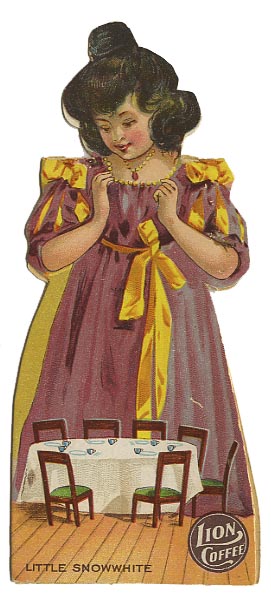
The theme for Sepia Saturday this week was almost too easy for me: vintage advertising paper dolls. I have many in my collection. The following are all from the Lion Coffee "Children's Dolls With Stories" collection. In total there are 30 dolls to collect. I have yet to find all of them.

The Lion Coffee company was owned by Alvin Mansfield Woolson.
Alvin M. Woolson was born in Huron Ohio, October 5, 1840 (always considered a good year for coffee in this office). Brought-up by foster parents, the boy did his share of farm labor, attending school only during the three winter months of the year. He worked in a country store, and later took a turn as a printers devil for the Sandusky Register. At the outbreak of the Civil War young Alvin enlisted in the First Regiment, Ohio Volunteers. In the course of the War, he received as appointment as Sergeant Major, of Artillery, in the Army of the Patomac.

In the aftermath of the war, Woolson moved west with the Union Pacific Railroad of E.H. Harriman, working in the capacity of accountant. In later years he recounted that among his duties was to ward off Indian attacks. With his feelings of wonderlust fullfilled and the railroad complete, Woolson moved back to Ohio where he clerked in a country store for a year prior to making the decision to set up for himself which he did, in the town of Wauseon with a capital of $125.00. He subsequently courted and married Francis (Frankie) Tillinghast and settled in Toledo in 1875. There he opened a grocery store on Adams Street near 12th.

There were opportunities for a fellow with ambition, and a grubstake, in the wholesale grocers trade and Alvin Woolson was not a man to let grass grow beneath his feet. In 1882 the Woolson Spice Co. was formed with a capital of $30,000.00 which represented significant local support from Toledo's business community including John Berdan and James Secor. The old Warren & Bidwell company was in financial straights and was to fall under the gavel at a government forclosure sale. Woolson was the successful bidder.

Woolson was a man possessed. He was tireless in his efforts to establish Lion Coffee as a major brand. It was 10 years before the first profits were realized. Then the tide came in and over the next five years over million profits were realized.

As markets filled and competition became fierce Woolson utilized a program of "premiums" to promote his products and encourage sales. "Save the wrapper" and "Cut out the Lion's Head" became the watchword of the day in households where the Lion Brand was used. Trading cards accompanied packages and toys could be sent for. There was something for everyone in the way of a Lion brand premium from bicycles and jackknifes to lace curtains. (SOURCE: The Free Library)
Click here to see a photo of Woolson.

I wonder if those who created these advertising premiums ever thought about their work still being around long after they were gone. Did they imagine these little scraps of paper would last well over a hundred years and be sought after? I doubt it. These were items meant to be played with and tossed.

I'll admit there are books I've designed that I know will be around for decades after I'm gone. I hope they provide pleasure to those who find them.




10/5/13

1912 Apperson Jack-Rabbit


Click on images to see them larger.

From Wikipedia:
The Apperson was a brand of American automobile manufactured from 1901 to 1926 in Kokomo, Indiana.
The company was founded by the brothers Edgar and Elmer Apperson shortly after they left Haynes-Apperson; for a time they continued to use a FR layoutont-mounted flat-twin engine, following it with a horizontal four.
Apperson cars
By 1904, Apperson offered vertical fours in two models. The 1904 Apperson Touring Car was a touring car model. Equipped with a tonneau, it could seat 6 passengers and sold for US$6000. The vertical-mounted straight-4, situated at the front of the car, produced 40 hp (29.8 kW).[1] A 4-speed transmission was fitted. The steel-framed car weighed 2800 lb (1270 kg). The wheel base was 96 inches.[1] The Apperson offered electric lights, a novelty for the time, and used a modern cellular radiator. The 25 hp (18.6 kW) version weighed 1800 lb (816 kg) and sold for US$3500.
In 1906 the company catalogued a 95 hp (71 kW) four at $10,500. The next year the first of the famed Jackrabbit speedsters rolled off the line; this was a 60 hp (45 kW) that sold for $5000. For a time, the entire range was known as the "Jack Rabbit" - in 1913 a 32.4 hp (24 kW) four and a 33.7 hp (25 kW) six were listed, and a 33.8 hp (25 kW) 90-degree V-8 of 5.5 L (5502 cc/335 in3) followed in 1914.

Roadplane models introduced
In 1916 the company announced production of the "Roadplane" six and eights. The term "Roadplane" did not refer to a specific model but was a marketing concept devised by Elmer Apperson that was applied to the "Chummy Roadster" and the "Touring" car. Elmer took the unusual step of patenting the "Chummy Roadster" design (see:"U.S. Patent 48359").
The "Silver-Apperson", designed by Conover T. Silver, was launched in 1917; the model was known as the "Anniversary" after 1919. A sedan proprietary with six cylinders of 3.2 L (3243 cc/197 in3) appeared in 1923, and a Lycoming eight-cylinder was offered beginning in 1924.
Final production
By now, Apperson and Haynes were both losing sales; a rumored re-marriage came to naught, and Apperson folded for good despite the introduction of four-wheel brakes on the 1926 models. (SOURCE: Wikipedia)
(SOURCE: Hemmings.com)

Click here to read a woman's memory of riding in a Jack-Rabbit in 1924.

And here's an ad, currently available on ebay, for a 1911 Apperson Jack-Rabbit.

10/4/13

1906 AUTOCAR ROADSTER


I haven't found any information about this car, so if someone does know anything let me know and I'll post it.

What I can tell you is that this vintage postcard is part of a series of cards that City Chevrolet in San Diego sent out to potential customers. If you search around the net for "1906 Autocar Roadster" you'll find lots of car dealers used the same card, only the information on the back was different.


Click on images to see them larger.

I guess the big question for me is what company created this series and sold it to dealers? Where were they located and what else did they market that was used by a variety of companies?

UPDATE: Thanks to WJY I have some info about the manufacturer of this car:
Next time you see a garbage truck take a close look. You might see an Autocar logo. They're still in business. Your car was made in Ardmore, Pennsylvania.
And this then led me to Wikipedia:
The Autocar Company is a Hagerstown, Indiana specialist manufacturer of cabover vocational trucks, mainly for refuse applications. Started in 1899 in Ardmore, Pennsylvania as a manufacturer of Brass Era automobiles, and from 1907, trucks. The last cars were produced in 1912, but the company continued as a truck maker until 1953 when they were taken over by the White Motor Company. White was taken over in turn by Volvo Trucks in 1980 with Autocar continuing as a division. In 2001, it was sold to Grand Vehicle Works Holdings, which continues to use the brand name for their line of trucks.
The company was called the Pittsburgh Motor Vehicle Company when started in Pittsburgh, Pennsylvania in 1897 but became the Autocar Company in 1899 when it moved to Ardmore, Pennsylvania, outside Philadelphia. One of the company's early cars was the Pittsburgher. By 1907, the company had decided to concentrate on commercial vehicles, and the Autocar brand is still in use for commercial trucks.
 Based on the minutes of company board of directors meetings during 1903-1907 it is known that in 1903 the Board of Directors included the president, Louis S. Clarke, the secretary, John S. Clarke, as well as, James K. Clarke. Both Louis Semple Clarke and his brother John S. Clarke were members of the fabled South Fork Fishing and Hunting Club of Johnstown Flood fame.
Autocar founder Louis Semple Clarke (1867–1957) was a successful mechanical engineer. Among Clarke's innovations were the spark plug for gasoline engines, a perfected drive shaft system for automobiles, and the first design of a useful oil circulation system. Clarke's insistence of placing the driver on the left hand side of the vehicle led to that standardization throughout most of the automotive industry worldwide, and consequently we drive on the right side of the road. The patented porcelain-insulated spark plug process was sold to Champion and remains the industry standard.
Clarke was also a talented photographer. His family were members of the elite South Fork Fishing and Hunting Club above Johnstown, Pennsylvania, whose earthen dam at Lake Conemaugh burst on May 31, 1889, causing the Johnstown Flood.
 Clarke sold his interest in Autocar in 1929 and retired from business. He died in Palm Beach, Florida, on January 6, 1957, and is buried in Allegheny Cemetery, in Pittsburgh. (SOURCE: Wikipedia)
Click here to read about the various vehicles they built.

10/3/13

1910 WARREN-DETROIT


Back in the 1970s a car dealer in San Diego sent out advertising postcards featuring vintage autos. Fortunately for me, my best friend saved all of them.

We start with the 1910 Warren-Detroit made by the Warren Motor Car Company.


Click on images to see them larger.

According to this ad, available here on ebay, the car originally cost $1250.


Now, let's take a ride.

9/30/13

1969 Chevy CORVETTE


I'm still trying to wrap my head around the huge used car sale that occurred this weekend in Nebraska. It was an amazing find of vintage cars. Seeing the images on tv was like walking down a street from my childhood.

I wonder if they had one of these?


Click on images to see them larger.

A friend once had a Corvette, I don't know the year. Her husband, an actor, won it with a hole-in-one at a golf tournament. She loved that car, but they finally had to get rid of it. I never asked why, sore subject.

7/28/13

MOTEL hopping: HOLIDAY INN memories


For so many years staying at a Holiday Inn was only a dream. They were too expensive for my family. Gradually, I guess as my father's income increased, we began to stay at them more often. The last one I remember staying in was in London in 1975. After weeks and weeks of traveling through Europe my friends and I just wanted something that felt familiar with a bathroom NOT down the hall.

On the same trip we'd also stayed at the Holiday Inn in Augsburg, Germany. Actually there's a very long story about that hotel which only personal friends have been bored with. I'll save you the details, but there was a McDonald's clown involved, a stick shift in a candy colored green Opal, and trolley tracks. Like I said, a long story.


Click on image to see it larger.

6/29/12

PORK AND BEANS...in a can...think about it


If you watch Mad Men and saw this season you'll remember Peggy had to work up ads for baked beans. Yeah, one of the reasons I didn't go into advertising. I'm sorry, but having to think about beans and pork in a can day after day would have me hitting my head against a steel beam.

So what was the pitch like for this ad? A kid fishing next to a waterfall and baked beans almost seems identical to the fictitious ads. The idea that baked beans are a part of everyone's childhood and should be cherished. Memories of mom opening the can, updumping it into a pan (you can almost hear that initial sucking sound as the weight of the contents glump into the pan), and then serving it on a plate next to a naked hot dog. I do believe I have that memory. But pork, beans, and waterfalls? Not getting it.


(SOURCE: Sunset, November 1967)

And no, the coupon won't work. It's passed its shelf life.

But I do really like the can...without the waterfall.