Showing posts with label paper dolls. Show all posts

10/2/15

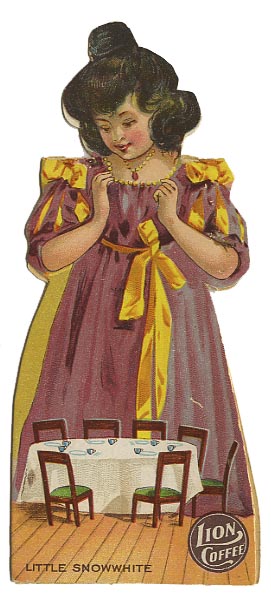
Vintage LION COFFEE PAPER DOLLS


The theme for Sepia Saturday this week was almost too easy for me: vintage advertising paper dolls. I have many in my collection. The following are all from the Lion Coffee "Children's Dolls With Stories" collection. In total there are 30 dolls to collect. I have yet to find all of them.

The Lion Coffee company was owned by Alvin Mansfield Woolson.
Alvin M. Woolson was born in Huron Ohio, October 5, 1840 (always considered a good year for coffee in this office). Brought-up by foster parents, the boy did his share of farm labor, attending school only during the three winter months of the year. He worked in a country store, and later took a turn as a printers devil for the Sandusky Register. At the outbreak of the Civil War young Alvin enlisted in the First Regiment, Ohio Volunteers. In the course of the War, he received as appointment as Sergeant Major, of Artillery, in the Army of the Patomac.

In the aftermath of the war, Woolson moved west with the Union Pacific Railroad of E.H. Harriman, working in the capacity of accountant. In later years he recounted that among his duties was to ward off Indian attacks. With his feelings of wonderlust fullfilled and the railroad complete, Woolson moved back to Ohio where he clerked in a country store for a year prior to making the decision to set up for himself which he did, in the town of Wauseon with a capital of $125.00. He subsequently courted and married Francis (Frankie) Tillinghast and settled in Toledo in 1875. There he opened a grocery store on Adams Street near 12th.

There were opportunities for a fellow with ambition, and a grubstake, in the wholesale grocers trade and Alvin Woolson was not a man to let grass grow beneath his feet. In 1882 the Woolson Spice Co. was formed with a capital of $30,000.00 which represented significant local support from Toledo's business community including John Berdan and James Secor. The old Warren & Bidwell company was in financial straights and was to fall under the gavel at a government forclosure sale. Woolson was the successful bidder.

Woolson was a man possessed. He was tireless in his efforts to establish Lion Coffee as a major brand. It was 10 years before the first profits were realized. Then the tide came in and over the next five years over million profits were realized.

As markets filled and competition became fierce Woolson utilized a program of "premiums" to promote his products and encourage sales. "Save the wrapper" and "Cut out the Lion's Head" became the watchword of the day in households where the Lion Brand was used. Trading cards accompanied packages and toys could be sent for. There was something for everyone in the way of a Lion brand premium from bicycles and jackknifes to lace curtains. (SOURCE: The Free Library)
Click here to see a photo of Woolson.

I wonder if those who created these advertising premiums ever thought about their work still being around long after they were gone. Did they imagine these little scraps of paper would last well over a hundred years and be sought after? I doubt it. These were items meant to be played with and tossed.

I'll admit there are books I've designed that I know will be around for decades after I'm gone. I hope they provide pleasure to those who find them.




1/12/13

BERTA and ELMER HADER, Hansel and Gretel, 1925


Paper doll collectors should be acquainted with the names Berta and Elmer Hader. They created some really lovely paper dolls for magazines in the 1920s. They are highly collectible and hard to come by.
Berta Hoerner (1891-Feb. 6, 1976) and Elmer Stanley Hader (Sept. 7,1889-Sept. 7,1973) were a husband-and-wife team that illustrated more than 70 children's books, about half of which they also wrote. Their most notable contribution to children's literature was in 1949, when they won the Caldecott Medal for The Big Snow. (SOURCE: Wikipedia)
This image, a peek-box set, is from the June 1925 Pictorial Review. Oh my the smile I had when I saw this. Into the "'buy" pile immediately.


To read about the Haders and see more of their work, including purchasing reproductions of their original paper dolls, visit their official site. Oh to have some spare cash handy!

3/12/10

Dreams of being a WASP


Let's hear it for the women who came before us who opened the doors even if they were shut again for decades.

It was so wonderful to see the women of the Women Airforce Service Pilots of World War II finally get recognition this week. Of course it took far too long to acknowledge them with so many having passed on already.
The Women Airforce Service Pilots (WASP), and the predecessor groups the Women’s Flying Training Detachment (WFTD) and the Women's Auxiliary Ferrying Squadron (WAFS) (from September 10, 1942) were pioneering organizations of civilian female pilots employed to fly military aircraft under the direction of the United States Army Air Forces during World War II. The female pilots would end up numbering a little over thousand, each freeing a male pilot for combat service and duties. The WFTD and WAFS were combined on August 5, 1943 to create the para-military WASP organization. (SOURCE: Wikipedia)
Today approximately 300 are still alive. Three of them met this week with President Obama to receive the Congressional Gold Medal. What took so long? Well, history wasn't kind to them.
All records of the WASP were classified and sealed for 35 years, so their contributions to the war effort were little known and inaccessible to historians. In 1975, under the leadership of Col. Bruce Arnold, son of General Hap Arnold, the WASPs fought the "Battle of Congress" in Washington, D.C., to belatedly obtain recognition as veterans of World War II. They organized as a group again and tried to gain public support for their official recognition. Finally, in 1977, the records were unsealed after an Air Force press release erroneously stated the Air Force was training the first women to fly military aircraft for the U.S. (SOURCE: Wikipedia)
So I ask you, why was the government twiddling their thumbs when in 1943 Merrill Publishing Company issued this beautiful paper doll set to honor these women?

Girl Pilots of the Ferry Command_ft_tatteredandlost
Girl Pilots of Ferry Command_bk_tatteredandlost
Click on images to see them larger.

38 WASP were killed during the war.

To read more about these amazing women click on any of the links below:


And yes, this is my personal mint set.

2/27/10

PAPER DOLLS and PIN-UPS


When I first saw the Ovaltine ad I posted yesterday my first thought was how similar it looked to my favorite paper doll set, Seven and Seventeen.

I'm putting out a challenge to the paper doll obsessors out there to find the name of the artist for the cover of Seven and Seventeen: Big and Little Sister. I know I've read it somewhere, but can't find it. I've looked through the Mary Young books about the different artists, but don't see it mentioned. I'd sure appreciate the help.

Seven and Seventeen paper doll_ft_tatteredandlost

Seven and Seventeen paper doll_bk_tatteredandlost
Click on either image to see them larger. © 1945 Merrill Publishing Company,

Mine is a mint set. I spent a few years trying to get one. I mean, it's incredibly mint and I love it. That's why I'm not going to open it and scan the pages. I'm not messing with this one. For those not acquainted with this set I'll tell you that the pages inside are full of color. Each page shows a small scene of the sisters doing something dressed in matching outfits. Truly a wonderful set when paper dolls were in their hey-day.

Now I ask you, is anybody getting their money's worth here? Getting enough bang for your buck? If not let me know. What is it you'd rather be seeing?
________

UPDATE: I've received an anonymous comment informing me that the illustrator for these dolls/cover were done by pin-up artist Pearl Fresh. Thank you very much for filling in the pieces!

You can see more of her beautiful work by clicking on the source at the end of this brief bio.
Pearl Frush

As one of the top three women pin-up and glamour artists in the calendar art market at mid-century, Pearl Frush readily commanded the respect of the art directors, publishers, sales managers, and printers with whom she worked. Yet because she worked primarily in watercolour and gouache, her originals could rarely be reproduced in large enough quantities for her to achieve widespread popular acclaim. A close examination of her work, however, reveals a talent for meticulously realistic images comparable to those of the far better known Alberto Vargas.

Frush was born in Iowa and moved to the Gulf Coast of Mississippi as a child. She began drawing as soon as she could hold a crayon in her hand; when she was ready for formal studies, she enrolled in art instruction courses in New Orleans. After additional training in Philadelphia and New York, Frush joined her family in Chicago, where she studied at the Chicago Art Institute under Charles Schroeder.

Frush opened her first studio in Chicago in the early 1940s. While she accepted freelance jobs, she also worked at the studio of Sundblom, Johnston, and White. By 1943, she had become one of the Gerlach-Barklow Calendar Company's most important artists, creating a string of popular series: Liberty Belles, Sweethearts of Sports, Girls of Glamour and Glamour Round the Clock. In 1947, her Aquatour series, a dozen pin-ups all located in aquatic settings, broke all sales records. By 1955, Frush had become a "hot property" in the calendar-publishing business, so it was only natural that Brown and Bigelow should seek her out. A year later, the firm published its first Frush pin-up, a horizontal picture especially done for "hangers" (large wall calendars with one print attached).

A vigorous and attractive woman, Frush enjoyed sailing, canoeing, swimming, and playing tennis, and she would often incorporate sport themes into her work portrayed in a crisp, straightforward style, her pin-ups and glamour paintings effectively captured the spirit of young womanhood. Her girls were wholesome and fresh, shapely but never overtly sexual. Somehow they were able to look both like movie stars and like the girls-next-door.

She sometimes signed her paintings with her married name "Mann". Her renderings were always done with great precision, capturing every nuance of a subject in an almost photo-realist technique.(SOURCE: The Pin-Up Files)


________

UPDATE: Another anonymous comment about who the illustrator was:
I contacted OleButtonz on ebay (not realizing she died two years ago. She had bought out all of Merrill's remaining paper dolls and asked her about the illustrator of Seven and Seventeen. Her son answered me and said Clara Ernst is the illustrator of the cover and the inside pages.

9/23/09

GIRL RESERVE has been preserved

These lovely little ladies date back to 1940. They were place cards at a Girl Reserve dinner held on March 15, 1940 for a "Mother-Daughter Banquet", which is what it says under the lace of the little fan. 

mother and daughter papeerdolls_tatteredandlost

mother and daughter placecards_tatteredandlost
Click on images to see them larger.

Inside the little fan there are three pages of typed copy. The first page reads:
"A mother is a mother still--
The holiest thing alive."
                   --Coolridge
Next page, the menu:
  • Fruit cup
  • Baked Ham
  • Horseradish Sauce
  • Stuffed Baked Potato
  • Vegetable Salad
  • Rolls
  • Butter 
  • Coffee
  • Ice Cream 
  • Cookies
And the final page: 
Toastmistress------------------------- Betty Jo Scheafer

G-rateful Hearts----------------------Mrs. Potadle
I-nspirational Melody---------------Jean, Lucille, Judith
R-estful Moments--------------------Alice Peck
L-oving memories-------------------Rosamond Hancock
S-olo-----------------------------------Miss Johnson

Song - Nebraska Girl Reserve
This was purchased at the same estate sale where I purchased the lovely wedding paperdolls. These were on a table in a little plastic bag. I thought they were fascinating and more than likely few others have survived since this big wing ding took place. 

Now, I'd never heard of the Girl Reserves, but a little googling gave me some information. Click on the link below in the source to see some of the paraphernalia associated with the group, ie. armbands, booklets, photos, rings, etc. 
Officially the Girl Reserves of the Young Women's Christian Association (YWCA) began in 1918. However, like many clubs - it evolved from many informal girl gatherings under the YWCA program and from the Patriotic League of the YWCA. The Girl Reserves sought to help girls 12-18 develop a well-balanced personality, grow physically and take on social responsibility.

By 1921 there was a Girl Reserves handbook  to outlined the program.  It was a uniformed group, although by the 1930 there was a great deal of discussion on the merits of uniforms. (SOURCE: Vintage Kid Stuff)
And here's the Foreword to the aforementioned handbook along with a link in the source to the rest of the book:
FOREWORD 

THE Young Women's Christian Association is a fellow- 
ship of women and girls. The value of the fellowship 
lies in whatever it may contribute to self-expression, dis- 
cipline and growth of the whole life of each of its members and 
in the effectiveness of that group as it functions in the life of 
a community. It offers, therefore, to advisers of g'irls a place 
of leadership which has the greatest value. 

There is a standard toward which the development of all the 
membership both girls and advisers is set. The standard 
is expressed in the name "The Christian" and makes the teach- 
ings of Jesus the informing and directing principles of any of 
the Association's programs. His example of growth in wis- 
dom and stature and in favor with God and man is consciously 
followed. Any girl may enter this fellowship; there is noth- 
ing selective about its membership. The possibility of ful- 
filling this standard of achieving -this growth, is in direct 
proportion to the gift of self of those advisers who have ac- 
cepted places of leadership in the " Association movement. 

The Girl Reserves are a cross section of the whole fellow- 
ship. They are a movement within the movement of the whole. 
All the resources of the organization, general and specialized, 
lie back of the Girl Reserves, and are available for their de- 
velopment. The Girl Reserves are to the Young Women's 
Christian Association, of which they are a part, the fresh 
stream which feeds into the main current of the movement at 
its source or along itsl course the very youth of its youth. 
They have its future in their keeping. 

MABEL CRATTV. 

Office of THE GENERAL SECRETARY, 

National Board, Young Womens Christian Associations, 
United States of America. 
June 1921. (SOURCE: Archive.org)
I basically gather it was like Scouts and Campfire Girls. Now, did they sell candy or cookies? I don't know. Girl Reserve Cookies just doesn't roll off your tongue like "Give me a box of thin mints!"

9/14/09

I'm going to BUY A PAPER DOLL


These paper people reside inside an old Fannie May candy box bought at an estate sale about two months ago. It was a really intriguing sale with all sorts of goodies. Fortunately for me two guys who got in the door about 10 minutes before me, who are usually buying exactly what I want, were tired, and one had forgotten to bring his glasses. Thus when looking through the box of old photographs the one guy kept muttering that there wasn't anything good, but then he'd add "Of course if I had my glasses...." I sort of hovered, watching what they picked up and put down. I was hoping he'd put the photo box down and I'd zoom in. I nicely said, "Hey, when you're done with the photos I'd like to take a look." He was very accommodating as I continued to hover. Finally I had my shot at the box and I continued to monitor them through the eyes in the back of my head. They continued muttering that there wasn't much to be had, the sellers had not told the truth in their ad, etc. And then I heard it...

"Hey, do you want this box of paper dolls?" said the one guy to the other.

I about broke my neck. I never find paper dolls at estate sales. Never! I see these sales on ebay all the time where someone just happened into an estate sale and bought a ton of mint paper doll books. I don't go to those kind of sales. Never my luck. Anyway...

"No, I've sort of stopped buying paper dolls."

The fellow then saw me standing with the photo box in my hands, salivating, wondering what was in the white candy box he was holding. He said, "Are you interested?" I hope my grab wasn't too rude. I looked inside and was delighted! Lovely old 1930s dolls, clothes, accessories. Lots of goodies, most not completely cut-out. 

Now comes the problem. Who are these people? I know from the style they're from the 1930s, but for the life of me I cannot find them in any of my Mary Young paper doll reference books. I'm sure they're in there, but I'm just not finding them. So if someone out there in the darkness staring at their screen can give me a hint I'd be most grateful. I'd like to mentally name them other than "Fanny May Wedding Party" which I'm sure is a very sweet (sorry) name, but I need to know the facts. 

paper dolls 1_tatteredandlost copy

bridal party paper dolls_tatteredandlost.jpg copy

bridal party paper dolls 2_tatteredandlost copy

And yes, there is a groom. Now mind you apparently the company figured he wouldn't get played with much because he's on the same paper as the clothes, unlike all the other dolls which were punched out from the cover. Poor groom. I imagine not many survived. Ain't that always the way when you get this many women in a room with one guy? Okay, the fact that he is slightly effeminate...pretty much the given with paper dolls. The guys almost always look like one of the girls. I guess they were less threatening. I really don't know. 

bridal party paper dolls groom_tatteredandlost.jpg
Click on any image to see it larger.

Oh yeah, amongst the photos they passed up, the "famous" melon eating pig I posted at my vernacular photography site.  I left that sale a very happy girl.

UPDATE: Thanks to Linda at The Paper Collector who has identified the set as Wedding of the Paper Dolls from 1935, published by Merrill Publishing. It was illustrated by Lucille Webster. A reprint of this was available several years ago, but I haven't seen it recently. Now that we know the name of it keep your eyes open for the repro. The illustrations really are lovely!