Showing posts with label 3-D ephemera. Show all posts

7/10/10

SEX to sell Cream of Wheat


Was there any other time that sex was used to sell Cream of Wheat? I'm just a wonderin'.

Li'l Abner_Al Capp_tatteredandlost

This ad dates from the November 3, 1952 Life magazine. It made the $5 purchase worth it.

Last year I did a post about Li'l Abner at my vernacular photography site. I was questioning whether or not I am in possession of an actual photo of Mammy Yokum. Strangely this photo now shows up on the first page of Google's image search for "Mammy Yokum" so I guess this poor woman and her kin will go down as having lived in Dogpatch.

6/10/10

It's a PICTORIAL WONDERLAND!


I am so buried under work I can't see straight. I'm not complaining, only stating a fact. Deadlines will be the death of me. That said I still needed to stop in and share. Think of me standing in front of the class at show-and-tell. This is what I've brought for today. I will pass it around and expect to get it back in the same condition as when it left my hand. Those in the class with snotty noses need not touch the card.

Stanford University Memorial Court_tatteredandlost
Click on image to see it larger.

It's amazing how much work I can get done when I duct tape myself to this chair and forgo sleep and nutrients, well...except chocolate. I would really have to be dead to forgo chocolate.

You may now ohhhhh and awwww over the pretty card. I really do like this card. I love the colors, the shadows, the perspective. It's not often I really really like architectural images on post cards, but this one is a keeper.

5/9/10

Mother's Day BARKER CARD


For anyone who has been with this blog for at least a year you might remember me discussing the scrapbooks of a man named Ted Kramer. I bought two books at a flea market that were being sold by one of his daughters. Full of his memories from college, courting his wife, birth of his daughters, and holidays. Here is one from the early 50s from Ted to his wife, Pearl.

To Ted and Pearl and the lives they led. Why their memories so carefully saved by Ted ended up at a flea market on a foggy cold day I'll never fully understand.

Mothers Day_Barker Card_ft_tatteredandlost

Mothers Day_Barkers Card_tatteredandlost
Click on either image to see them larger.

4/23/10

Shooting STARS


You know those obnoxious little subscription cards blown into magazines that always fall out and annoy the heck out of you when you're trying to look through a magazine in a store? Do you bend over and pick them up or do you leave them on the floor? Don't worry, I'm not going to judge you one way or the other. More than once I've taken my foot and slid them under a counter just to get them out of the way so someone doesn't slip on the blasted things.

What you see below are insert cards I actually saved. These were in the American Film Institute magazine. I'm not sure if it was late 70s or early 80s, but I have a small stack with 20 different photos. Can you name the stars and the films? Give it a try and let me know. They're all pretty easy.


4/22/10

With GUNS ABLAZIN'...


I found this really really tattered book in a junk store, or maybe it was in the trash, a long time ago and always loved it. B-movie Western indeed. As I took it off the shelf to scan, it fell apart. This cowpoke is on his last legs. His repeater ain't goin' to be repeatin' for long.

Click on the dude to see him blazin' his guns even bigger.

The author, Lee Floren, was a slightly prolific writer in the Western genre, though apparently not a good one. He also had a penchant for writing bad soft-porn under the name Matt Harding. To see an example of his writing, if you aren't convinced that such a cheesy cover wasn't for a bad two-bit novelist, click here to see a complete story in the June 29, 1952 The Deseret News Magazine out of Salt Lake City, Utah (and yes, that's the correct spelling). Happy reading!

As to the company that published this gem:
Hillman Periodicals

Hillman Periodicals was an American magazine and comic book publishing company founded in 1938 by Alex L. Hillman, a former New York City book publisher. It is best known for its true confession and true crime magazines; for the long-running general-interest magazine Pageant; and for comic books including Air Fighters Comics and its successor Airboy Comics, which launched the popular characters Airboy and The Heap.

Founding
In the late 1930s and early 1940s, Hillman competed with Bernarr Macfadden and Fawcett Publications by publishing comics, true confessions magazines (Real Story, Real Confessions, Real Romances) and crime magazines (Crime Detective, Real Detective, Crime Confessions).

In 1948 Hillman began publishing paperback books. There were several series of abridged mystery and western novels published in the larger 'digest' size. The long running Hillman paperbacks first appeared in 1948 and lasted until 1961.

Pageant and Airboy
In 1944, Hillman launched a digest-sized, general-interest, "slick" (glossy paper) magazine, Pageant, with an initial print run of 500,000 copies. To obtain the paper during World War II wartime rationing, Hillman ended his detective magazines and comics, which together brought in a $250,000 annual profit. He returned to comics in 1946, resuming some titles from the earlier series.

Like most comic book publishers during the period fans and historians called the Golden Age of comic books, Hillman's titles included costumed superheroes. As trends in the comic book market changed, the focus shifted more to crime fiction/detective stories (Crime Detective Comics, Real Clue Crime Stories), and Westerns (Dead-Eye Western Comics and Western Fighters). Hillman's most notable character, continuing in new stories by another publisher, Eclipse Comics, in the 1980s, was the aviator-adventurer Airboy in Air Fighters Comics and its successor, Airboy Comics.

Later years
Hillman ceased publishing comic books in 1953, while continuing to launch such new magazines as Homeland and People Today, while also distributing Freeman, a journal of right-wing opinion. Amid a 1953 battle for control of directors and editors, Hillman announced his resignation as the Freeman treasurer because "it has been almost impossible for the past six months to run the magazine".

The following year, Hillman said he was thinking about launching a "conservative Republican" morning newspaper in Washington, D.C., but nothing came of it.

Hillman sold Pageant to Bernarr Macfadden Macfadden in April 1961, and the magazine continued until 1977.

Alex L. Hillman
Publisher Alex L. Hillman was a noted art collector who initially developed an interest in the field when he was a book publisher, commissioning artists to illustrate new editions of classic literature. He was married to Rita Hillman. He began his collection with such American painters as Raphael Soyer and Preston Dickenson, and expanded it to included impressionist and other painters. He eventually established the Alex Hillman Family Foundation, a private foundation in Manhattan, to oversee the collection. Gary A. Reynolds, curator of the Alex Hillman Family Foundation, died July 23, 1990 at the age of 40. (SOURCE: Wikipedia)
I've always hoped I'd find other books in the series because it's just so hokey, type and all. So far, nada.

2/15/10

I really don't know WHAT TO SAY


I'll let this piece speak for itself. I cannot figure it out. It's from a 1919 high school yearbook. I kid you not. I bought this yearbook a few years ago specifically because of this ad. It leaves me speechless.

1919 yearbook ad_tatteredandlost
Click on image to see it larger.

"The Correlator" was published by the University High School of Chicago, Illinois. I'm trying to imagine what the store was thinking when they placed this ad. I really do wish I knew the back story.

I was on my school's yearbook staff my senior year. I was pretty good at selling ads. In fact, I was the first and only person that year to sell a full page ad. It was for a motorcycle shop. I hated selling ads. I found I had to be a bit of a liar to sell the blasted things. When I went into the motorcycle shop, cold call mind you, the guy said, "Yeah, sure. I'll take a full page ad if I can have a photo of a girl in a bikini on a bike." Wish I had a shot of my face when he said this. These days girls wouldn't bat an eye at this. I stood there staring at the guy, my mind spinning, nodding my head. "Ohhhhhhhhhhkaaaaaaaaay. Let me ask the teacher."

So next day at school I hesitantly went up to the teacher and told her what the guy wanted. I figured it would get shot down. Nope. She loved it. Well, she loved the money. I think the ad cost $100. Nobody else sold a hundred dollar ad that year. And when the teacher wondered what girl they could ask to pose all the boys started grinning and nodding. They all said the same name. Yup, she was the school slut. And yes she enthusiastically agreed to pose.

The reason I tell this is I'm trying to imagine when the high school kid walked into the Leopold store in Chicago, in 1919, did the guy behind the counter say, "Sure kid. I'll take a full page, but I want a cross-dressing boy in my ad." Ohhhhhhhhkaaaaaaaaay.

Seriously, talk amongst yourselves. You're on your own in the weird world of 1919 ephemera.

UPDATE: I just found the following two ads online for Langham-High Clothes. They definitely had a specific market in mind. And it's all a little strange for the time period.


Okay, I just made a rather startling discovery about this yearbook. Ever heard of the Leopold and Loeb murder? Two University of Chicago boys who killed a 14 year old just for fun? Well, Richard Albert Loeb is in this yearbook I have. And yes, I will do a post about this. Hitting my head against the wall never having any idea.

2/10/10

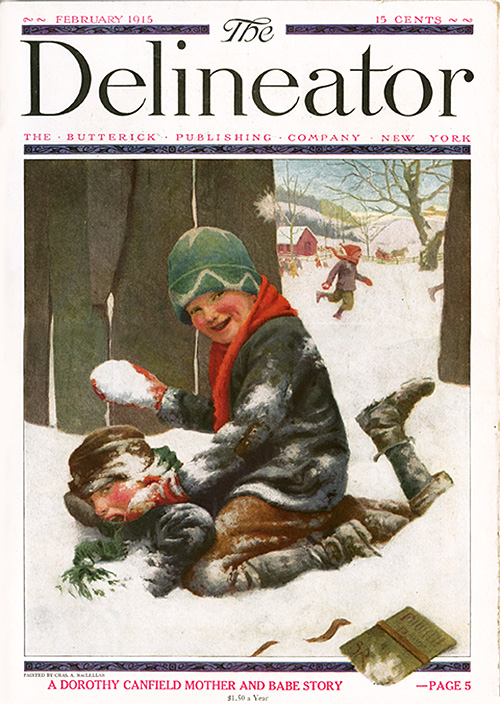
Charles A. MacLellan


Sometimes I just don't find anything. Put a name into a search and nothing much shows up. So okay, this is going to save me time. I'll just post this image to share and move on with what's left of my day and the real work I need to be doing.

Delineator cover_Feb.1915_tatteredandlost
Click on image to see it larger.

The cover is self-explanatory. Delineator, February 1915. I thought it appropriate for all the kids who stayed home today because of a snow day. It also reminds me of the scene in A Christmas Story when Ralphie beats up the neighborhood bully.

I'm not finding biographical information about the artist, Charles Archibald MacLellan, other than he was born in 1885 in Trenton, Ontario, Canada. He lived in Delaware and was known for doing illustrations of children. His teacher was Howard Pyle. He exhibited at the Pennsylvania Academy of the Fine Arts, and was apparently a student at the Brandywine School and the School of the Art Institute of Chicago. He is known for his cover illustrations for the Saturday Evening Post and he worked in oil paints. That's it folks. No death notice, but I'm figuring we can gather from his date of birth he's no longer here. If I ever find anything else I'll update this post.

To see examples of his Post covers click here and here.

That's it for today's Tattered and lost Ephemera break.
_______

UPDATE:
On November 30, 2010 I received the following biographical information about Charles A. MacLellan from his niece:
Uncle Charlie lived in a studio apartment in Wilmington, DE for many years. I believe it is now headquarters for some sort of an artists' group. Perhaps the address is 1305 Franklin Street. About 15 years ago I sent the artists' group a post card (or letter) from Howard Pyle indicating agreement to rent the place to Uncle Charlie.
Uncle Charlie died in October 1961 and a service was held at a local Presbyterian Church. He was cremated and his ashes were scattered by several ladies in the artists' organization.
My two sisters and I were his heirs. My mother, Marjorie MacLellan Dawson, was executor of his will.

He was a very, very funny man - very proper and irreverent at the same time.
Thank you! I love finding out more about the man who did this wonderful painting.
_______
UPDATE: on August 27, 2011 I received the following information in a comment from Ian Schoenherr said...
You can see some c.1911 photos of MacLellan taken in Howard Pyle’s studio in the Olive Rush Papers at the Archives of American Art. 


He appears in photos 17 (on the left), 19 (on the right), and 20 (on the left).
Thank you Ian!

UPDATE: The following biographical information was submitted anonymously to the comments section. Whoever sent it along, thank you.
Charles Archibald MacLellan, known as “Mac”, was born in Canada in 1885. He attended Chicago’s Art Institute School for about two and a half years before accepting a position at an engraving house. 
While in Chicago, MacLellan illustrated several magazine covers, designed stained glass windows, created advertisement posters, and did newspaper sketches for the Chicago Examiner.
In 1909, he relocated to Wilmington, Delaware, where her studied with legendary illustrator Howard Pyle. At that time, MacLellan began painting calendars and established a highly successful illustration career that lasted through the first half of the twentieth century.
MacLellan is best known for his cover paintings for The Saturday Evening Post. Between 1913 and 1936, he painted forty-four covers, making him one of the most prolific Post cover illustrators of his day. MacLellan specialized in painting women, and nearly all of his cover illustrations feature a woman as the central, and often only, subject.
By the late 1930s he turned to portrait painting and also spent more time acquiring antique furniture on behalf of the Winterthur Museum in Delaware.
MacLellan taught at the Studio, in Howard Pyle’s old studio in Wilmington, Delaware, from 1943 until his death in 1961.

1/27/10

OOPS! That's embarrassing.


"The 'Best Story' Series No. 12. There are others. Ask your dealer."

I really don't think I need to add anything.

Best Story Series No. 12_tatteredandlost
Best Story Series No. 12_back_tatteredandlost

12/12/09

EDDIE ELEPHANT by Johnny Gruelle, author of RAGGEDY ANN


By now you'll have noticed the flashing introduction to Eddie Elephant next to this post. Well, let me tell you a bit about Eddie.

Eddie Elephant, by Johnny Gruelle, was published in 1921 and was my dad's favorite book as a child. It was given to him by his cousin. In fact it's the only book that has survived from his childhood. He has virtually nothing from those days so whenever he sees this book it makes him smile. So I decided if Eddie can make my dad smile, and he certainly makes me smile, more people should have the chance to be brought on board and become fans of Eddie.

The story of Eddie is very simple. Eddie sets out from home to go visit Granny Elephant and has an adventure along the way meeting all sorts of friends in Jungleville. 

The author, Johnny Gruelle, was born on December 25, 1880 in Arcola, Illinois and died January 3, 1938 of a sudden heart attack in  Miami Beach, Florida. During that span of life he created one of the most beloved characters, Raggedy Ann. 
Johnny Gruelle was an American artist, political cartoonist, and writer of children's books. He is best known as the creator of Raggedy Ann and Raggedy Andy. He also provided colour illustrations for a 1914 edition of Grimm's Fairy Tales.
He was born John Barton Gruelle in Arcola, Illinois. His father, Richard Gruelle was a noted artist affiliated with Hoosier Group of Indiana artists. His first well known cartooning work was Mr. Twee Deedle which Gruelle created after he beat out 1,500 other entrants in a cartooning contest sponsored in 1911 by The New York Herald. Mr. Twee Deedle was in print from 1911 to 1914.

One day, Johnny gave his daughter Marcella a dusty, faceless rag doll found in the attic. Johnny drew a face on the doll and named her Raggedy Ann. Marcella played with the doll so much, Raggedy Ann became like a sister to her. Gruelle figured other children would like the doll as much too. Gruelle's Raggedy Ann doll U.S. Patent D47,789 was dated September 7, 1915. In 1918, the PF Volland Company published Raggedy Ann Stories. Gruelle then created a following series of popular Raggedy Ann books and dolls.

Marcella, after being vaccinated at her school for smallpox, was given an unidentified second shot without the consent of either parent. She soon contracted diphtheria and died, aged 13. After this bitter blow, family friends described him as "possessed, with a heavy countenance, and ... with the only thing he would bear to have near him as a reminder of Marcella a rag doll."

Gruelle lived in the Silvermine section of New Canaan, Connecticut, where the dolls were first mass produced, and later moved his home and company to neighboring Wilton, Connecticut. Gruelle spent a year in Ashland, Oregon from 1923-1924. He died in Miami Beach, Florida on January 8, 1938, of a sudden heart attack. (Source: Wikipedia)
To see more of Johnny Gruelle's work click here to go to Google's image site.

Eddie long ago was out-of-print so I thought I'd start Eddie back on his road to adventure by adding images of Eddie to my CafePress shop. More images are to come so keep checking back. 

Eddie is probably one of the sweetest elephants you'll ever come across, not that many of us come across elephants in our own day-to-day adventures. Oh shoot, just take a look and tell me what you think.

9/23/09

GIRL RESERVE has been preserved

These lovely little ladies date back to 1940. They were place cards at a Girl Reserve dinner held on March 15, 1940 for a "Mother-Daughter Banquet", which is what it says under the lace of the little fan. 

mother and daughter papeerdolls_tatteredandlost

mother and daughter placecards_tatteredandlost
Click on images to see them larger.

Inside the little fan there are three pages of typed copy. The first page reads:
"A mother is a mother still--
The holiest thing alive."
                   --Coolridge
Next page, the menu:
  • Fruit cup
  • Baked Ham
  • Horseradish Sauce
  • Stuffed Baked Potato
  • Vegetable Salad
  • Rolls
  • Butter 
  • Coffee
  • Ice Cream 
  • Cookies
And the final page: 
Toastmistress------------------------- Betty Jo Scheafer

G-rateful Hearts----------------------Mrs. Potadle
I-nspirational Melody---------------Jean, Lucille, Judith
R-estful Moments--------------------Alice Peck
L-oving memories-------------------Rosamond Hancock
S-olo-----------------------------------Miss Johnson

Song - Nebraska Girl Reserve
This was purchased at the same estate sale where I purchased the lovely wedding paperdolls. These were on a table in a little plastic bag. I thought they were fascinating and more than likely few others have survived since this big wing ding took place. 

Now, I'd never heard of the Girl Reserves, but a little googling gave me some information. Click on the link below in the source to see some of the paraphernalia associated with the group, ie. armbands, booklets, photos, rings, etc. 
Officially the Girl Reserves of the Young Women's Christian Association (YWCA) began in 1918. However, like many clubs - it evolved from many informal girl gatherings under the YWCA program and from the Patriotic League of the YWCA. The Girl Reserves sought to help girls 12-18 develop a well-balanced personality, grow physically and take on social responsibility.

By 1921 there was a Girl Reserves handbook  to outlined the program.  It was a uniformed group, although by the 1930 there was a great deal of discussion on the merits of uniforms. (SOURCE: Vintage Kid Stuff)
And here's the Foreword to the aforementioned handbook along with a link in the source to the rest of the book:
FOREWORD 

THE Young Women's Christian Association is a fellow- 
ship of women and girls. The value of the fellowship 
lies in whatever it may contribute to self-expression, dis- 
cipline and growth of the whole life of each of its members and 
in the effectiveness of that group as it functions in the life of 
a community. It offers, therefore, to advisers of g'irls a place 
of leadership which has the greatest value. 

There is a standard toward which the development of all the 
membership both girls and advisers is set. The standard 
is expressed in the name "The Christian" and makes the teach- 
ings of Jesus the informing and directing principles of any of 
the Association's programs. His example of growth in wis- 
dom and stature and in favor with God and man is consciously 
followed. Any girl may enter this fellowship; there is noth- 
ing selective about its membership. The possibility of ful- 
filling this standard of achieving -this growth, is in direct 
proportion to the gift of self of those advisers who have ac- 
cepted places of leadership in the " Association movement. 

The Girl Reserves are a cross section of the whole fellow- 
ship. They are a movement within the movement of the whole. 
All the resources of the organization, general and specialized, 
lie back of the Girl Reserves, and are available for their de- 
velopment. The Girl Reserves are to the Young Women's 
Christian Association, of which they are a part, the fresh 
stream which feeds into the main current of the movement at 
its source or along itsl course the very youth of its youth. 
They have its future in their keeping. 

MABEL CRATTV. 

Office of THE GENERAL SECRETARY, 

National Board, Young Womens Christian Associations, 
United States of America. 
June 1921. (SOURCE: Archive.org)
I basically gather it was like Scouts and Campfire Girls. Now, did they sell candy or cookies? I don't know. Girl Reserve Cookies just doesn't roll off your tongue like "Give me a box of thin mints!"

9/6/09

General Motors is proud to present PETER BENCHLEY'S JAWS!


Okay, cue the music. Da da, da da...da da, da da...dooo doo dooooooooooooo.

General Motors 1956 was apparently anticipating Jaws 11 years into the future because they seem to have been thinking about manufacturing a car that looks like a great white shark. A great white shark driving through the Castro District on Halloween. I'm not kidding!

Remember when cars had tail fins? Ummm...NOT LIKE THIS YOU DON'T! This thing has a dorsal fin on the trunk. A HUGE dorsal fin. Imagine trying to open the trunk in your garage? Oops, there goes the roof.

General Motors Mortorama of 1956_postcard_tatteredandlost
Click on image to see it LARGER 
and for crying out loud SAVE YOURSELF, STAY OUT OF THE WATER!

And I'm starting to think that maybe this great white that's been spotted this weekend in Cape Code...GM junk drifting towards shore. Somewhere along the line they dumped this model car in the ocean and it's been dislodged from a reef during the recent Atlantic storms and is now heading towards Cape Code. I'm just sayin'.


8/23/09

Only FOUR-AND-A-HALF DAYS


Leave San Francisco aboard ship and in 4-1/2 days you'd be coming around the bend of Diamond Head towards the harbor in Honolulu. I've said before it was a wonderful way to travel and an incredible place for two little girls to play. Running up and down the passageways, by the gift shop, across the wooden decks, out to the fantail to eat lunch. Glorious time. 

Matson advertisement 1960_tatteredandlost
(Source: Paradise of the Pacific 1960, No. 11, Vol. 71)  Click on image to see it larger.

Once you arrived on the island that was not your last encounter with the ships. As military families you always had friends coming and going so you often went back down to the Aloha Tower to see ships arrive or set sail. This meant you got to be part of the big party that took place on the docks. A small Hawaiian band would play, there were dancers, and best of all there were streamers. Those onboard would stand at the railing looking down on us and fling long streamers from the ship to the dock. Thousands of different colored tendrils were soon stretching across the expanse. My friend and I loved grabbing as many streamers as we could to make into a huge pile of paper to hide in. There was also always a man with a wide broom sweeping the paper into large piles making our "job" a lot easier. It was all giggles, colors, and noise. Grand times.

Here is someone's home movie of the Lurline as it arrives in Honolulu.


And this, though it has really dreadful music, also shows the fun of sailing on a Matson Liner. Why they chose this music, well who knows what they were thinking, It's an old travel film made back on the Mainland far away from the land of strumming ukuleles. Personally I don't remember any "race horses" when we were onboard, but I might be wrong. I think by the late 50s they'd done away with that. This was just a film to be shown to potential travelers. We weren't given a choice so we never saw any travel films. We were told "You're going to Hawaii." Well actually my father was given a choice. It was Oahu or Kodiak, Alaska. My mother said "NO!" to Alaska. Good thing.

7/24/09

Living in a PARALLAX PANORAMAGRAM UNIVERSE


Does anybody remember these? Little cards that were inserted in the back of Look magazine back in the 60s? This first one shows a bust of Edison surrounded by some of his various inventions.

parallax panoramagram_Edison_tatteredandlost
Click on image to see it larger.

Parallax Panoramagram. Rolls off the tongue nicely doesn't it? Okay, when I google it I get bored really fast because of information like this:
Parallax panoramagram having improved depth and sharpness

United States Patent 6850210

Abstract:  A parallax panoramagram has increased depth and sharpness when a sharpness filter is applied after interdigitation of multiple image portions. An optical path of wave train (204) (on-axis) and wave train (205) (off-axis) intersect a single lenticle (201). The lenticle has a focal length (208) and the on-axis (204) and off-axis (205) wave trains correspond to different stripes. These wave trains (204 and 205) comme to focus at points (206 and 207) respectively. The surface (202) has a cylindrical curvature, and bracket (203) denotes the width of the lenticle (201). Each eye of the observer sees its own perspective view when looking at a lenticular stereogram. (SOURCE: http://www.freepatentsonline.com/6850210.html)
I get the basics of what they're talking about, but I just don't care. On the other hand a 1964 issue of Time has the following:
"A LOOK FIRST: 3-D PHOTO," proclaimed the message on the cover. The Parallax Panoramagram "may mark the beginning of a new era in graphic-arts," said the press release. As it turned out, Look's first ran almost last in the magazine. On page 105, just short of the back cover, persevering readers found a stiff, postcard-size appendage, attached in the manner of a subscription renewal card. On the card was a black and white picture that showed a bust of Thomas Alva Edison surround ed by some half-dozen of his inventions. What made most readers stop and look twice was the picture's distinct illusion of depth.

Look's stunt, the result of 13 years' research, constitutes the latest effort to translate the real world of three dimensions into the picture world of two. Artists have employed trompe I'oeil three-dimensional techniques for centuries. But true success for photographers awaited the invention of the stereopticon camera in the 19th century, which took two pictures of the same subject through lenses that were separated like a pair of human eyes. When the viewer saw each picture separately, through separate lenses, his brain automatically supplied the missing dimension of depth.

The Look process is almost identical. A specially designed camera takes pictures through a transparent screen that is serrated to break up the image into hair-thin vertical slices. The camera is then moved slightly to the right or left, as other, sliced-up pictures are taken on the same negative.

The process is laborious, costly and slow, and not yet adaptable to highspeed printing. Merely to pose the static picture in last week's Look took two full days of work with a one-ton, cubical camera as complicated as an electronic computer. Five additional weeks were required to engrave the photograph, print it some 7,000,000 times on a sheet-fed offset press and then pour on and properly shape the clear plastic film that covers the picture with what amounts to a collection of lenses. The plastic lenses are so arranged that the viewer's left eye sees one of the serrated pictures, the right eye sees the other (see diagram).

Look and its partners in the enterprise, Eastman Kodak Co. and Harris-Intertype Corp., which built the equipment that adds the plastic lens coat, have high hopes of commercial success. Cowles Magazines & Broadcasting, Inc., Look's parent company, plans to establish a separate corporation, to be called Visual Panographics Inc., to sell its 3-D process to greeting-card manufacturers, display-art companies and anyone else willing to pay the price in money and time for an unspectacled illusion of depth. (SOURCE: TIME)
I don't know how successful this proved to be for all parties involved because the process does not seem to have become part of our general lexicon for printing processes. I do have some postcards from the mid-to-late 70s that seemed to have improved on the process. And I have a few football player cards from boxes of cereal that were done by Xograph. I'm actually not sure if Xograph was a company or simply the printing process. Britannica describes xograph as: 
three-dimensional printing technique ( in printing (publishing): Three-dimensional printing (1960s) )
...essentially an illustration bearing two views, superimposed, of the same image taken from slightly different angles, on a transparent mount striped with a multitude of imperceptible parallel strips (Xograph process). On account of these strips, each eye, looking at the print from a different angle, sees only one image. (SOURCE: ENCYCLOPÆDIA BRITANNICA)
The poor things haven't actually aged very gracefully. They've yellowed and beneath the surface they have cracked into what looks like puzzle pieces. All still together and you can't really feel the cracks, but they're just below the surface of the plastic. 

I've always thought this second one especially odd. The woman posing in some sort of industrial plant. I'm just not getting it. I always think of one word...plastics.

parallax panoragagram_Kodel_tatteredandlost
Click on image to see it larger.

Here's an example of one labeled Xograph.

Xograph Three-Dimensional print_tatteredandlost
Click on image to see it larger.

If anyone knows anything about these I'd be happy to hear from you. Post a comment and let us all know.

UPDATE:  I did find a bit more about this technique online in this book History of Lenticular and Related Autostereoscopic Methods by David E. Roberts (©2003 Leap Technologies, LLC.). At the top of page 12 it states:
"Lenticular techniques showed rapid progress in the 1960's as large corporations recognized its advertising potential. Mass production became a reality on February 15, 1964, when a Look Magazine issue featured the first ink-printed postcard sized "parallax panoramagram". The black and white still life of the bust of Thomas Edison surrounded by some of his more famous inventions required a 1000-pound camera, tracked in a programmed arc, to photograph. The manufacturing process involved printing the image using a 300 line offset press and a special technique for coating and lenticulating a thin layer of plastic on the image at high speed. The process, known as "Xograph" was developed at Eastman Kodak in Tennessee and was credited to Arthur Rothstein and Marvin Whatmore. Over 8 million copies were sold. Look Magazine followed with a color lenticular on April 7, 1964.

With the growth in popularity of lenticular in the 1960's, several companies entered the market including Vari-Vue of New York, which was co-founded  by Victor Anderson, who contributed greatly to the practical commercial success of the product. Vari-Vue, along with companies such as Crowle Communicatons, Hallmark, Toppan ("Top Stereo") and Dai-Nippon of Japan and later Optigraphics ("Optipan" and "Linearoptics") produced a wide variety of products over the next twenty years, including Cracker Jack premiums, Political buttons, 3D baseball cards, postcards, magazine and book covers and point-of-purchase displays.

By the 1980's, as the novelty value of lenticular wore thin, the only significant manufacturer left in the US was Optigraphics who's success was largely the result of the continued expertise of Victor Anderson."
UPDATE: From Debbie Thorne in 2013:
I found your site when trying to do something special with all my fathers negatives, black and white photos and slides that he has collected from his travels as a photographer for Look and Venture magazines. i was excited to see his 3 d photos on your site. Our family has albums of the 3 d pictures. I also watched my dad shoot many 3d pictures at the look magazine building on madison ave in nyc. Then the studio in Arlington, texas. He would create a shadow box for some pictures where he would cut out the models or items they were advertising. The camera was very large and it would move slowly to shoot a blurred image and then my father would design a plastic coating to give the photo the 3d effect. I have a very large mac tonight picture he did for Mc donalds hamburger in the late 60's or early 70' My fathers boss and a friend was Arthur Rothstein. They worked for look and venture until spring of 1973. Victor Anderson was one of the men at opticgraphics.