2/6/13

The cruel and harsh world of COMIC BOOK PAPER DOLLS


Oh how cruel they were! How evil to have done this! Have they no shame?

Hyperbole? Perhaps, but you take a look at the evidence before you let them off the hook for this crime against little kids who just wanted to play with the paper doll.

Now, imagine you've saved up your 10 cents in 1959 and bought the latest issue of Laugh featuring Archie and his friends. Lo and behold also included was a Katy Keene storyline. And is it just me, but is it doubtful that Katy and sis came from the same DNA?


Click on image to see it larger.

So you turn the page and there are all these wonderful clothes for a paper doll. The only problem is which came first? The doll or the clothes? The doll is on the preceding page, the clothes on the following verso.


Click on image to see it larger.

Hmmmmm...didn't anyone at HQ see this coming? If the kid cuts out the clothes the doll is gone. If the kid cuts out the doll the clothes are gone. Sneaky, very sneaky. But wait, there's a simple solution. Cough up another 10 cents to some unknown ranch in Santa Barbara and a fictitious character will send you the doll and clothes even though you're already holding them in your hand. They even state:
Readers Note: All these fashion cut-outs fit the sis doll on the preceding page!
Yeah, yeah, but you've stuck your little reader in a Twilight Zone episode. How would I have solved this? I'd have traced the clothes, used my crayolas to color them, then cut out the dang busted doll. I'd have been a happy, though slightly irritated, camper.

And I'd have thought the extra clothes on the last page of the story were just super keene. But I still wouldn't buy that sis has any chance at all of growing up to look like Katy. I'm thinking we need to see the milkman, the Fuller Brush salesman, and the paper boy.


Click on image to see it larger.

2/5/13

THE MOST SENSATIONAL TOY IN AMERICA! HONEST!


It is stated that this is "THE MOST SENSATIONAL TOY IN AMERICA." It was sold by Honor House. Who wouldn't trust a company with "honor" in their name? I'm sure the ship was exactly as they described it. No kid was disappointed when their huge space ship arrived in a small cardboard box.


What could possibly go wrong?

Vintage comic book ads are often the only good part of old comics. Even when the comics were new the ads were usually so mysterious, so enticing, so expensive to a kid who got 10 cents a week for making her bed. Not once did I ever send away for anything. I'd have never heard the end of it from my folks. Hard earned money was not to be spent on useless items in the back of comic books. So instead I saved up to buy more comic books and anxiously awaited each issues ads.

And what did it actually look like? Looks like these little fellows were pleased.

(SOURCE: Terror Daves)

Click here to see another version of the ad. And click here to see the actual ship in pieces with instructions.

I'm guessing this was the space ship dashboard which obviously needed some assembly...and imagination.


I sort of wish all of these things were still available for $2.98 because now I get even more for making my bed each week. I think first I'd buy the Sea Monkeys and the X-Ray glasses. I'd hold out awhile before purchasing the space ship.

Someday I'll get around to buying this book. I've had it on my "to buy" list for several years. It looks like a great collection of all the old ads, some I don't even remember. Better yet is that the author delves into the mystery behind all of this junk. Are kids more savy these days? Some are, some aren't. But I think most kids these days would be a little unhappy to get a cardboard space ship for Christmas after playing computer virtual reality games.

2/4/13

The voice of PHILCO RADIO


These days we're used to loud mouths spouting what is supposed to be news. Most often it isn't news because they're just speculating on what might happen or what they'd like to see happen. Real news is harder to find. Too much hot air filling the atmosphere from the current crop of media clowns. Think it's something new?


Click on image to see it larger. 

I give you Boake Carter for Philco radios. It will all feel rather familiar.
Harold Thomas Henry Carter (15/28 September 1903, Baku – 16 November 1944, Hollywood, Los Angeles, California), aka Boake Carter, was an American national news commentator in the 1930s and early 1940s. He was born in Baku, Russian Empire (now the capital of Azerbaijan), where his father, Thomas Carter, worked for a British oil company. Carter would later claim his father had been in the British Consular Service. Carter grew up in the United Kingdom, and enlisted in the Royal Air Force at the age of fifteen, serving with the RAF's Coast Patrol for eighteen months. He attended Tonbridge School from 1918 to 1921, and would later claim to have attended Christ's College in Cambridge. He arrived in the United States on September 25, 1921, after his father was assigned to Mexico.

Carter worked at the Philadelphia Daily News as a journalist of no particular acclaim.He entered broadcasting as a news commentator with WCAU in Philadelphia in 1930, initially as the announcer for a rugby game, getting the job by default as he was the only person WCAU's director knew who was familiar with the sport. In 1931, he became the narrator for Hearst-Metrotone newsreels. He rose to fame as a broadcast journalist when he covered the Lindbergh kidnapping trial, beginning in 1932. He continued to work for WCAU, with his broadcasts distributed through the CBS network.

After achieving fame, he was a familiar radio voice, but his commentaries were controversial, notably his criticisms of Franklin D. Roosevelt's New Deal and the powerful Congress of Industrial Organizations. Carter was an accomplished salesman for the sponsor of his program from 1933-1938, Philco Radios, blending his reporting and commentary with plugs for the company's sets. In 1936, he had more listeners than any other radio commentator. He published several books in the 1930s, and began writing a widely syndicated column in 1937. But by 1937, the Roosevelt White House already had three federal agencies investigating him. In 1938, under pressure from Roosevelt's allies, he lost his WCAU job, was barred from CBS, and lost his General Foods sponsorship that had replaced Philco. With his removal, there was no longer any popular radio commentator who opposed Roosevelt's foreign policy.

That year, Carter went on a speaking tour through the States. He subsequently continued to work in broadcasting where he could.

In the early 1940s, Carter was drawn into a 'British Israelite' cult led by a Moses Guibbory.

He was almost a forgotten figure when he died of a heart attack in 1944. A messy fight between his three former wives followed over his estate. Stewart Robb's "The Strange Death of Boake Carter," published in 1946, suggested Boake was murdered, perhaps by Guibbory. In 1949, his final years were documented in a book, "Thirty-three candles," by fellow cult adherent David Horowitz. (SOURCE: Wikipedia)

2/3/13

Zenith TRANS-OCEANIC


Yesterday and today I've done posts at Tattered and Lost Photographs (here and here) showing old Zenith Trans-Oceanic radios. How fortuitous that today I found an old ad in a August, 1947, National Geographic.


Click on image to see it larger. (SOURCE: National Geographic, August 1947)

2/2/13

Introducing THE STRANGE LOVES OF DANIEL NAUMAN


First off, I have a guest blogger today, The Strange Loves of Daniel Nauman, who loves vintage radios. He’s going to provide some interesting information about the old radio dials on the big beautiful pieces of furniture radios once were.

When I think of the old furniture style radios I think of people during the Depression sitting around listening to Roosevelt’s Fireside Chats. At those moments the country was one. They heard him tell of the Japanese attacking Pearl Harbor and the years of war that followed.


Click on image to see it larger. (SOURCE: The American Magazine, October, 1936)

On a lighter side I think of families gathering around to listen to their favorite comedies, dramas, and musical programs. Unlike today, where everything is in our face, listeners had to use their imaginations. I guess the closest today would be audio books and listening to Prairie Home Companion.

Click on image to see it larger. (SOURCE: The American Magazine, October, 1936)

And now, The Strange Loves of Daniel Nauman. Note that you can click on any of the images of radio dials below to see them larger.
___________________________ . . .

When Herb Bell’s mother complained that she couldn’t read the typically tiny dials found on early 1930s radios, he set out to do something about it. After all, he could---being co-founder of California’s own Packard Bell radios. He picked up on the latest 1935 trend of the full view round ‘airplane’ type dial but enlarged the size so he could print the station call letters above the frequency numbers. Their trademarked ‘Stationized’ dials were soon mimicked by many other California radio manufacturers.

The first image is from a late 1936 Packard Bell.  You'll see some of the stations are in a larger font than the others, which indicates higher powered stations like KFI Los Angeles.  KPO San Francisco would become KNBR (NBc Radio) in the 1950s.  At 1560kc, W6AXI Bakersfield was above the commercial broadcast band at the time (550-1550kc) and therefore was stuck with an amateur’s call letters despite having a wide and eager audience for their high fidelity signal. Back in 1933, W6AXI was the audio source for the first regularly scheduled mechanical television broadcasts on the West Coast. A high school student sat before a broiling bank of lights and read the news from the evening paper.


The second image is of a 1936 Tiffany Tone dial, which incorporates a few stations from farther east, such as WFAA Dallas and Crosley Radio’s 500,000 watt superstation WLW Cincinnati. The lower short wave portion of the dial shows the principal cities and countries where short wave broadcasts originated.


The third image is of a 1937 Gilfillan 'Radio Log Dial'. This dial omits W6AXI, perhaps because of its experimental status.  The dial does favor KGU Honolulu, however—so it’s likely  Gilfillan had a distributor in Hawaii. Water greatly increases the range of AM broadcasts, so Hawaiians could take advantage of dials marked with KFI, KNX and KPO. I've also discovered that Gilfillan actually had different call letter dials for different markets on their little late 1930s Plastikon radios—such as one for the Salt Lake region, one for Seattle, etc.  It's interesting they'd made the effort---and they must have advertised the fact, as it would be a good gimmick for a cheap plastic radio.


The fourth image is of a circa 1938 Tiffany Tone dial, showing the call letter change from experimental W6AXI to commercial KPMC (Pioneer Mercantile Company) when the broadcast band was increased up to 1600kc.


The fifth image is of a circa 1940 Remler. While most California radio manufacturers were based in Los Angeles, Remler was based in San Francisco, so it isn’t surprising their station list is mostly concerned with the Bay Area. Note the position of KQW San Jose on the dial.


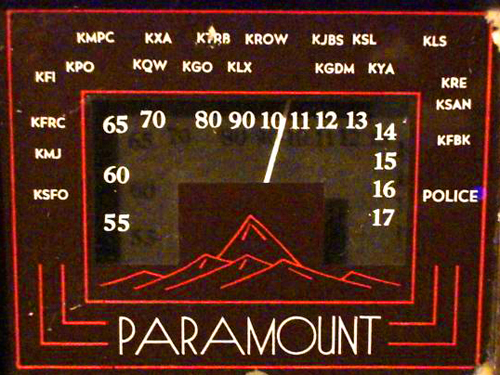
Lastly, a Paramount dial, circa 1946.  I believe this a rebranding of Remler, as once again the station list favors Northern California.  KQW San Jose has been moved down to 740kc—its first step in becoming a high powered station, completed with its rebranding as KCBS about ten years later.


When civilian electronics production resumed after World War II, the majority of California radio manufacturers continued profiting from their military contracts due to the nascent Cold War. Within five years most ceased their consumer operations, unable or unwilling to compete on a nationwide scale. Only Packard Bell stuck with their trademark ‘Stationized’ dials into the early 1950s before vying for a share of the national market.

, , , ___________________________ 

Thank you Daniel!

Do you think The Strange Loves of Daniel Nauman should be a blog? Let him know you enjoyed what he wrote by reaching him at  thestrangelovesofdanielnauman@gmail.com.