Glenn Ford (May 1, 1916 – August 30, 2006) was a Canadian-born American actor from Hollywood's Golden Era with a career that spanned seven decades. Despite his versatility, Ford was best known for playing ordinary men in unusual circumstances.
Born as Gwyllyn Samuel Newton Ford at Jeffrey Hale Hospital in Quebec City, Ford was the son of Anglo-Quebecers Hannah Wood Mitchell and Newton Ford, a railway conductor. Through his father, Glenn Ford was a great-nephew of Canada's first Prime Minister Sir John A. Macdonald. Ford moved to Santa Monica, California with his family at the age of eight, and became a naturalized citizen of the United States in 1939.
After Ford graduated from Santa Monica High School, he began working in small theatre groups. Ford later commented that his railroad executive father had no objection to his growing interest in acting, but told him, "It's all right for you to try to act, if you learn something else first. Be able to take a car apart and put it together. Be able to build a house, every bit of it. Then you'll always have something." Ford heeded the advice and during the 1950s, when he was one of Hollywood's most popular actors, he regularly worked on plumbing, wiring and air conditioning at home. At times, he worked as a roofer and installer of plate-glass windows.
He acted in West Coast stage companies, before joining Columbia Pictures in 1939. His stage name came from his father's hometown of Glenford, Canada. His first major movie part was in the 1939 film, Heaven with a Barbed Wire Fence.
In 1942, Ford's film career was interrupted when he volunteered for duty in World War II with the United States Marine Corps Reserve on December 13, 1942, as a photographic specialist at the rank of Sergeant. He was assigned in March 1943 to active duty at the Marine Corps Base in San Diego. He was sent to Marine Corps Schools Detachment (Photographic Section) in Quantico, Virginia three months later, with orders as a motion-picture production technician. Sergeant Ford returned to the San Diego base in February 1944 and was assigned next to the radio section of the Public Relations Office, Headquarters Company, Base Headquarters Battalion. There he staged and broadcast the radio program Halls of Montezuma. Ford was honorably discharged from the Marines on December 7, 1944.
In 1958, he joined the U.S. Naval Reserve and was commissioned as a lieutenant commander with a 1655 designator (public affairs officer). During his annual training tours, he promoted the Navy through radio and television broadcasts, personal appearances, and documentary films. He was promoted to commander in 1963 and captain in 1968.
Ford went to Vietnam in 1967 for a month's tour of duty as a location scout for combat scenes in a training film entitled Global Marine. He traveled with a combat camera crew from the demilitarized zone south to the Mekong Delta. For his service in Vietnam, the Navy awarded him a Navy Commendation Medal. His World War II decorations are as follows: American Campaign Medal, Asiatic-Pacific Campaign Medal, World War II Victory Medal, Rifle Marksman Badge, and the U.S. Marine Corps Reserve Medal. He retired from the Naval Reserve in the 1970s at the rank of captain.
Following military service, Ford's breakthrough role was in 1946, starring alongside Rita Hayworth in Gilda. He went on to be a leading man opposite her in a total of five films. While the movie is mostly remembered as the vehicle for Hayworth's "provocative rendition of a song called Put the Blame on Mame, The New York Times movie reviewer Bosley Crowther praised Ford's "stamina and poise in a thankless role" despite the movie's poor direction.
Ford's career flourished in the 1950s and into the 1960s and continued into the early 1990s, with an increasing number of television roles. His major roles in thrillers, dramas and action films include A Stolen Life with Bette Davis, The Secret of Convict Lake with Gene Tierney, The Big Heat, Blackboard Jungle, Framed, Interrupted Melody with Eleanor Parker, Experiment in Terror with Lee Remick, Four Horsemen of the Apocalypse, Superman and westerns such as The Fastest Gun Alive, 3:10 to Yuma and Cimarron. Ford's versatility also allowed him to star in a number of popular comedies, such as The Teahouse of the August Moon, Don't Go Near the Water, The Gazebo, Cry for Happy and The Courtship of Eddie's Father.
In 1971, Ford signed with CBS to star in his first television series, a half hour comedy/drama titled The Glenn Ford Show. However, CBS head Fred Silverman noticed that many of the featured films being shown at a Glenn Ford film festival were westerns. He suggested doing a western series instead, which resulted in the "modern day western" series, Cade's County. Ford played southwestern Sheriff Cade for one season (1971–1972) in a mix of western drama and police mystery. In The Family Holvak (1975–1976), Ford portrayed a depression era preacher in a family drama, reprising the same character he had played in the TV film, The Greatest Gift.
In 1978, Ford had a supporting role in Superman, as Clark Kent's adopted father, Jonathan Kent, a role that introduced Ford to a new generation of film audiences. Ford's final scene in the film begins with a subtle indirect reference (either sly or coincidental) to Blackboard Jungle - the earlier film's theme song "Rock Around the Clock" is heard on a car radio. In 1991, Ford agreed to star in a cable network series, African Skies. However, prior to the start of the series, he developed blood clots in his legs which required a lengthy stay in Cedars-Sinai Medical Center. Eventually he recovered, but at one time his situation was so severe that he was listed in critical condition. Ford was forced to drop out of the series and was replaced by Robert Mitchum.
The 2006 movie Superman Returns includes a scene where Ma Kent (played by Eva Marie Saint) stands next to the living room mantel after Superman returns from his quest to find remnants of Krypton. On that mantel is a picture of Pa Kent (as played by Glenn Ford). This "cameo" of sorts was Ford's last screen appearance (the photograph is more easily visible in a deleted scene included with the DVD release of the film).
Ford's first wife was actress and dancer Eleanor Powell (1943–1959), with whom he had his only child, Peter (born 1945). The couple appeared together on screen once, in a short subject produced in the 1950s entitled The Faith of Our Children; when they married, Powell was more famous than Ford. Ford subsequently married actress Kathryn Hays (1966–1969); Cynthia Hayward (1977–1984) and Jeanne Baus (1993–1994). All four marriages ended in divorce. Ford was not on good terms with his ex-wives. He also had a long-term relationship with actress Hope Lange in the early 1960s, although they never married.
In 1978, Ford underwent hypnosis at his home in Beverly Hills, and recalled a past life of being a Colorado cowboy named Charlie Bill. He gave a detailed description of a past life, which was tape-recorded for academics at the University of California to study. A second experiment was conducted at the university itself when Ford, then 61, responded well to the hypnosis. This time he did not recall the life of Charlie Bill, but that of a Scottish piano teacher named Charles Stuart. "I teach the piano to young flibbertigibbets", said Ford under the hypnosis, using a quaint old English word for rascals not in common use in California. He allegedly played a few notes on piano during the experiment, despite later telling that he never had been taught to play the instrument. The researchers then managed to locate the grave of a Charles Stuart in Elgin, Scotland, who died in 1840. After being shown a photo of the burial place, Ford said "That shook me up real bad. I felt immediately that it was the place I was buried."
Ford suffered a series of minor strokes which left him in frail health in the years leading up to his death. He died in his Beverly Hills home on August 30, 2006 at the age of 90.[8]
His interment was located in Santa Monica's Woodlawn Cemetery.
(SOURCE: Wikipedia)
Polish American Joe Miracle (Glenn Ford) returns from fighting in World War II, only to find his San Francisco nightclub under the control of the Mob, and his friend and partner Leo missing and presumed murdered. To get even, he robs $100,000 from his former business, planning to leave the country as soon as possible.
He goes to the apartment of Victor Christopher (Ray Meyer), Leo's brother, where he picks up a ticket Victor and his wife Clara (Angela Clarke) had purchased for him. However, he discovers to his dismay that they could only book him on a ship that sails for Yokohama on Christmas Eve, the next night. He has to hide until then. When the police come to stop Victor from ringing a bell and disturbing the neighbors, Joe pretends to be him in order to spend the night safely in jail. However, Jenny Jones (Evelyn Keyes), a kind-hearted social worker, gets him remanded into her custody instead.
She takes him to the Borden Street Settlement House, where the down and out are helped, among them a talkative, opinionated carpenter named Rickle (Percy Kilbride). As they get better acquainted, Jenny and Joe begin falling in love, though she turns down the advances of a married wife beater. Joe causes trouble. He turns the tables on some youths who try to cheat him at craps and also accidentally falls on an old piano, breaking it. Feeling responsible, he goes to a nearby piano store (actually a front for a gambling parlor) and, pretending to be newly assigned to the police precinct, cons the owner into donating a piano in return for Joe turning a blind eye to the illicit activities there. However, he is recognized by newspaper columnist Henry "Early" Byrd (John Ireland).
Byrd tries to find out from Jenny if Joe is staying at the settlement house, but she refuses to divulge anything. From Byrd's description, Jenny realizes that Joe is not Victor. Then, when she finds out Joe also has a pistol, she insists he leave. Byrd returns and tries to get Joe to tell him the name of the man providing protection to the crooks, but Joe refuses to talk. When he collects his money, Jenny pleads with him to give it back so they can start a life together. He counters by asking her to leave the country with him. Neither accepts the other's proposal. Meanwhile, the mobsters force Clara to tell them where Joe is hiding and start a fire to smoke him out. They recover the money, while the settlement house is left in smoldering ruins.
Joe enters the nightclub through a secret passageway and takes the money again from the new boss, Barney Teener (Roman Bohnen). Then he hires some men to dress up as Santa Claus to distribute presents to the children at a fundraiser at the settlement house. Joe slips in as another Santa and leaves the money to pay for the rebuilding. As he slips away, Jenny realizes what is going on and chases him out into the street, calling his name. Hearing this, the waiting mobsters shoot Joe in the back. The film ends at this point, leaving it unclear whether he will live or die, or what the future holds for the couple.
(SOURCE: Wikipedia)
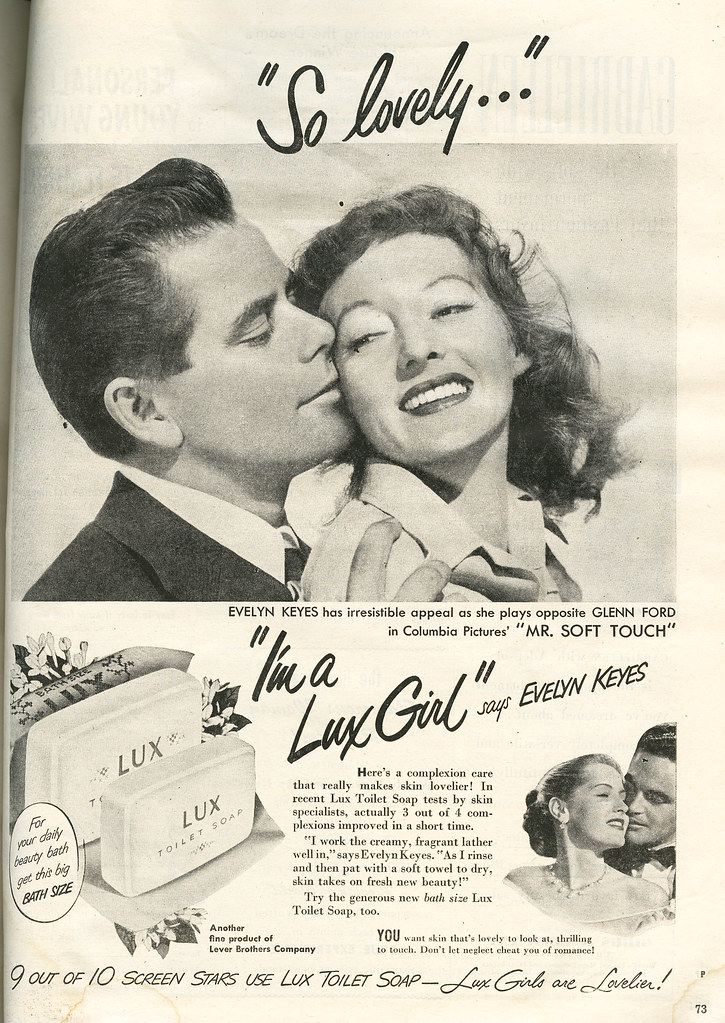
Does it strike anyone else that it's sort of funny that they're using Lux soap to hawk a film called Mr. Soft Touch? How often did that work out so perfectly? Let's see, Betty Grable was hawking The Beautiful Blond from Bashful Bend and Wabash Avenue, June Allyson for High Barbaree, and Judy Garland for Ziegfield Follies. I'm guessing Lux never found a better movie title than Mr. Soft Touch.
*Well, not me personally. I've got a cousin's wife who keeps cranking out enough soap to keep me clean for years to come.





 Posts


