Continuing on our road trip after a pleasant night's sleep at the Travel Lodge, I'm now in search of roadside distractions, I mean attractions. You know, the foolish things people create hoping to get you to stop and part with some cash. The book I posted about the other day, California Crazy, was about buildings made to attract tourists. However now what I'm talking about are simply things, non-functioning things. Often times they make no sense at all.
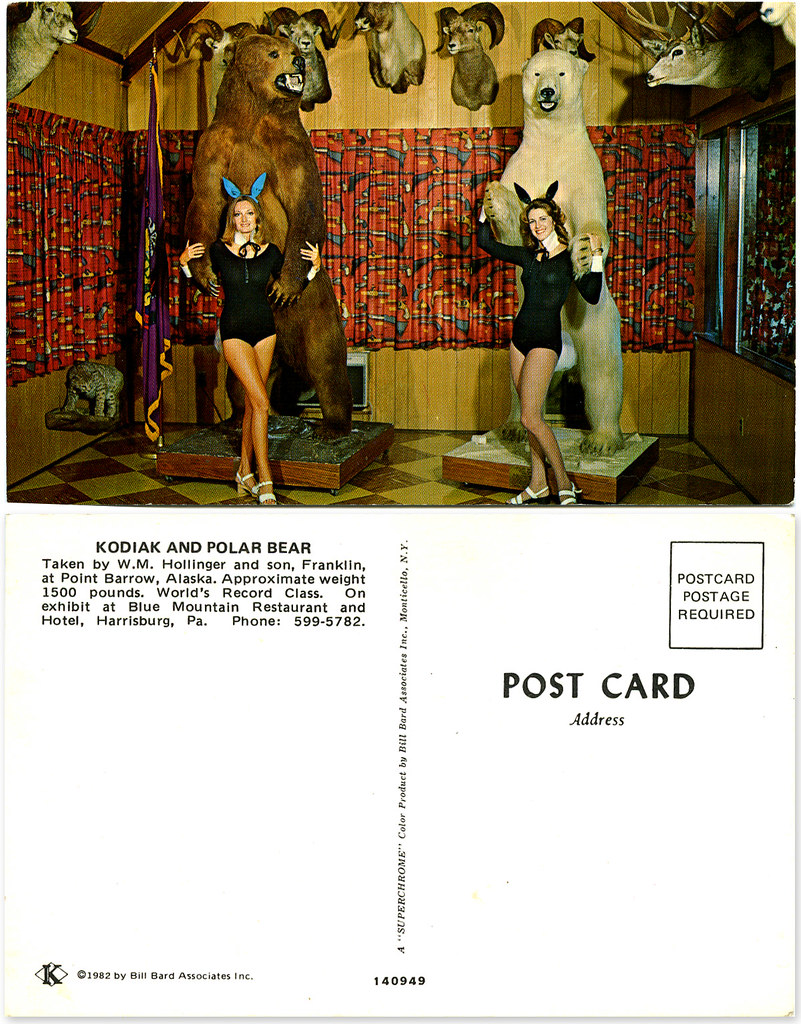
Our first stop is at the Blue Mountain Restaurant and Hotel in Harrisburg, Pennyslvania. It's really hard to explain the tackiness of this post card, and I'm not finding anything online about it. Sometimes ephemera just makes you hit your head against a wall to try and get the image out of your mind.
Click on image to see it larger.
Why were there two dead bears standing in a restaurant in Harrisburg, capitol of the state? Why the flag pole? Did State Representatives come here for lunch so the owner thought they'd add a flag? Was the "decorator" color blind or did they actually think the drapes made the room?Most especially why were there women dressed as cheap versions of Playboy bunnies? Did they wait tables like this? What exactly was the theme of this place? Does it make you feel like the meal is going to be especially memorable, but for all the wrong reasons? If anyone has memories of this place I'd love to hear them.
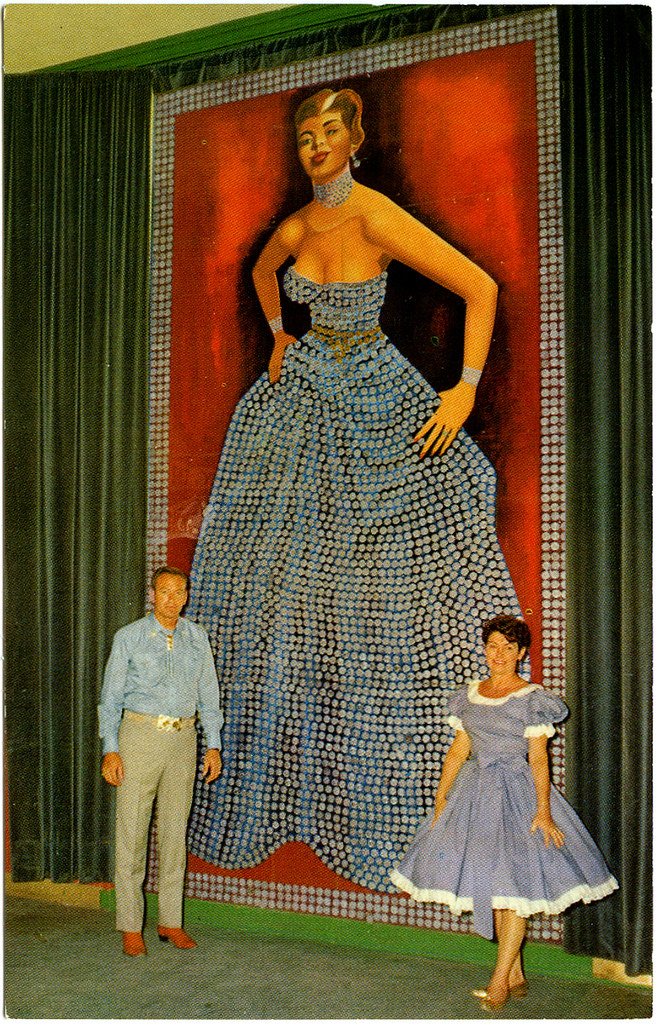
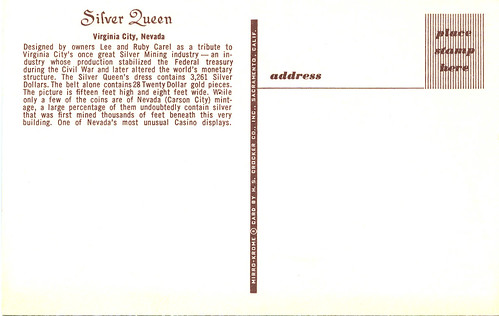
Then we come to Virginia City, Nevada. I've actually seen this Silver Queen in person inside an old western saloon/casino/hotel. You can read on the back of the card all about her. I'm not finding anything else online.
Click on images to see them larger.
Virginia City is well worth a visit. An old silver mining town hanging on the side of a hill. Great main street, great cemetery. But it gets hot. Very hot, so you've been warned.

Virginia City Historic District is a National Historic Landmark encompassing the former mining villages of Virginia City and Gold Hill, both in Storey County, as well as Dayton and Silver City, both to the south in adjacent Lyon County, Nevada, United States. Declared a National Historic Landmark in 1961, it is one of only six in the state of Nevada.
Virginia City was the prototype for future frontier mining boom towns, with its industrialization and urbanization. It owed its success to the 1859 discovery of the Comstock Lode. It is laid out in a grid pattern 1,500 feet below the top of Mount Davidson. Most of the buildings are two to three story brick buildings, with the first floors used for saloons and shops. It was the first silver rush town, and the first to intensely apply large-industrial mining methods.After a year in existence, the boomtown had 42 saloons, 42 stores, 6 restaurants, 3 hotels, and 868 dwellings to house a town residency of 2,345. At its height in 1863, the town had 15,000 residents. From its creation in 1859 to 1875, there were five widespread fires. The 1875 fire, dubbed the Great Fire of 1875, caused $12,000,000 in damages.Today, Virginia City is but a shadow of its former glory, however, it still draws over 2 million visitors per year. In 2004 its condition was considered "threatened". One reason is that an inactive mining pit may cause some of the buildings that make up the historic nature of the district to slide into the pit. The cemeteries are constantly vandalised and are in danger of erosion. Continued use of the district for tourism is harming those historical buildings still in use, and neglect of privately-held unused buildings increases the damage to the district. (SOURCE: Wikipedia)
At one point Mark Twain, Samuel Clemens, lived in Virginia City and wrote for a local newspaper. I remember seeing his old desk in one of the buildings along the main street. So Twain is one of the roadside distractions if you visit this town. I think he'd appreciate that.
If you ever want to read his accounts of his time in Virginia City read Roughing It. I'm stunned to find that Amazon offers virtually nothing but Kindle editions of this book. You can also get it for free as a download from Project Guttenberg. I'd recommend checking through used bookstores. One of my very favorite books. Very very funny!
Twain joined his brother, Orion, who in 1861 had been appointed secretary to James W. Nye, the governor of Nevada Territory, and headed west. Twain and his brother traveled for more than two weeks on a stagecoach across the Great Plains and the Rocky Mountains, visiting the Mormon community in Salt Lake City along the way. These experiences inspired Roughing It, and provided material for The Celebrated Jumping Frog of Calaveras County. Twain's journey ended in the silver-mining town of Virginia City, Nevada, where he became a miner. Twain failed as a miner and found work at a Virginia City newspaper, the Territorial Enterprise.Here he first used his famous pen name. On February 3, 1863, he signed a humorous travel account "Letter From Carson – re: Joe Goodman; party at Gov. Johnson's; music" with "Mark Twain". (SOURCE: Wikipedia)
And since we're so close to Lake Tahoe why not take a visit to the Ponderosa Ranch. Yes, THE Ponderosa of Bonanza fame.
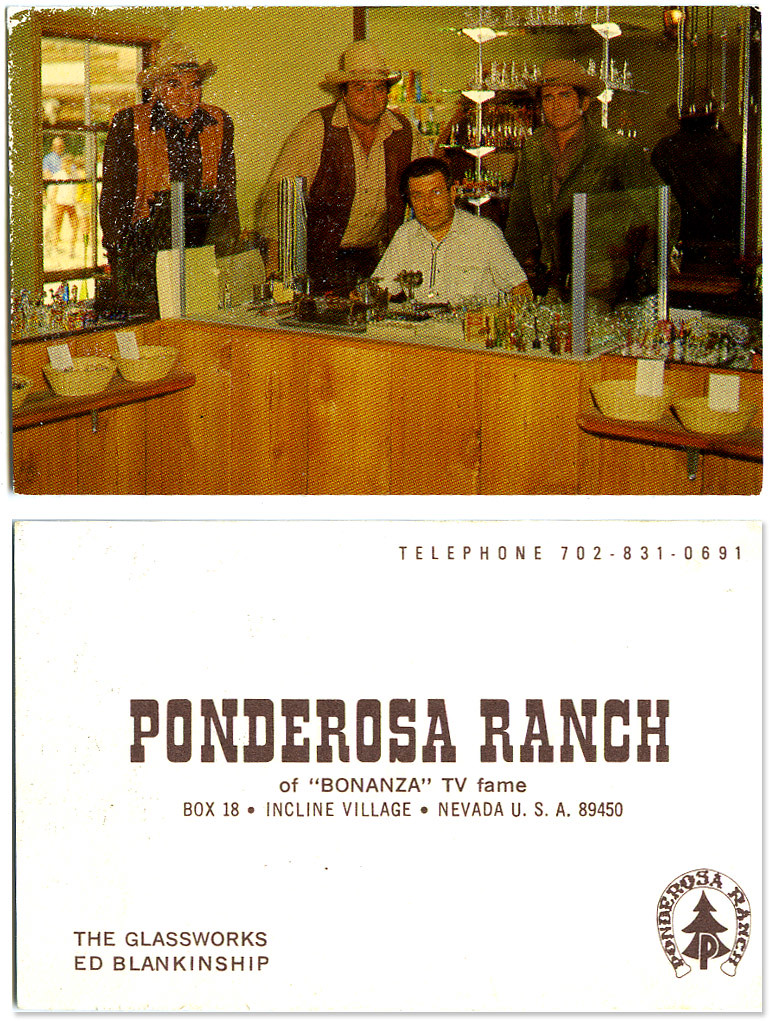
Okay, the majority of the show was shot in L.A. on a sound stage, but in the late 1960s an "amusement" park was built at Incline Village, Lake Tahoe, California. In the summertime it was fun place to visit. It was all fake, but when the show was still being produced you could enjoy walking through a replica of the Cartwright home and walking down the dusty Main Street. Alas, the park is now gone.
The idea for the theme park came about in 1965. Bill and Joyce Anderson owned a small horse ranch, which happened to be located at about the same area as the Ponderosa on the fictional burning map. According to the Andersons, tourists would regularly show up at their gates, asking where the Ponderosa was. Smelling opportunity, the Andersons contacted NBC and Bonanza creator/ producer David Dortort. They proposed turning their small ranch into a theme park. NBC, Dortort, and the cast saw the tie-in as a bonanza for everyone. All parties being in one accord, the cast agreed to promos being shot at the ranch site and the Virginia City set- including the nearby Silver Dollar Saloon- for financial consideration. The ads greatly stimulated revenue for the park.The park opened to the public in 1967, complete with a scale replica of the Cartwright ranch house and barn, similar to the ones seen on TV each week. A replica of Virginia City was later added to the property. The original plan was to open the set to tourists, once filming had wrapped. However, shuttling cast and crew up to Incline Village on a weekly basis became cost-prohibitive. Thus, very few episodes of Bonanza were actually shot there. A majority of ranch-specific scenes were shot on a sound stage at Paramount Studios in Hollywood. Outdoor scenes were filmed on location at nearby Big Bear Lake, Red Rock Canyon, Mojave or eastern Kern County, California. However, Michael Landon, Lorne Greene, Dan Blocker and David Canary often made appearances at the ranch in costume to mingle with fans and sign autographs. Blocker died in 1972. NBC canceled the series the following year. Canary, dressed in character as Candy, made his last visit there in 2002 for a PAX-TV special. Mitch Vogel (Jamie Cartwright) appeared at the ranch for the Travel Channel's "TV Road Trip" in 2002, in which he pitched a behind-the-scenes look at the Ponderosa Ranch and Incline Village. Copies of the "Bonanza Map", autographed by three of the Cartwrights (Pernell Roberts, who had played Adam, left before construction began) were handed out as souvenirs at the ranch for decades afterward, along with tin cups bearing their likenesses.Episodes that were filmed entirely or in part at the ranch, bear a title plate at the end of the credits, indicating such. These episodes are from the 10th season on (1968-73). (SOURCE: Wikipedia)
And yes, I have one of the tin cups and a wall map like the one used in the opening credits.
Well, it's time to head back out onto the road to see what we can find next on our summer trip across the USA.







 Posts
Posts


