Showing posts with label photography. Show all posts

12/8/15

More from HILDEGARD WOODWARD


The following images are, like yesterday, from a book entitled Christmas: A Book of Stories Old and New published by Charles Scribner's Sons. The illustrator is Hildegard Woodward. These are only a sampling of the black and white illustrations throughout, including spot drawings.


And please take a moment to look at my new book Tattered and Lost: Forgotten Dolls.

12/7/15

Christmas with HILDEGARD WOODWARD and FORGOTTEN DOLLS


The following images are from a book entitled Christmas: A Book of Stories Old and New published by Charles Scribner's Sons in 1937. Well, actually I'm not sure when it was published because the copyright page says 1935, but the title page says '37. Perhaps this is a different edition. The anthology was put together by Alice Dalgliesh with illustrations by Hildegard Woodward.

Endsheet


Click on image to see it larger.
Hildegard Woodward was born in Worcester, Massachusetts February 10, 1898. Her parents were Rufus and Stella Woodward. She was educated at the School of the Museum of Fine Arts, Boston and in Paris. She is the author and illustrator of many children's books, two of which were awarded a Caldecott Honor. In 1948 she was recognized for her illustrations of Roger and the Fox written by Lavinia R. Davis and again in 1950 for The Wild Birthday Cake.

In 1953 Woodward painted a mural on the wall of the Center School cafeteria in Brookfield, Connecticut near her residence in Hawleyville.

She began to lose her sight in the 1960, but didn’t stop painting. When she went blind she developed a method of "painting by touch".

Woodward's art was not restricted to children's books; her portfolio includes numerous works of fiction and humor for adults. Although most noted for her watercolor illustrations, she painted in oil and [6] was a children's portrait artist.

Woodward never married or had children. She died in December 1977 in Connecticut. (Source: Wikipedia)
Frontispiece


___________

New book NOW available on Amazon.
Tattered and Lost: Forgotten Dolls

This one is for those who love dolls!

Snapshots from the last 100+ years of children and adults with dolls. Okay, there are a couple of dogs too.

Perfect stocking stuffer for the doll collector on your list!


12/4/15

Tattered and Lost: FORGOTTEN DOLLS


I'm a doll lover/collector from childhood. Eventually I realized there just wasn't going to be enough room for me to continue down this path. That didn't mean I couldn't still collect dolls, I'd just take it in a different direction. The result is my new book Tattered and Lost: Forgotten Dolls.

New book NOW available on Amazon.
Tattered and Lost: Forgotten Dolls

This one is for those who love dolls!

Snapshots from the last 100+ years of children and adults with dolls. Okay, there are a couple of dogs too.

Perfect stocking stuffer for the doll collector on your list!


7/24/09

Living in a PARALLAX PANORAMAGRAM UNIVERSE


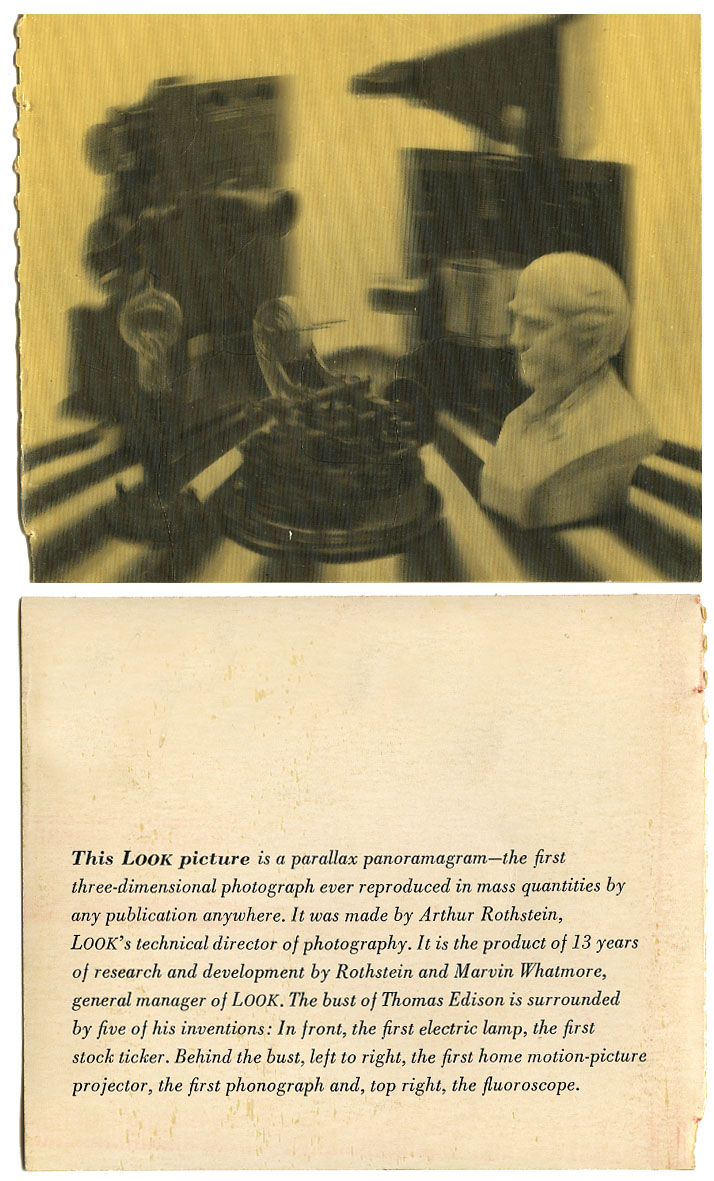
Does anybody remember these? Little cards that were inserted in the back of Look magazine back in the 60s? This first one shows a bust of Edison surrounded by some of his various inventions.

parallax panoramagram_Edison_tatteredandlost
Click on image to see it larger.

Parallax Panoramagram. Rolls off the tongue nicely doesn't it? Okay, when I google it I get bored really fast because of information like this:
Parallax panoramagram having improved depth and sharpness

United States Patent 6850210

Abstract:  A parallax panoramagram has increased depth and sharpness when a sharpness filter is applied after interdigitation of multiple image portions. An optical path of wave train (204) (on-axis) and wave train (205) (off-axis) intersect a single lenticle (201). The lenticle has a focal length (208) and the on-axis (204) and off-axis (205) wave trains correspond to different stripes. These wave trains (204 and 205) comme to focus at points (206 and 207) respectively. The surface (202) has a cylindrical curvature, and bracket (203) denotes the width of the lenticle (201). Each eye of the observer sees its own perspective view when looking at a lenticular stereogram. (SOURCE: http://www.freepatentsonline.com/6850210.html)
I get the basics of what they're talking about, but I just don't care. On the other hand a 1964 issue of Time has the following:
"A LOOK FIRST: 3-D PHOTO," proclaimed the message on the cover. The Parallax Panoramagram "may mark the beginning of a new era in graphic-arts," said the press release. As it turned out, Look's first ran almost last in the magazine. On page 105, just short of the back cover, persevering readers found a stiff, postcard-size appendage, attached in the manner of a subscription renewal card. On the card was a black and white picture that showed a bust of Thomas Alva Edison surround ed by some half-dozen of his inventions. What made most readers stop and look twice was the picture's distinct illusion of depth.

Look's stunt, the result of 13 years' research, constitutes the latest effort to translate the real world of three dimensions into the picture world of two. Artists have employed trompe I'oeil three-dimensional techniques for centuries. But true success for photographers awaited the invention of the stereopticon camera in the 19th century, which took two pictures of the same subject through lenses that were separated like a pair of human eyes. When the viewer saw each picture separately, through separate lenses, his brain automatically supplied the missing dimension of depth.

The Look process is almost identical. A specially designed camera takes pictures through a transparent screen that is serrated to break up the image into hair-thin vertical slices. The camera is then moved slightly to the right or left, as other, sliced-up pictures are taken on the same negative.

The process is laborious, costly and slow, and not yet adaptable to highspeed printing. Merely to pose the static picture in last week's Look took two full days of work with a one-ton, cubical camera as complicated as an electronic computer. Five additional weeks were required to engrave the photograph, print it some 7,000,000 times on a sheet-fed offset press and then pour on and properly shape the clear plastic film that covers the picture with what amounts to a collection of lenses. The plastic lenses are so arranged that the viewer's left eye sees one of the serrated pictures, the right eye sees the other (see diagram).

Look and its partners in the enterprise, Eastman Kodak Co. and Harris-Intertype Corp., which built the equipment that adds the plastic lens coat, have high hopes of commercial success. Cowles Magazines & Broadcasting, Inc., Look's parent company, plans to establish a separate corporation, to be called Visual Panographics Inc., to sell its 3-D process to greeting-card manufacturers, display-art companies and anyone else willing to pay the price in money and time for an unspectacled illusion of depth. (SOURCE: TIME)
I don't know how successful this proved to be for all parties involved because the process does not seem to have become part of our general lexicon for printing processes. I do have some postcards from the mid-to-late 70s that seemed to have improved on the process. And I have a few football player cards from boxes of cereal that were done by Xograph. I'm actually not sure if Xograph was a company or simply the printing process. Britannica describes xograph as: 
three-dimensional printing technique ( in printing (publishing): Three-dimensional printing (1960s) )
...essentially an illustration bearing two views, superimposed, of the same image taken from slightly different angles, on a transparent mount striped with a multitude of imperceptible parallel strips (Xograph process). On account of these strips, each eye, looking at the print from a different angle, sees only one image. (SOURCE: ENCYCLOPÆDIA BRITANNICA)
The poor things haven't actually aged very gracefully. They've yellowed and beneath the surface they have cracked into what looks like puzzle pieces. All still together and you can't really feel the cracks, but they're just below the surface of the plastic. 

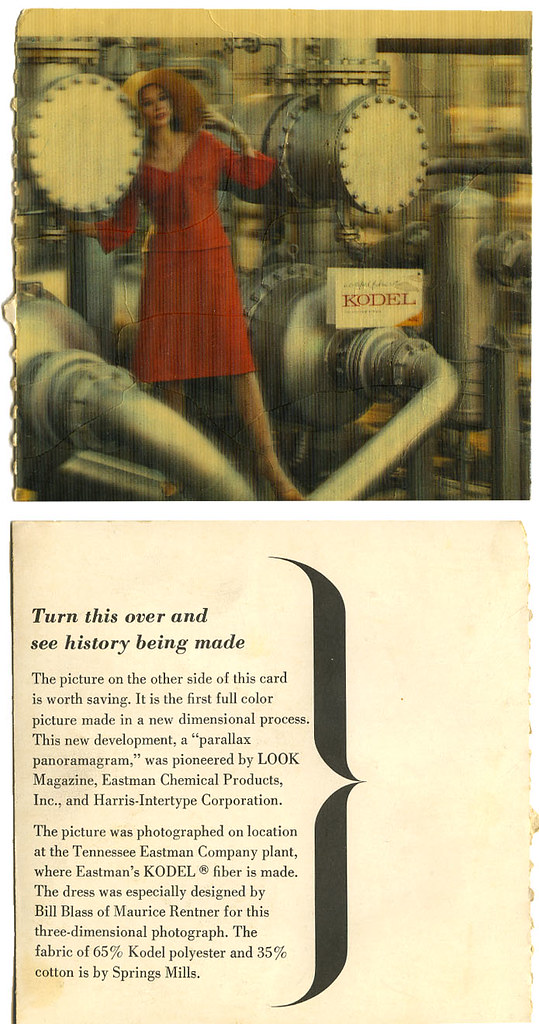
I've always thought this second one especially odd. The woman posing in some sort of industrial plant. I'm just not getting it. I always think of one word...plastics.

parallax panoragagram_Kodel_tatteredandlost
Click on image to see it larger.

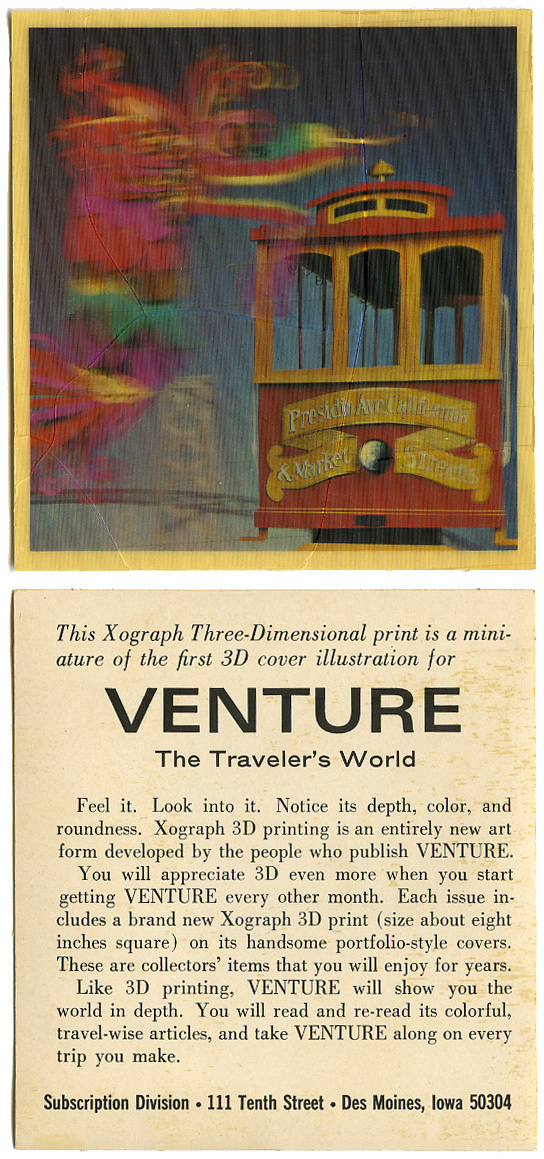
Here's an example of one labeled Xograph.

Xograph Three-Dimensional print_tatteredandlost
Click on image to see it larger.

If anyone knows anything about these I'd be happy to hear from you. Post a comment and let us all know.

UPDATE:  I did find a bit more about this technique online in this book History of Lenticular and Related Autostereoscopic Methods by David E. Roberts (©2003 Leap Technologies, LLC.). At the top of page 12 it states:
"Lenticular techniques showed rapid progress in the 1960's as large corporations recognized its advertising potential. Mass production became a reality on February 15, 1964, when a Look Magazine issue featured the first ink-printed postcard sized "parallax panoramagram". The black and white still life of the bust of Thomas Edison surrounded by some of his more famous inventions required a 1000-pound camera, tracked in a programmed arc, to photograph. The manufacturing process involved printing the image using a 300 line offset press and a special technique for coating and lenticulating a thin layer of plastic on the image at high speed. The process, known as "Xograph" was developed at Eastman Kodak in Tennessee and was credited to Arthur Rothstein and Marvin Whatmore. Over 8 million copies were sold. Look Magazine followed with a color lenticular on April 7, 1964.

With the growth in popularity of lenticular in the 1960's, several companies entered the market including Vari-Vue of New York, which was co-founded  by Victor Anderson, who contributed greatly to the practical commercial success of the product. Vari-Vue, along with companies such as Crowle Communicatons, Hallmark, Toppan ("Top Stereo") and Dai-Nippon of Japan and later Optigraphics ("Optipan" and "Linearoptics") produced a wide variety of products over the next twenty years, including Cracker Jack premiums, Political buttons, 3D baseball cards, postcards, magazine and book covers and point-of-purchase displays.

By the 1980's, as the novelty value of lenticular wore thin, the only significant manufacturer left in the US was Optigraphics who's success was largely the result of the continued expertise of Victor Anderson."
UPDATE: From Debbie Thorne in 2013:
I found your site when trying to do something special with all my fathers negatives, black and white photos and slides that he has collected from his travels as a photographer for Look and Venture magazines. i was excited to see his 3 d photos on your site. Our family has albums of the 3 d pictures. I also watched my dad shoot many 3d pictures at the look magazine building on madison ave in nyc. Then the studio in Arlington, texas. He would create a shadow box for some pictures where he would cut out the models or items they were advertising. The camera was very large and it would move slowly to shoot a blurred image and then my father would design a plastic coating to give the photo the 3d effect. I have a very large mac tonight picture he did for Mc donalds hamburger in the late 60's or early 70' My fathers boss and a friend was Arthur Rothstein. They worked for look and venture until spring of 1973. Victor Anderson was one of the men at opticgraphics.