
Showing posts with label nasa. Show all posts

7/2/13

MOTEL hopping: Van Horn, Texas


The address for this card of the Western Lodge Motel in Van Horn, Texas, is so confusing that there's no way I can find where it is or was. Many of the highways listed on the back simply don't seem to exist anymore. So we really don't know whether we should unpack or not. I'm guessing we'll keep driving.


Click on images to see them larger.

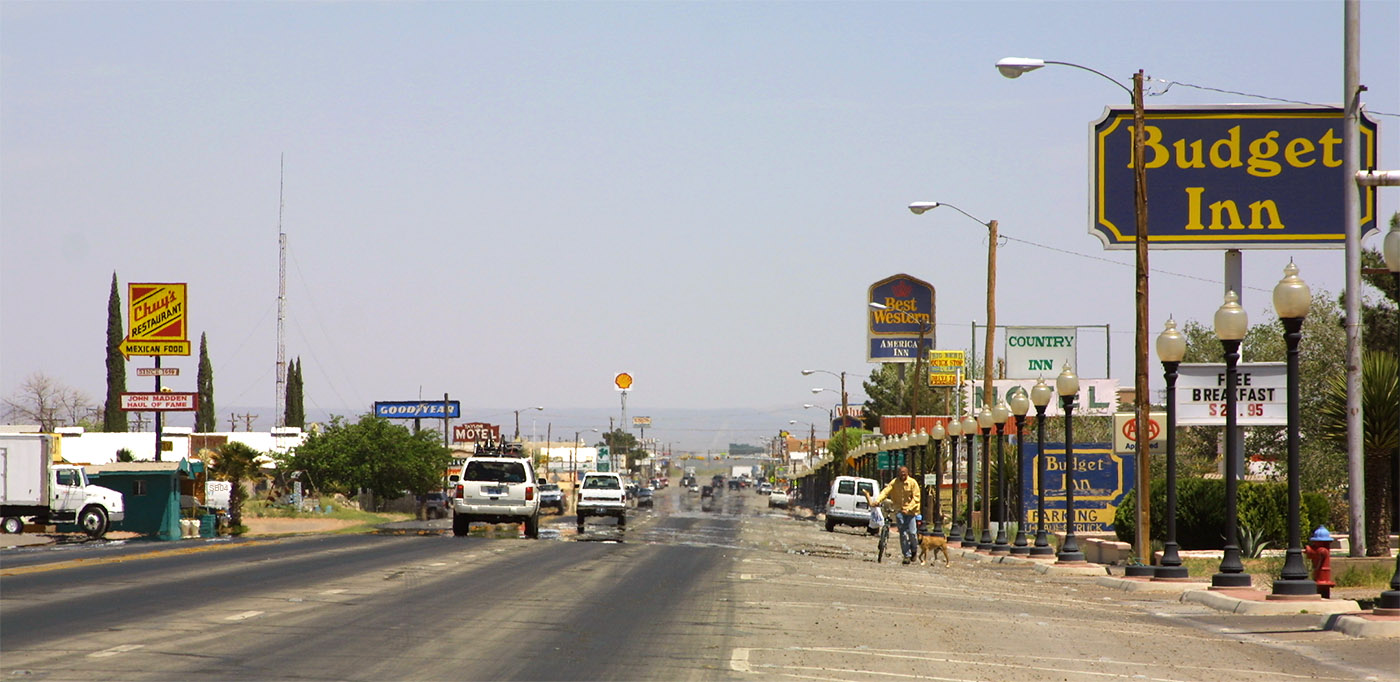
Apparently this is the main drag in Van Horn. I do see another Best Western, but it is not called the Western Lodge.
(SOURCE: Wikipedia)  Click on image to see it larger.

This strip reminds me of so many towns I remember from my childhood. My father driving, my mother with the AAA guide, and me in the backseat with the dog, my doll, and pillow.

Some towns just seemed to be a few miles of gas stations and motels. There were no houses. My mother might have a place picked out, but once we saw it and my parents passed judgement we might pass it by with my dad saying, "What's the next town?" sending my mother back to the AAA trip-tick and guide book.

I always enjoyed when we headed to "the next town" because it usually meant we'd arrive after the sun went down meaning I'd get to see all the neon motel signs. Then, too exhausted to drive any further, my dad would say, "I don't care what it looks like. I'm stopping." And so my mother and I would sit in the car while my dad went into the office. By then I was ready for bed, most likely already in my pjs, having changed while we were driving. My dad would come out of the office and my mother would say, "Did you ask if they take dogs?" And usually my dad would say, "No." End of discussion.

Now, I have no idea if Mr. and Mrs. Evans Burnett or Mr. and Mrs. A. A. Brune allowed dogs, but, looking at the surrounding territory in which Van Horn, Texas sits, I'm thinking the "refrigerated air" was most welcome.

Click on image to see it larger.
Surely I don't want you coming away thinking Van Horn is just a dry spot in a bigger dry spot. Van Horn is part of the space race, such as it is.
Space Tourism
In late 2006, the Wall Street Journal reported that Jeff Bezos, founder and CEO of amazon.com, had acquired 290,000 acres (1,200 km2) of land 25 miles (40 km) north of Van Horn to house his fledgling space tourism company, Blue Origin. As of 2008, Blue Origin had been expected to start commercial operations as early as 2010, aiming for 52 launches per year from the Van Horn, Texas facility. As of March 2010 however, Blue Origin and Bezos "have been very secretive about" the plans for the Van Horn facility for the past five years, having granted no interviews with news media since a single interview with the Van Horn Advocate in early 2005. 
In early 2010, NASA awarded Blue Origin US$3.7 million to work on an advanced technology, which detaches a crew cabin from its launcher if the shuttle malfunctions."[14]

10,000 Year Clock
In 2009 the The Van Horn Advocate announced that the Long Now Foundation was starting geologic testing for an underground space to house a 10,000 Year Clock of the Long Now, on the Bezos ranch, north of Van Horn.
Well there you go then. Learn something new every single day.

And one more thing...why would someone call a motel a "lodge motel?" I mean, it's not really a lodge. It's a motel. I know, a lodge sounds a bit more homey, but it's rather deceptive, don't you think?

4/17/12

DEFENDERS OF AMERICA from National Biscuit Company: U. S. ARMY MOHAWK TURBO-PROP AIRPLANE


This is card number 23 in the National Biscuit Company's (Nabisco) 1959 trading card series, Defenders of America. As I've said before, I do not have the complete series, just a few random cards.


Click on either image to see it larger.

The Grumman OV-1 Mohawk is an armed military observation and attack aircraft, designed for battlefield surveillance and light strike capabilities. It is of twin turboprop configuration, and carried two crew members with side by side seating. The Mohawk was intended to operate from short, unimproved runways in support of United States Army maneuver forces

Development
The Mohawk began as a joint Army-Marine program through the then-Navy Bureau of Aeronautics (BuAer), for an observation/attack plane that would outperform the Cessna L-19 Bird Dog. In June 1956, the Army issued Type Specificationn TS145, which called for the development and procurement of a two-seat, twin turboprop aircraft designed to operate from small, unimproved fields under all weather conditions. It would be faster, with greater firepower, and heavier armour than the Bird Dog, which had proved vulnerable during the Korean War. The Mohawk's mission would include observation, artillery spotting, air control, emergency resupply, naval target spotting, liaison, and radiological monitoring. The Navy specified that the aircraft must be capable of operating from small "jeep" escort class carriers (CVEs). The DoD selected Grumman Aircraft Corporation's G-134 design as the winner of the competition in 1957. Marine requirements contributed an unusual feature to the design. As originally proposed, the OF-1 could be fitted with water skis that would allow the aircraft to land at sea and taxi to island beaches at 20 kts. Since the Marines were authorized to operate fixed wing aircraft in the close air support (CAS) role, the mockup also featured underwing pylons for rockets, bombs, and other stores.
The Air Force did not like the armament capability of the Mohawk and tried to get it removed. The Marines did not want the sophisticated sensors the Army wanted, so when their Navy sponsors opted to buy a fleet oil tanker, they dropped from the program. The Army continued with armed Mohawks and developed cargo pods that could be dropped from underwing hard points to resupply troops in emergencies.
The radar imaging capability of the Mohawk was to prove a significant advance in both peace and war. The SLAR could look through foliage and map terrain, presenting the observer with a film image of the earth below only minutes after the area was scanned. In military operations, the image was split in two parts, one showing fixed terrain features, the other spotting moving targets.
The prototype (YAO-1AF) first flew on April 14, 1959. The OV-1 entered production in October 1959.

General characteristics
  • Crew: Two: pilot, observer
  • Length: 41 ft 0 in (12.50 m)
  • Wingspan: 48 ft 0 in (14.63 m)
  • Height: 12 ft 8 in (3.86 m)
  • Wing area: 360 ft² (33.45 m²)
  • Empty weight: 12,054 lb (5,467 kg)
  • Loaded weight: 15,544 lb (7,051 kg) (Normal take-off weight, IR mission)
  • Max. takeoff weight: 18,109 lb (8,214 kg) (SLAR mission)
  • Powerplant: 2 × Lycoming T53-L-701 turboprops, 1,400 shp (1,044 kW) each
Performance
  • Never exceed speed: 450 mph (390 knots, 724 km/h)
  • Maximum speed: 305 mph (265 knots, 491 km/h) at 10,000 ft (3,050 m) (IR mission)
  • Cruise speed: 207 mph (180 knots, 334 km/h) (econ cruise)
  • Stall speed: 84 mph (73 knots, 135 km/h)
  • Range: 944 mi (820 nmi, 1,520 km) (SLAR mission)
  • Service ceiling:
  • 25,000 ft (7,620 m)
  • Rate of climb:
  • 3,450 ft/min (17.5 m/s)

(SOURCE: Wikipedia)


Next time...U. S. Army Hawk Missile

4/14/12

DEFENDERS OF AMERICA from National Biscuit Company: X-15 ROCKET POWERED RESEARCH PLANE


Before you read about the X-15 I wanted to let you know you can see several vintage snapshots my father took of seaplanes in the late 1940s and early 50s by visiting my other site, Tattered and Lost Photographs.

And now...the X-15, courtesy of the National Biscuit Company late 1950s trading cards.


Click on either image to see it larger.
The North American X-15 was a rocket-powered aircraft operated by the United States Air Force and the National Aeronautics and Space Administration (NASA) as part of the X-plane series of experimental aircraft. The X-15 set speed and altitude records in the early 1960s, reaching the edge of outer space and returning with valuable data used in aircraft and spacecraft design. As of 2012, the X-15 holds the official world record for the fastest speed ever reached by a manned rocket-powered aircraft.
During the X-15 program, 13 different flights by eight pilots met the USAF spaceflight criteria by exceeding the altitude of 50 miles (80 km) thus qualifying the pilots for astronaut status. The USAF pilots qualified for USAF astronaut wings, while the civilian pilots were awarded NASA astronaut wings in 2005, 35 years after the last X-15 flight.
Of all the X-15 missions, two flights (by the same pilot) qualified as space flights per the international (Fédération Aéronautique Internationale) definition of a spaceflight by exceeding 100 kilometers (62.1 mi, 328,084 ft) in altitude.

General Characteristic
  • Crew: one
  • Length: 50 ft 9 in (15.45 m)
  • Wingspan: 22 ft 4 in (6.8 m)
  • Height: 13 ft 6 in (4.12 m)
  • Wing area: 200 ft2 (18.6 m2)
  • Empty weight: 14,600 lb (6,620 kg)
  • Loaded weight: 34,000 lb (15,420 kg)
  • Max. takeoff weight: 34,000 lb (15,420 kg)
  • Powerplant: 1 × Thiokol XLR99-RM-2 liquid-fuel rocket engine, 70,400 lbf at 30 km (313 kN)

Performance
  • Maximum speed: Mach 6.72 (4,520 mph, 7,274 km/h)
  • Range: 280 mi (450 km)
  • Service ceiling: 67 mi (108 km, 354,330 ft)
  • Rate of climb: 60,000 ft/min (18,288 m/min)
  • Wing loading: 170 lb/ft2 (829 kg/m2)
  • Thrust/weight: 2.07


(SOURCE: Wikipedia)

Next time...U. S. Army Mohawk Turbo-Prop Airplane