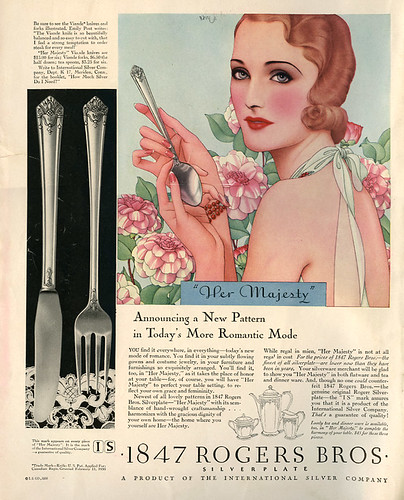
Wish I had something clever to say but my mind is runnin' on empty. Okay, it's specifically running on Ambien which I stupidly took too soon which now has me wondering if I'll actually even take the muscle relaxant for the dislocated jaw. Oh whatever. Let's all pretend we're this lovely lady with the come hither eyes. Probably lived on Park Avenue and only knew about the Depression when her car drove quickly by the people standing in food lines. I'm being mean. She was probably a nice lady...just like the wives of the Wall Street honchos with the humongous gross out bonuses. Oh it's time for me to hit the sack. My cursor is starting to look like a little bug on the screen and soon I'll be down the hall spreading Nutella on a tortilla and then completely forgetting about it until I wake up the next morning and find chocolate on my toothbrush. Ambien...a dangerous dance with the pharmaceutical devil.
But back to this lady. Ummmmmmmmm...I know nothing other than she was illustrated by Dynevor Rhys. I posted two more of his illustrations back in October.

Click on image to see it larger. (Source: Delineator, December 1931)
Talk amongst yourselves. Today's discussion is on the NRA. NO not that one. Not the one that thinks people should have a gun in each pot and four semi-autmatics loaded under the bed just in case a deer walks by. No this is the National Recovery Act and how desperately do we need one now? You can see the eagle logo in the lower left portion of the cover. Here's a bit of history about the logo:
The Blue Eagle, a blue-colored representation of the American "thunderbird," with outspread wings, was a symbol used in the United States by companies to show compliance with the National Industrial Recovery Act. It was proclaimed on July 20, 1933, as the symbol of industrial recovery by Hugh Samuel Johnson, the head of the National Recovery Administration.The design was sketched by Johnson, and based on an idea utilized by the War Industries Board during World War I.All companies that accepted President Franklin D. Roosevelt's Re-employment Agreement or a special Code of Fair Competition were permitted to display a poster showing the Blue Eagle together with the announcement, "NRA Member. We Do Our Part." Consumers were exhorted to buy products and services only from companies displaying the Blue Eagle banner. According to Johnson, "When every American housewife understands that the Blue Eagle on everything that she permits into her home is a symbol of its restoration to security, may God have mercy on the man or group of men who attempt to trifle with this bird."On September 5, 1935, following the invalidation of the compulsory code system, the emblem was abolished and its future use as a symbol was prohibited. (Source: Wikipedia)
UPDATE: Wow I figured this would be bad when I looked at it this morning but not that bad. This is what happens when you mix a piece of fudge at bedtime and an Ambien. Above is the cleaned up version. My best friend alerted me to my stupidity. Sistee Lister indeed!




 Posts


