Showing posts with label Bert's collection. Show all posts

3/19/11

Artist CHRIS JORGENSEN and Bert's mother


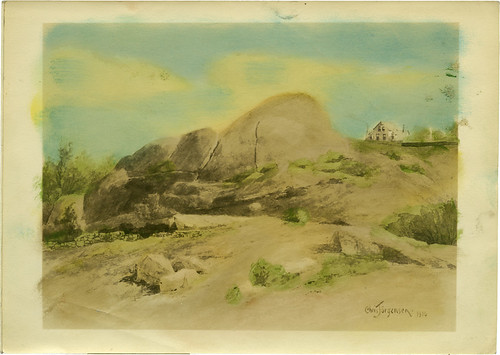
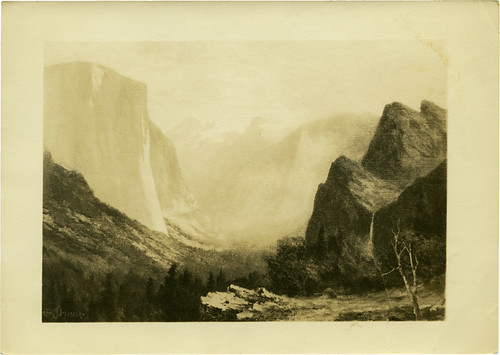
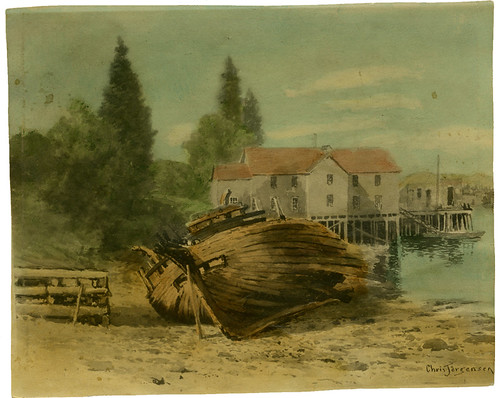
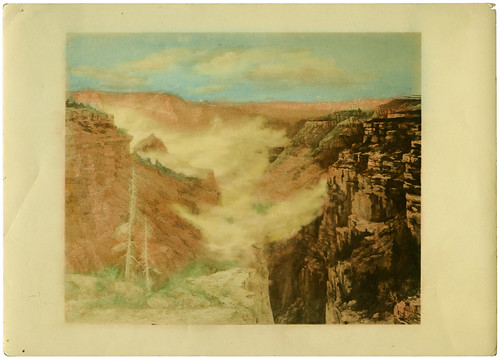
Hand-coloring images with oil paints used to be quite a hobby before color film was readily available. I've seen many old photos that were colored with oils, but had never seen images like these.

These were given to me by my friend Bert. All belonged to his mother. She is the one who added the coloring. He gave me a small stack of images, some she'd colored, some she'd started, and others still awaiting her artistic hand. Images could be purchased, I'm imagining, specifically for this hobby. There are several different artists represented in the small stack Bert gave me.
Norway_Chris Jorgensen_tatteredandlost

Grand Canyon_tatteredandlost

Christ Jorgensen_1916_tatteredandlost

Yosemite Valley_Chris Jorgensen_tatteredandlost

The artist for all of these images was Chris Jorgensen.
CHRIS JORGENSEN
1860-1935

Chris Jorgensen was born in Oslo, Norway, in 1860. At the age of ten years he came to America making California his home. He was interested in drawing and painting from earliest childhood and was the first student to enroll in the California School of Fine Arts organized in San Francisco in 1874. From 1881 to 1883 he was assistant director of the school. In his sketch class was Angela Ghirardelli, a young society girl of San Francisco, a gifted pupil and art critic. Jorgensen’s picture, “Along the Wharfs,” had hung on the wall of the school for some time. Angela admired it and appraised it highly. It was exhibited by the Art School in 1882 and immediately sold. Angela felt the loss of the picture so keenly that Jorgensen recovered it from the purchaser and presented it to his pupil. The following year Chris Jorgensen and Angela Ghirardelli were married. There followed more than half a century of rare companionship. Two children, a son and daughter, completed the family circle.


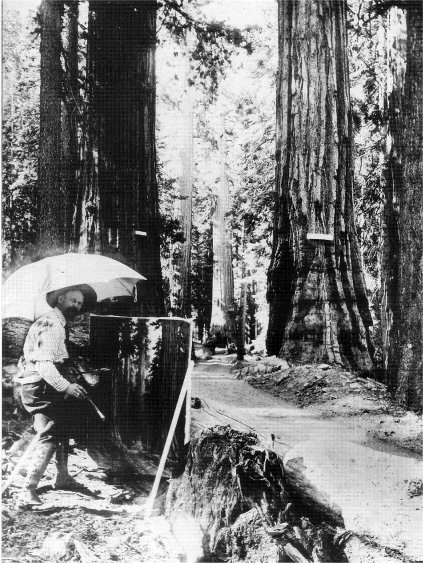
Chris Jorgensen painting Wawona Tunnel Tree


In 1892 Mr. and Mrs. Jorgensen went to Italy, the homeland of Angela Ghirardelli, where they spent two years with Italy’s great artists. Shortly after returning Jorgensen built a studio home in Yosemite, for which he drew the plan and did much of the labor of building. The panel over the fire-place—a study of heads —was the work of Mrs. Jorgensen. The artist made all the furniture in this studio home. Mr. Jorgensen says of this home: “The studio proper is a room twenty-four feet square and is always open during the summer for friend or stranger. The big, broad porch of our cottage—ten feet in width—is a main lounging place and it is here that most of the social life goes on.” This studio he used for twenty years. It was here that he began his painting of Yosemite scenes, most of which canvases were sold from the studio. Among these were “Yosemite in the Winter,” “Cathedral Spires,” and “Happy Isles.” Other noted pictures of this period are “Mount Lyell at Sunset,” “Big Trees,” and the entire “Yosemite Valley,” the canvas needed for this painting was so large that it was taken to the point of view on a truck
and here the artist did his work.


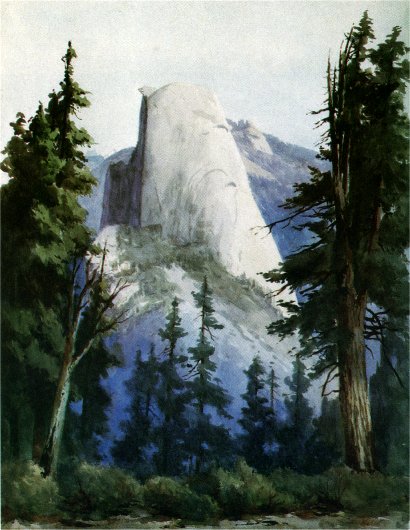
Half Dome from Washburn Point Area.
Watercolor by Christian Jorgensen


Chris Jorgensen had a deep feeling for the old missions which he expressed on canvases. When in 1905 he built a studio home at Carmel-by-the-Sea he painted the Carmel Mission for the panel above the fire-place. He also built a bungalow at Pebble Beach. His home on the Piedmont Hills, surrounded by trees and shrubs and winding ways, was an artist’s home built for the family; for artist friends; for the social life of the son and daughter and their friends; it was built to meet the unlimited hospitality which characterized both Mr. and Mrs. Jorgensen. It was a rambling house of many rooms in each of which a picture from nature in its changing moods was framed in.

Chris Jorgensen had a studio home in his beloved San Francisco where he was also a member of the Bohemian Club and where his pictures were frequently exhibited. His canvases are many and will live for their portrayal of mountain grandeur; of boisterous waters; of quiet meadows; of by-gone mission days; of fishermen and wharves. One great picture will live in history. This canvas is the expression of the artist’s love and distress for the city that fell in April, 1906. It bears the title “San Francisco in Ruins.”

In Galen Clark’s book, Yosemite Indians, published in 1904, are four drawings by Chris Jorgensen. The cover design and the drawing of a “Chuck'-ah” are by Mrs. Jorgensen. Jorgensen’s portrait of Galen Clark, etched on a slab of red-wood, has, for many years hung in the Yosemite Museum and is much admired.

Chris Jorgensen died at his Piedmont studio after a brief illness on June 25, 1935. Only a few months later, in February, 1936, Mrs. Jorgensen died. The recaptured picture, “Along the Wharves,” was still hanging on the wall of her room, a precious token of girlhood days. The son, Virgil Jorgensen, is the only survivor, the daughter having died some years ago.

By the will of Mrs. Jorgensen many of her husband’s paintings are bequeathed to the United States Government for exhibit at the Yosemite Museum. (SOURCE: Pioneer Yosemite History Center)
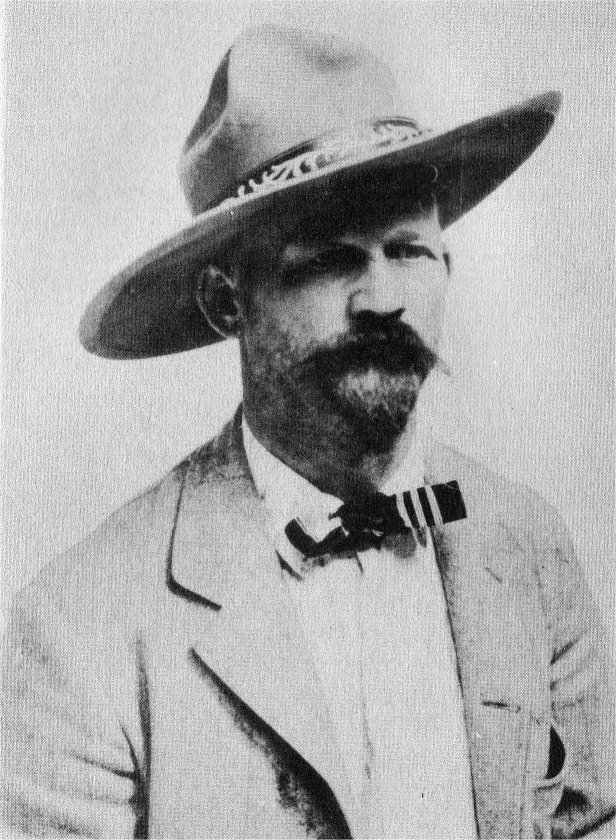
If it hadn't been for Bert's mother I might have never known about this artist.

Click here to see paintings by Jorgensen of California Missions.

Click here and here to see Jorgensen's cabin in Yosemite.

And click here to see some illustrations done by Jorgensen for a book entitled Indians of the Yosemite.

UPDATE: For those who live or will be visiting Northern California and are interested in seeing a series of very nice paintings done by Jorgensen of the California Missions, make sure to visit the mission in the town of Sonoma. An entire room filled with beautiful paintings.

2/26/11

Let's form a SWEET POTATO BAND!


Okay folks...
Let's put on a show! You bring your sweet potato and I'll bring mine!
or for the more refined folks visiting here...
Let us consider performing this evening for a few of our really smart chums. You bring your ocarina and I'll bring mine.
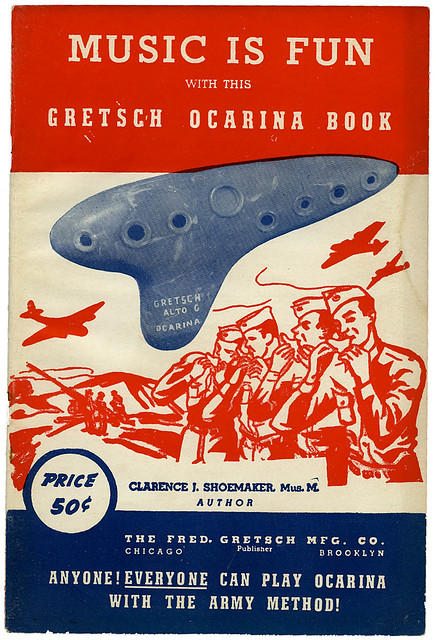
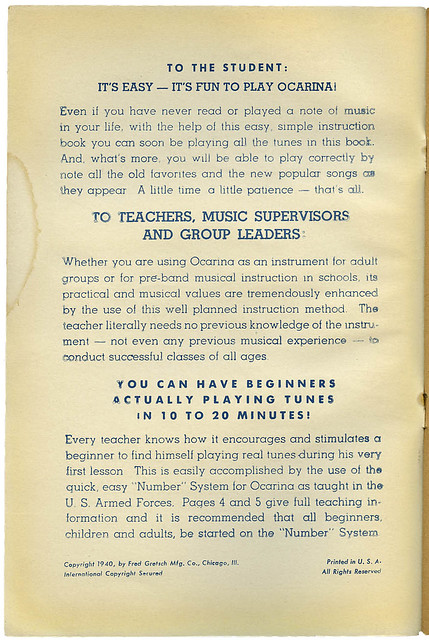
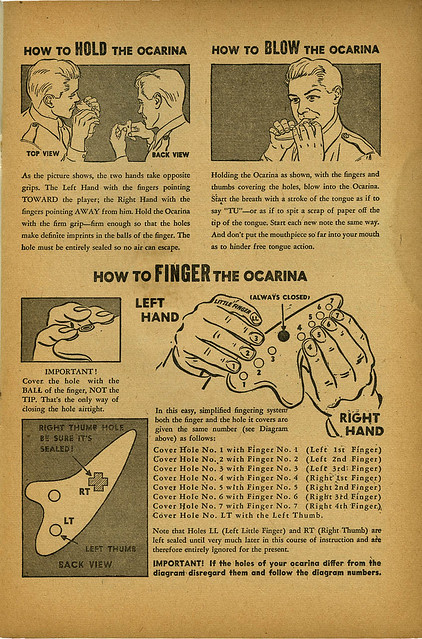
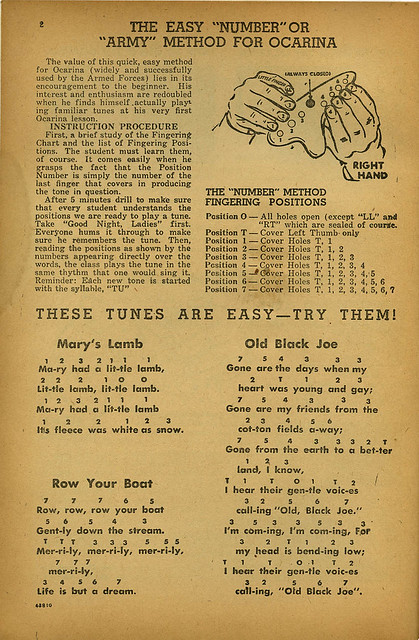
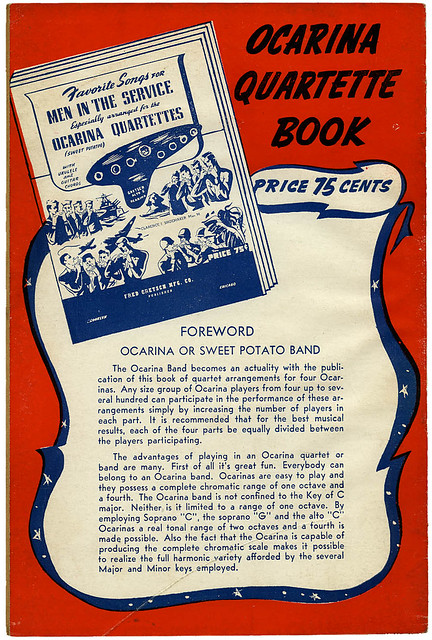
This book, Music Is Fun with this Gretsch Ocarina Book, dates back to 1940, pre-war. I'm wondering if it actually became popular, as this book hoped, for service men to form ocarina bands. I would like to hear that. This is another dandy from Bert's collection

Click on any image to see it larger.

Ocarina_FT_tatteredandlost

Ocarina_1_tatteredandlost

Ocarina_2_tatteredandlost

Ocarina_3_tatteredandlost

Ocarina_BK_tatteredandlost

I guess you could say this is another "raise your hand" post. Who remembers sweet potatoes when you were a kid. (No, not those things in the bowl with the melted marshmallows on top.) I remember someone having one made out of plastic. Maybe I owned it, I don't know. I do still have my kazoo, but that's a whole other story.

For your listening pleasure I give you some faux ocarina playing by Hope and Crosby. The sound is true ocarina, but they aren't playing it.

2/25/11

It's HAPPINESS BOYS FRIDAY!


Have you got your ukulele in tune? Well sit down and do it now before you read any further.

There’s a reason I’m calling this Happiness Boys Friday. You won’t have a difficult time figuring it out.

Happiness Boys_cover_tatteredandlost

Happiness Boys_inside cover_tatteredandlost

Happiness Boys_title pg_tatterdandlost

Happiness Boys_back_tatteredandlost
Click on any image to see it larger.

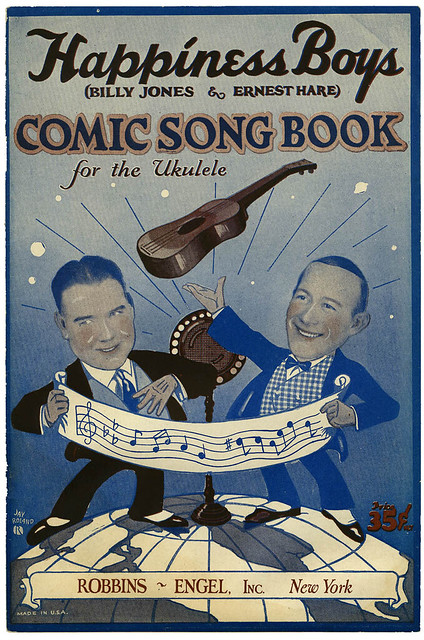
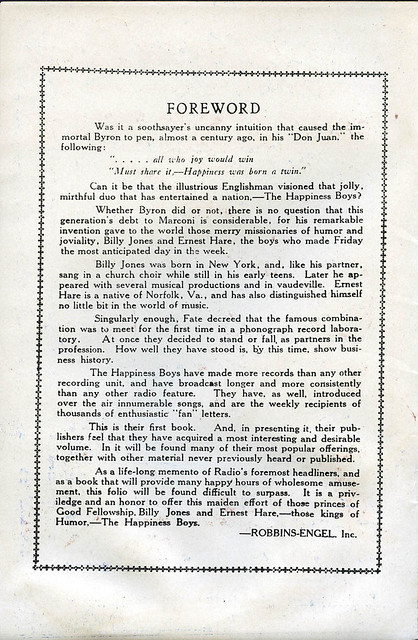
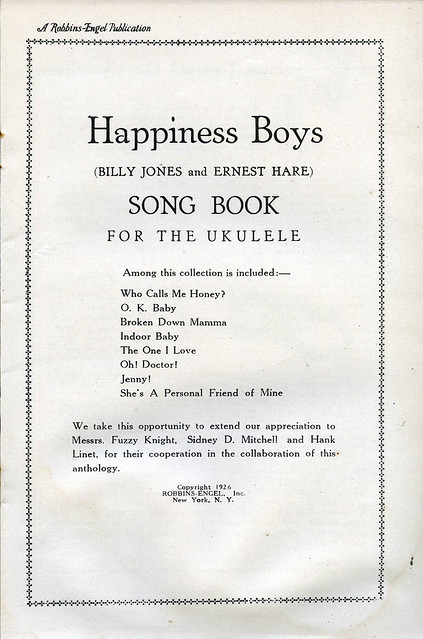
This song book is from the big box of sheet music Bert gave me. It dates from 1926. I’d never heard of these fellows, but I’m stunned I know one of the songs they were known for.

So who were the Happiness Boys (aka The Taystee Loafers and The Interwoven Pair)? According to Wikipedia:
The Happiness Boys was a popular radio program of the early 1920s. It featured the vocal duo of tenor Billy Jones (1889-1940) and bass/baritone Ernie Hare (1881-1939) who sang novelty songs.

Career
Jones and Hare were already established as soloists on phonograph records. One of Jones's better solos was "Mary Lou," while Hare scored with the Yuletide novelty "Santa Claus Hides in the Phonograph." In 1920 recording executive Gus Haenschen had them sing an accompaniment on a Brunswick recording. They went on to do numerous recordings for Brunswick Records, Edison, and other companies. Similarities between the two singers were often noted: same height, same weight, birthdays a few days apart.

They began on radio October 18, 1921 on WJZ (Newark, New Jersey), where they were sponsored by the chain of Happiness Candy stores. Listeners mailed in their comments about the singers on cards supplied to retailers by Happiness Candy.

Beginning August 22, 1923, the Happiness Boys broadcast on New York's WEAF, moving to NBC from a run from 1926 to 1929.

By 1928, Jones and Hare were the highest paid singers in radio, earning $1,250 a week. They also made highly successful personal appearances in the United States and Europe.

The partnership ended with Ernie Hare's death on March 9, 1939. Hare's 16-year-old daughter, Marilyn Hare, joined Jones at the microphone, allowing the act to continue as "Jones and Hare" until Jones's death on November 23, 1940. (SOURCE: Wikipedia)
Want a sample? You sure?


Here are the words to two of their catchy tunes included in this book:
Broken Down Mamma

Broken Down Mamma
Broken Down Mamma
Quit your tormenting me
Broken Down Mamma
You’re as sassy as can be,
Go on an’ take yo’body on a big long trip
Your daddy’s done found some brand new lip
Broken Down Mamma
You’re just a broken mamma to me.


Indoor Baby

She’s what you call an Indoor Baby
She’s awfully fond of indoor sports
She’s more proficient at parlor games
Than on the links or tennis courts
Two loving arms,
Two lips and two eyes
She’ll challenge any boy
Who likes that kind of exercise.
She’s is not the kind who can ride, swim or climb
But she’s an Indoor Baby all the time.
Wouldn't you like to hear these?

You might now be wondering which song of their’s is now running through my head? Okay, so you’re probably not wondering, but I’ll tell you anyway. It's "Does Your Chewing Gum Lose Its Flavor on the Bedpost Overnight?” Raise your hand if you remember it. And what was the catchy chorus? Take a listen to this version by Lonnie Donegan and if you’re of a certain age you’ll probably remember singing along when you were a kid.

11/17/10

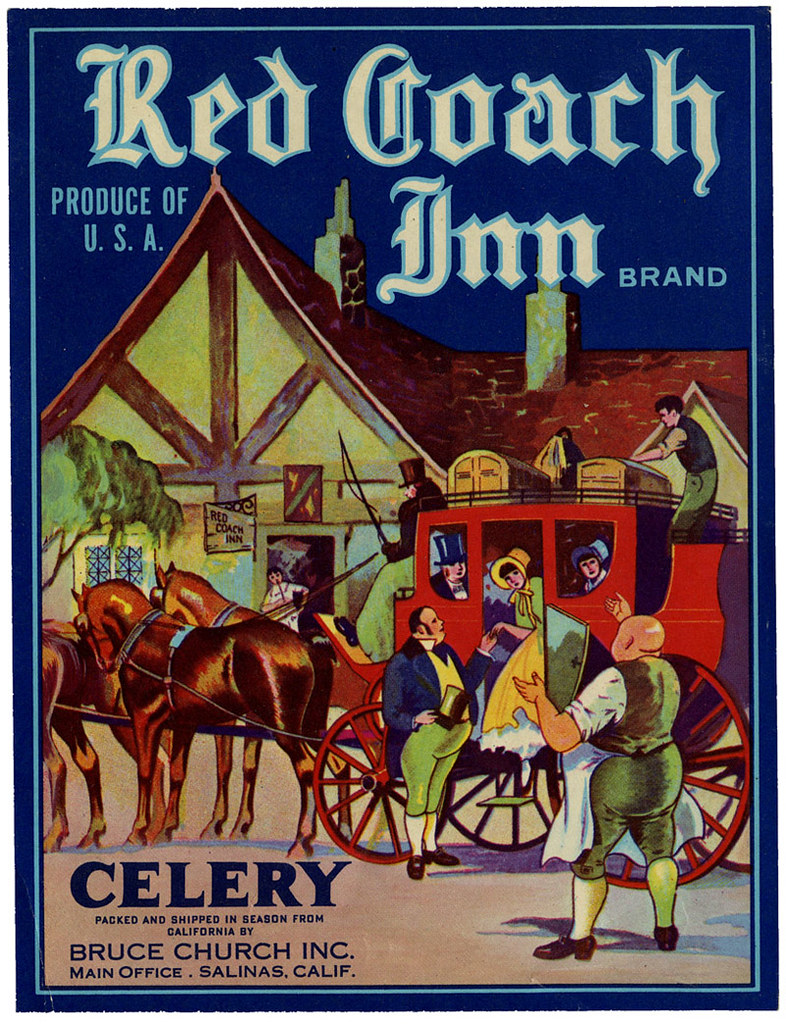
RED COACH INN Label


I've posted some fruit labels in the past and have said if you're looking for something fun, colorful, easy to store, and relatively inexpensive to collect keep fruit and vegetable labels in mind.

This particular label comes from Bert's collection.

Red Coach Inn_tatteredandlost
Click on image to see it larger.

My first thought when looking at it is how easy it would be to revise it and make it into an image for a holiday greeting card. Mentally that was about as far as I got.

I then began a Google search and found the label for sale at various sites. Okay, fine and dandy, but that didn't give me any information. Then I typed in "Bruce Church Inc." and stumbled upon this:
THE DEATH OF CESAR CHAVEZ

Cesar Estrada Chavez died peacefully in his sleep on April 23, 1993 near Yuma, Arizona, a short distance from the small family farm in the Gila River Valley where he was born more than 66 years before.

The founder and president of the United Farm Workers of America, AFL-CIO was in Yuma helping UFW attorneys defend the union against a lawsuit brought by Bruce Church Inc., a giant Salinas, Calif.-based lettuce and vegetable producer. Church demanded that the farm workers pay millions of dollars in damages resulting from a UFW boycott of its lettuce during the 1980's. Rather than bring the legal action in a state where the boycott actually took place, such as California or New York, Church "shopped around" for a friendly court in conservative, agribusiness-dominated Arizona-where there had been no boycott activity.

"Cesar gave his last ounce of strength defending the farm workers in this case," stated his successor, UFW President Arturo Rodriguez, who was with him in Arizona during the trial. He died standing up for their First Amendment right to speak out for themselves. He believed in his heart that the farm workers were right in boycotting Bruce Church Inc. lettuce during the l980's and he was determined to prove that in court." (When the second multimillion dollar judgement for Church was later thrown out by an appeal's court, the company signed a UFW contract in May 1996.

After the trial recessed at about 3 p.m. on Thursday, April 22, Cesar spent part of the afternoon driving through Latino neighborhoods in Yuma that he knew as a child. Many Chavezes still live in the area.

He arrived about 6 p.m. in San Luis, Arizona-about 20 miles from Yuma, at the modest concrete-block home of Dofla Maria Hau, a former farm worker and longtime friend. Cesar and eight other UFW leaders and staff were staying at her house in a poor farm worker neighborhood not far from the Mexican border.

Cesar ate dinner at around 9 p.m. and presided over a brief meeting to review the day's events. He had just finished two days of often grueling examination by attorneys for Bruce Church Inc.

He talked to his colleagues about taking care of themselves-a recent recurring theme with Cesar because he was well aware of the long hours required from him and other union officers and staff. Still, he was in good spirits despite being exhausted after prolonged questioning on the witness stand; he complained about feeling some weakness when doing his evening exercises.

The UFW founder went to bed at about 10 or 10:30 p.m. A union staff member said he later saw a reading light shining from Cesar's room.

The light was still on at 6 a.m. the next morning. That was not seen as unusual. Cesar usually woke up in the early hours of the morning well before dawn to read, write or meditate.

When he had not come out by 9 a.m., his colleagues entered his bedroom found that Cesar had died apparently, according to authorities, at night in his sleep.

He was found lying on his back with his head turned to the left. His shoes were off and he still wore his clothes from the day before. In his right hand was a book on Native American crafts. There was a peaceful smile on his face. (SOURCE: United Farm Workers)
And this:
Farm Workers Sign Accord With Lettuce Growers, Ending a Long and Bitter Conflict

By CAREY GOLDBERG
Published: May 30, 1996

SALINAS, Calif., May 29 — After nearly 18 years of supermarket boycotts, legal clashes and bitter conflicts in the fields, the United Farm Workers of America and one of the nation's top lettuce growers signed a work contract today, laying to rest one of the oldest American farm labor disputes.

Along with setting out the terms for five years of employment for more than 400 workers who pick Red Coach lettuce, mainly in the Salinas Valley, the agreement appeared to mark the passing of a generation of internecine farmer-laborer fights over California's bounty, labor analysts said.

Things change, life is changing rapidly," said Steve Taylor, president of Bruce Church Inc., which grows Red Coach lettuce. "Businesses that don't change become extinct. And unions are the same way."

When the Red Coach conflict began, Mr. Taylor's father, Ted, was at the helm of Bruce Church, then the second largest lettuce grower in the country, and Cesar Chavez, the farm labor organizer, headed the United Farm Workers, which he had founded. (SOURCE: NY Times)
There are a variety of other posts online about Bruce Church Inc. including a case that went to the Warren Burger Supreme Court in 1970 in which the ruling was in Church's favor.

As to Bruce Church I think you'll be surprised to find the following:
Fresh Express Inc.
1020 Merrill Street

Salinas, California 93901

U.S.A.

Web
site: http://www.freshexpress.com

Wholly Owned Subsidiary of Chiquita Brands International Inc. 

Incorporated: 1978 as Red Coach Foods

Employees: 2,500

Sales: $900 million (2006 est.)

NAIC: 311423 Dried and Dehydrated Food Manufacturing

A subsidiary of Chiquita Brands International, Inc., Fresh Express Inc. is the market leader in the consumer packaged salad business. The Salinas, California-based company essentially invented the category, and today produces 40 million pounds of salad each month. Every week more than 20 million bags of Fresh Express salads are eaten by consumers. Product categories include Crispy Lettuces, featuring several ready-to-eat salad mixes using blends of iceberg, romaine, and green leaf lettuce along with carrots and red cabbage; Tender Lettuce Mixes, which include other types of lettuce and spinach leaves mixed with such ingredients as red cabbage, radishes, and carrots; Flavorful Whole Baby Blends, using baby leaves of various types of lettuce and spinach and other ingredients; organic mixes; complete salad kits that come with dressings, croutons, bacon crumbles, and other ingredients; and specialty salads, including a variety of cole slaws.

PIONEERING REFRIGERATED LETTUCE SHIPPING: 1926
Fresh Express was established by Bruce Church Inc., a company founded by Bruce Church in Salinas, California. Originally from Ireland, Church’s family had come to California by way of Canada and New York in 1875 and was originally involved in timber before turning to stock raising. Born in 1900, Church studied business economics at the University of California at Berkeley and then went to work for a produce shipper. In 1926 he found a financial backer in Whitney Knowlton, who provided $3,000 to buy a field of head lettuce, which Church packed in ice and shipped to the eastern markets. The shipment garnered $100,000 for the two men from enthusiastic customers. One company legend holds that the term iceberg lettuce originated with these deliveries, as children in Maine greeted the arrival of the vegetable shipments with shouts of “The icebergs are coming!” In any event, Church’s idea paid off, leading to the creation of Bruce Church, Inc., and turning its founder into one of the valley’s largest produce growers and shippers.

Church died in 1958 and son-in-law Edward “Ted” Taylor took charge and proved to be an innovator in his own right. Because produce was a commodity and subject to low profits, it was natural that shippers like Bruce Church Inc. would look to increase margins by adding value to their products. In the mid-1960s California lettuce growers introduced packaged shredded lettuce, an idea well ahead of its time. Although consumers were resistant, some fast-food restaurants embraced the idea because of the convenience, but by 1980, according to the New York Times, it still only accounted for about 5 percent of all lettuce sales. The biggest obstacle to gaining acceptance in the market was the product’s short shelf life. According to Forbes, “Once it’s cut, lettuce, like any plant, breathes in, or ‘respires,’ oxygen while giving off carbon dioxide, water and heat. Left in the open air, the lettuce will respire as much oxygen as it can get, speeding up its own decomposition.” Placing the shredded lettuce in a simple plastic bag did nothing to control the lettuce’s intake of oxygen, however.

To solve the respiration problem, a Whirlpool subsidiary called TransFresh Corporation, began experimenting with controlled- and modifiedatmosphere packaging. Taylor bought the company for Bruce Church Inc. in 1966 and two years later formed a venture called Trim Fresh to develop a packaged salad for the foodservice channel. The technology failed to measure up to the potential of the concept, however, and eventually Trim Fresh was shut down. However, company researchers continued to further the technology, so that in 1978 Taylor revived the packaged salad idea as Red Coach Foods (drawing its name from the company’s popular Red Coach lettuce). The company was able to drum up some foodservice business, selling packaged shredded lettuce and other raw produce to the likes of McDonald’s and Burger King.

In 1981 Ted Taylor asked his son Steve to spearhead an effort to sell packaged salads to the retail market. However, the requirements of foodservice customers were not the same as retailers, who needed a much longer shelf life. Once again the film available for packaging was not up to the task and after two years Steve Taylor left. He had never intended to become involved in the family business, having earned a degree in psychology from the University of California at Berkeley, and for a time he pursued a career in social work. He traveled east to earn a Harvard University M.B.A. After a stint running a Los Angeles restaurant, he returned to the family business in 1987, but while he was away film suppliers had made significant progress on meeting the needs of TransFresh. With a viable retail product in sight, Taylor again devoted himself to the effort, working closely with TransFresh and the film manufacturers to develop a bag capable of breathing, allowing oxygen in and carbon dioxide out. In addition, researchers learned to introduce nitrogen into the bag to lower oxygen levels in order to extend shelf life. (SOURCE: Encyclopedia.com)
So you just never know where a little old piece of paper might take you. And for me it comes down to Chief Justice Warren Burger because Burger's grandson and family once lived across the street from me. Not where I thought I'd end up when I scanned this image.

11/16/10

FRANK H. MOSS and the Cola Wars


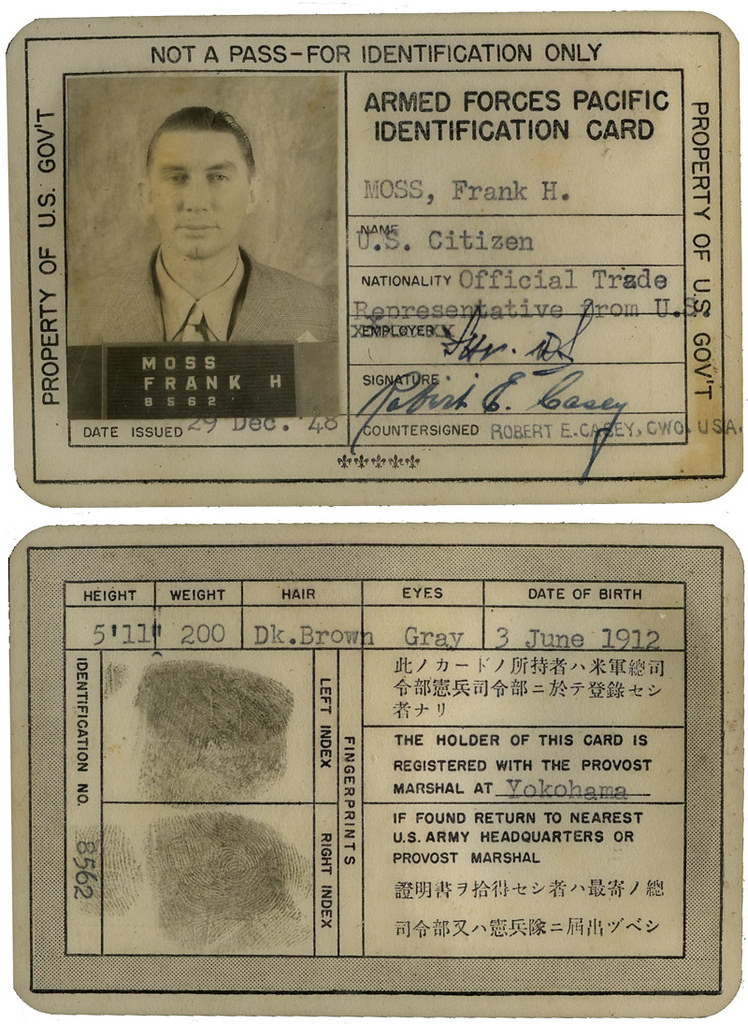
This laminated ID card of Frank H. Moss dates from 1948. This is from Bert's collection of photographs and ephemera.

Frank H. Moss_tatteredandlost

Was Frank a low level paper pusher while stationed in Yokohama following the war? Or is Frank the person responsible for writing a book entitled "The History of Coca-Cola in the Japanese Market as I Lived and Worked It"? According to what I find in Google Books Frank's book was not published and currently sits in a box in Coca-Cola's archives.

So we'll probably never know what part this Frank played in the cola wars following World War II or if he played any part at all.

11/15/10

Look BOTH WAYS


To find out why I haven't posted in so long it's best to just read my post at my vernacular photography site. Net access has been the problem.

I'm finding I'm so rusty at blogging that what once came naturally is a little foggy. I need to get back on the bike and go full tilt. No guidance needed. Okay, perhaps at my age it's best to take it slow and look both ways...which leads me to this post.

This image comes from the collection of a gentleman named Bert who I met last week. Again, it's best to read my other blog for the full information about how I came to have this and many other images to share. Bert, like many of you, loves ephemera and old photos. Burt is a collector with a keen eye.

crossing guard_tatteredandlost

Click on image to see it larger.

All I can tell you about this image is that it's dated 1932, was printed in the U.S.A, and there is an artist's signature which I cannot read in the lower left corner. Other than that it was in a bag of photos that Bert purchased at a flea market.

I adore this image. I love everything about it and would love to see more work by this illustrator. These images would have made wonderful paper dolls.

If anyone sees this and it looks familiar please drop me a line so I can fill in the pieces of the "where did this come from" mystery.