There were two Slapsy Maxie nightclubs that were popular back in the ‘40s and 50s. One was located in Los Angeles, the other in San Francisco. This ad is for the San Francisco location and is in the 1944
The Playgoer magazine that Montez Lawton kept in her scrapbook.
 Click on image to see it larger.
I’ll give you a little information about the clubs and this fellow with the top billing, Georgie Price.
The clubs were named after American boxer/actor
Max Everitt Rosenbloom who was known as "Slapsie Maxie." He was born on November 1, 1907 in Leonard’s Bridge, Connecticut. He died from
Paget’s disease of bone on March 6, 1976 in South Pasadena, California. He got the name Slapsie Maxie from a journalist who was making reference to his open gloved boxing style.
Few fighters stepped into the ring more often than Maxie Rosenbloom, who fought 299 times in sixteen years. Raised on the Lower East Side of New York, Rosenbloom left school after third grade and later served time in reform school. Reportedly, actor George Raft spotted the young Rosenbloom in a street brawl and advised him to become a boxer.Rosenbloom had an unusual style. He was a weak puncher and often slapped at his opponents with an open hand—earning him the nickname "Slapsie"—but he was a consummate defensive fighter and did whatever was necessary to avoid getting hit. He won the vast majority of his fights, although he only recorded nineteen knockouts in his entire professional career. (SOURCE: Harry Greb)
In 1930, he won the New York light heavyweight title. In 1932, he won the Light Heavyweight Championship of the World. He held and defended the title until November 1934, when he lost it to Bob Olin.As a professional boxer, Rosenbloom relied on hitting and moving to score points. He was very difficult to hit cleanly with a power punch and his fights often went the full number of required rounds. In his boxing matches he suffered thousands of head punches, which eventually led to the deterioration of his motor functions. (SOURCE: Wikipedia)
The story goes that the club was owned by mobster Mickey Cohen, but according to this December 1, 2011 article in the L. A. Times by Patrick Goldstein, that’s not the story.
According to most historical accounts, Maxie Rosenbloom, a former prizefighter, was simply the front man for Cohen, who actually owned the joint. In the film (The Gangster Squad), Cohen has a special table at the club, which has his bookmaking operations housed upstairs. But the nightclub's ownership history turns out to be more complicated than I realized.
After my story ran, I got an email from Marti Devore, setting me straight. Even though the club was originally in Cohen's hands, from 1947 through 1950 it was owned by Sy Devore and his older brother, Al. Marti, who is Al's daughter and Sy's niece, is the Devore family's unofficial historian, which, as it turns out, makes her something of an expert on Hollywood history too.
Her uncle Sy, who ran a men's store originally located on Vine near Sunset, was known for years as Hollywood's "tailor to the stars." Born in Brooklyn, Sy Devore was a natural-born hipster, operating a store in New York, at Broadway and 42nd Street, before he moved west.
Sy spent a lot of time in Harlem, running with the likes of Count Basie, Ella Fitzgerald and the Dorsey brothers, who bought their threads at his store and were the ones who told him that he'd be a natural fit in Hollywood. So he moved west, doing custom tailoring and throwing parties. His regular showbiz customers included Frank Sinatra and most of the Rat Pack as well as Bob Hope and Nat King Cole. Being flush with cash, they made Sy a lot of money. Marti says that Jerry Lewis used to boast that after hitting the bigtime, he bought 100 suits from Sy in 1949 alone.
Being so good at hanging out, it was inevitable that Sy would try his hand at running a nightclub. He knew Slapsy Maxie well—according to Marti, the ex-boxer turned bit actor showed up nearly every day at a barber shop that was located inside Sy's Vine Street store. So Sy and Al bought themselves a nightclub. (SOURCE: LA Times)
Click
here to see a photo of the outside of the Los Angeles club.
I’m finding very little about the San Francisco club other than this from
Billboard magazines August, 8, 1942 edition:
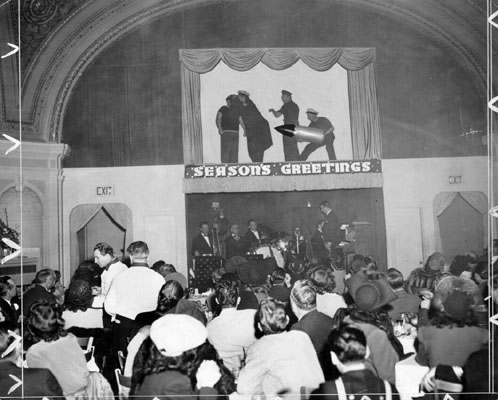
Here is an interior photo from 1942 of the San Francisco club.
You can see matchbook covers from the San Francisco and Los Angeles clubs
here,
here, and
here.
And
here and
here are the outside of a photo holder.
Here is a video of Jerry Lewis recalling his appearance with Dean Martin at the Copa in New York and in Los Angeles at Slapsy Maxie’s.
Now,
Georgie Price, headliner at the San Francisco Slapsy Maxie’s.
Georgie was born on January 5, 1901 in New York City. He died from a heart attack on May 10, 1964 in New York City.
When Georgie was born, his mother missed work as janitor of the building, and the landlord evicted the entire family of 11, carrying Mrs. Price and Georgie into the street in her bed. A famous lady social worker saved them, letting the family return home.
Georgie started singing and dancing on the streets and subways of New York at a very early age, and in 1907, accompanied an older brother on his dry-cleaning delivery rounds. He sang for the wife of Gus Edwards, a Vaudeville entrepreneur, and was adopted by the Edwards, thereafter taking Edwards as a middle name. He and "Lila Lee" starred as "Little Georgie and Cuddles" in Gus Edwards song review, "School Days". Surrounded and adored by old-timers of Vaudeville, he mastered many arts, including tap dancing, soft shoe, gag-writing, double-talk, and especially imitation, at which he was regarded as one of the best, not only for his accents and voices, but also for his ability to imitate dancers, singers (including Enrico Caruso, who offered to adopt him), and entertainers of the past—as taught to him by those who remembered them best.
He fell on hard times during his adolescence, when though short, he could no longer play children. Bribing an elevator operator at the Shuberts' office building, he donned the operator's uniform, and imprisoned one (or more) of the Shuberts between floors, just long enough to audition. He became their "headliner", replacing Al Jolson, and later became the first non-classical singer to get a long-term recording contract with RCA Victor.
In the Thirties, he took the advice of his friend Bernard Baruch to buy a seat on the New York Stock Exchange, beginning a second career, but continued on in show business, notably as president of The American Guild of Variety Artists, as a frequent emcee of charitable fund-raisers, as the host of "The Big Time", a CBS radio show in the early Fifties, and as a spokesman for Vaudeville and retired Vaudevilleans. (SOURCE: IMDb, Marshall Price)
Click
here to read more about Georgie Price.
Here is an old
Vitaphone video featuring Georgie.
Again, an old piece of paper has lead me on an interesting journey.




 Posts
Posts


