Showing posts with label Navy. Show all posts

4/14/12

DEFENDERS OF AMERICA from National Biscuit Company: X-15 ROCKET POWERED RESEARCH PLANE


Before you read about the X-15 I wanted to let you know you can see several vintage snapshots my father took of seaplanes in the late 1940s and early 50s by visiting my other site, Tattered and Lost Photographs.

And now...the X-15, courtesy of the National Biscuit Company late 1950s trading cards.


Click on either image to see it larger.
The North American X-15 was a rocket-powered aircraft operated by the United States Air Force and the National Aeronautics and Space Administration (NASA) as part of the X-plane series of experimental aircraft. The X-15 set speed and altitude records in the early 1960s, reaching the edge of outer space and returning with valuable data used in aircraft and spacecraft design. As of 2012, the X-15 holds the official world record for the fastest speed ever reached by a manned rocket-powered aircraft.
During the X-15 program, 13 different flights by eight pilots met the USAF spaceflight criteria by exceeding the altitude of 50 miles (80 km) thus qualifying the pilots for astronaut status. The USAF pilots qualified for USAF astronaut wings, while the civilian pilots were awarded NASA astronaut wings in 2005, 35 years after the last X-15 flight.
Of all the X-15 missions, two flights (by the same pilot) qualified as space flights per the international (Fédération Aéronautique Internationale) definition of a spaceflight by exceeding 100 kilometers (62.1 mi, 328,084 ft) in altitude.

General Characteristic
  • Crew: one
  • Length: 50 ft 9 in (15.45 m)
  • Wingspan: 22 ft 4 in (6.8 m)
  • Height: 13 ft 6 in (4.12 m)
  • Wing area: 200 ft2 (18.6 m2)
  • Empty weight: 14,600 lb (6,620 kg)
  • Loaded weight: 34,000 lb (15,420 kg)
  • Max. takeoff weight: 34,000 lb (15,420 kg)
  • Powerplant: 1 × Thiokol XLR99-RM-2 liquid-fuel rocket engine, 70,400 lbf at 30 km (313 kN)

Performance
  • Maximum speed: Mach 6.72 (4,520 mph, 7,274 km/h)
  • Range: 280 mi (450 km)
  • Service ceiling: 67 mi (108 km, 354,330 ft)
  • Rate of climb: 60,000 ft/min (18,288 m/min)
  • Wing loading: 170 lb/ft2 (829 kg/m2)
  • Thrust/weight: 2.07


(SOURCE: Wikipedia)

Next time...U. S. Army Mohawk Turbo-Prop Airplane

4/10/12

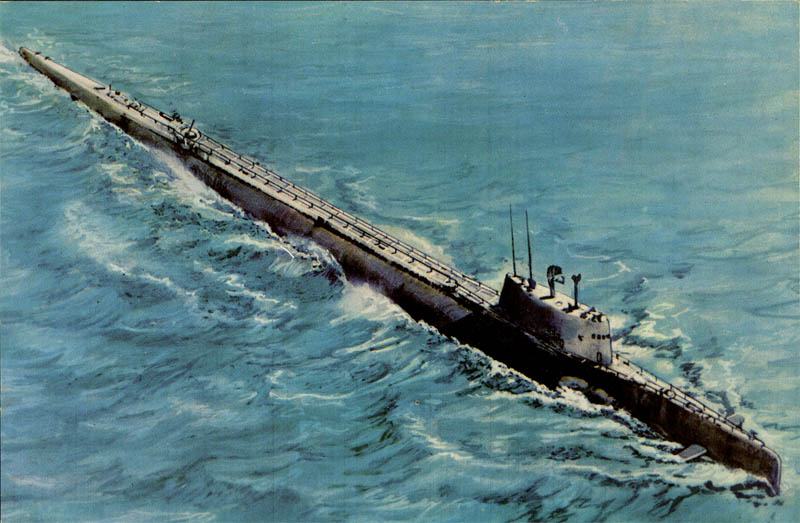
DEFENDERS OF AMERICA from National Biscuit Company: GUIDED MISSLE SUBMARINE POLARIS SSG(N)


Today's card is number 4 in the series of Defenders of America trading cards published by the National Biscuit Company in the late 1950s.
The first US Navy submarine capable of firing a strategic ballistic Polaris missile was the George Washington, a nuclear sub. Earlier submarines had carried strategic missiles, but the boats had been diesel powered, and the missiles required the boat to surface in order to fire. The missiles were also cruise missiles, which were vulnerable to the defenses of the day in a way that ballistic missiles were not.
George Washington's missiles could be fired while the boat was submerged, meaning that it was far less likely to be detected before firing. The nuclear power of the boat also meant that, like Nautilus, George Washington's patrol length was limited only by the amount of food the boat could carry. Ballistic missile submarines, carrying Polaris missiles, eventually superseded all other strategic nuclear systems in the USN. Deterrent patrols continue to this day, although now with Ohio-class submarines and Trident II missiles. (SOURCE: Wikiepdia)


Click on either image to see it larger.

To see other cards in this trading card series click on the "Defenders of America" label below the post.

Next time...USAF IM-99 Bomarc Missile

4/9/12

DEFENDERS OF AMERICA from National Biscuit Company: USS TRITON


I have eight trading cards called Defenders of America that were issued by the National Biscuit Company (changed to Nabisco in 1971) in the late 1950s. I have no idea where I got them. Most likely my best friend gave them to me.

The cards were given away inside boxes of Nabisco cereal. I found these two images of the package advertising online at The Imaginary World site.


There were twenty-four cards in the series. Over the next few posts I'll show you the eight I have.

This is card number 3 in the series.


Click on either image to see it larger.
USS Triton (SSRN/SSN-586), a United States Navy nuclear-powered radar picket submarine, was the first vessel to execute a submerged circumnavigation of the Earth (Operation Sandblast), doing so in early 1960. Triton accomplished this objective during her shakedown cruise while under the command of Captain Edward L. "Ned" Beach, Jr. The only member of her class, she also had the distinction of being the only Western submarine powered by two nuclear reactors. 
Triton was the second submarine and the fifth ship of the United States Navy to be named for the Greek god Triton. At the time of her commissioning in 1959, Triton was the largest, most powerful, and most expensive submarine ever built, at $109 million excluding the cost of nuclear fuel and reactors.
After operating for only two years in her designed role, Triton's role as a radar picket submarine was made obsolete by the introduction of the carrier-based Grumman WF-2 Tracer airborne early warning aircraft. Converted to an attack submarine in 1962, she became the flagship for the Commander Submarine Forces U.S. Atlantic Fleet (COMSUBLANT) in 1964. She was decommissioned in 1969, the first U.S. nuclear submarine to be taken out of service.
Triton's hull was moored at the St. Julien's Creek Annex of Norfolk Naval Shipyard in Portsmouth, Virginia as part of the reserve fleet until 1993, though she was struck from the Naval Vessel Register in 1986. In 1993, she was towed to Puget Sound Naval Shipyard to await the Nuclear Powered Ship and Submarine Recycling Program. The former Triton landed on the keel resting blocks in the drydock basin on 1 October 2007 to begin this recycling process which was completed effective 30 November 2009. (SOURCE: Wikipedia)
To read more about the design, construction and operational history click here.

Next time...U. S. Navy Guided Missile Submarine Polaris.